


Western Cape authorities are releasing second-quarter crime stats for 2025/2026. Community Safety MEC Anroux Marais and Provincial Police Commissioner Thembisile Patekile led the briefing.
Image: Ayanda Ndamane/ Independent Media
The Western Cape police officials have recognised that the crime stats for the second quarter, from July 2025 to September 2025, do not paint an encouraging picture, and that more work is needed.
MEC for Police Oversight and Community Safety, Anroux Marais and the Provincial Commissioner of the Western Cape, Lieutenant-General Thembisile Patekile, unpacked the Crime Stats for the province at a media briefing on Wednesday.
For the crime stats, police measure the count difference between the years by calculating the percentage increase and decrease in each category. To compare the provincial crime per 100,000, a ratio is calculated, and the percentage contribution is also calculated.
Murder for the province has risen 9,1% in comparison to the same period last year, but matches the volume of murders committed in 2023, with 1,160 counts recorded. Attempted murder has also risen by 4,8% with 1,157 counts recorded.
Police did record a decrease of 1,6% in sexual offences; however, sexual assault did increase by 3,0%. Rape cases decreased by 3,1% while police recorded 18 fewer counts of contact sexual offences.
For other contact crimes, assault GBH increased by 2,6%, common assault increased by 1,8%, and common robbery increased by 3,0%.
Carjacking, robbery at residential premises, and robbery at non-residential premises decreased by 21,3%, 22,2% and 28,1% respectively.
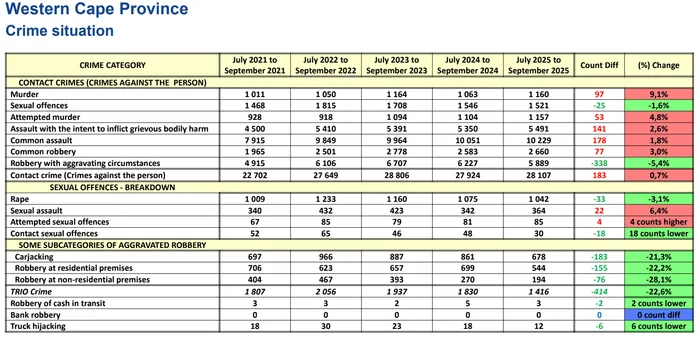
Murder for the province has risen 9,1% in comparison to the same period last year, but matches the volume of murders committed in 2023, with 1,160 counts recorded. Attempted murder has also risen by 4,8% with 1,157 counts recorded.
Image: SAPS
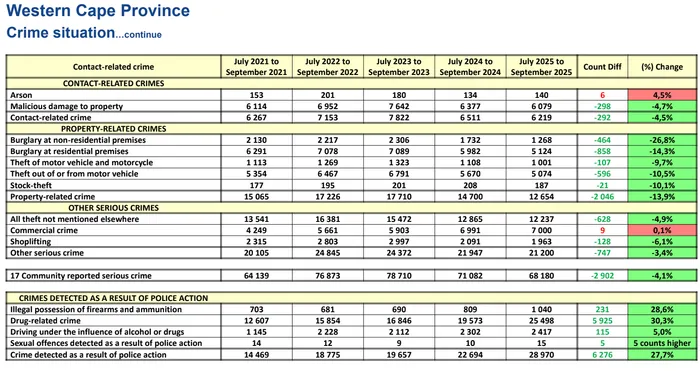
MEC for Police Oversight and Community Safety, Anroux Marais and the Provincial Commissioner of the Western Cape, Lieutenant-General Thembisile Patekile, unpacked the Crime Stats for the province at a media briefing.
Image: SAPS/Supplied
Patekile said that when the Minister of Police, Professor Firoz Cachalia, and the National Commissioner, General Fannie Masemola, released the stats at the end of November, it became apparent that the gains that were made in the first quarter were eroded by the spike in violent crimes during the second quarter, “particularly of note is the increase of murders and attempted murders in August this year”.
“Our crime analysis revealed that the violent crime is concentrated within the City of Cape Town. Hence, the Western Cape has nine police stations on the list of the Top 30 National Contact Crimes stations countrywide. Of the 9 stations, 8 are in the City of Cape Town.
“Even on the list of top 30 police stations for murder, the Western Cape now has 13 stations within the City of Cape Town.”

These are the top 30 stations for murder, of which 13 are on the national list.
Image: SAPS

Even on the list of top 30 police stations, the Western Cape now has 13 stations located within the City of Cape Town
Image: SAPS
He said that at the heart of these crimes is the use of illegal firearms and ammunition.
Patekile also noted that during the second quarter, 114 gang leaders were arrested, and 116 gang members were arrested. In August, 77 murders were gang-related.
“The City of Cape Town police station precinct provides fertile grounds for crime because of the following factors, among others: densely populated communities located mainly in informal settlements, a high unemployment rate, limited, if any, diversion programmes for the youth, and sprawling municipal flats that are cramped spaces.
“Causal factors for these bothersome crimes include, among others, gang violence, taxi violence, arguments, revenge attacks, extortion, and gender-based violence,” Patekile said.
“While we are not pleased with the second quarter performance, we remain competent. We will turn the corner with the concerted efforts as we navigate this space with other law enforcement agencies, such as the City of Cape Town and other metro police, traffic services, and scores of community volunteers, as well as neighbourhood watches.”
He said that these seizures and arrests do a dent in the community, but that they are aware that “it is cold comfort to families who have lost loved ones”.
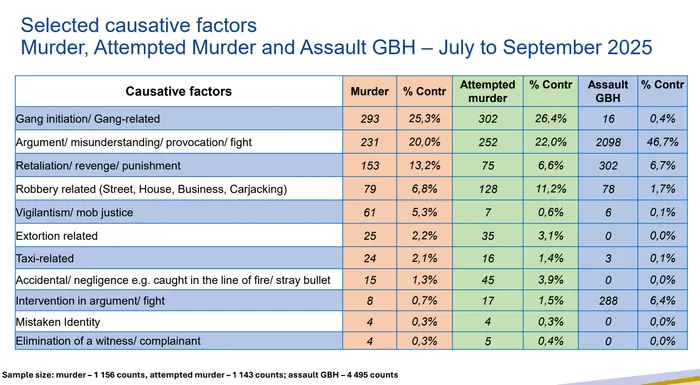
SAPS have identified some of the causative factors of murder, attempted murder and assault with the intent to inflict grievous bodily harm.
Image: SAPS
Marais added that the stats do not paint an encouraging picture of the crime situation.
“While there are areas of progress that we must acknowledge, the overall trends remind us that we need to work much harder and much smarter to make the Western Cape safer.
“These figures underscore a painful reality. Violent crime, particularly murder remains at unacceptably high levels in our province.
“However, when we look deeper into the data, an important and consistent pattern emerges, one that must guide how we respond going forward,” Marais said.
“In both quarters, murders decreased in our LEAP (Law Enforcement Advancement Plan) deployment areas while increasing sharply in the rest of the province. In quarter one, murders in combined LEAP areas fell by 7.1%, with significant reductions in Khayelitsha, Nyanga, and Philippi East.
“In the second quarter, murders in LEAP areas decreased by a further 9.4%, with reductions for two consecutive quarters in Khayelitsha, Nyanga, and Philippi East and an additional decrease in their. By contrast, areas outside of lead deployment saw increases of 4.5% in quarter one and a staggering 17.9% in quarter two,” Marais said.
“The message here is clear. Where there are more goods on the ground, where LEAP officers are deployed strategically, and where there is close cooperation between LEAP, SAPS and municipal law enforcement, we see real and measurable impact.
“This is further reinforced by reductions in murders in our reaction unit areas, including Manenberg, Steenberg, and Elsies River.
“While we must strengthen law enforcement capacity, we must also acknowledge that crime prevention is not the responsibility of the police alone. All government departments, community structures and citizens have an important role to play,” she said.