

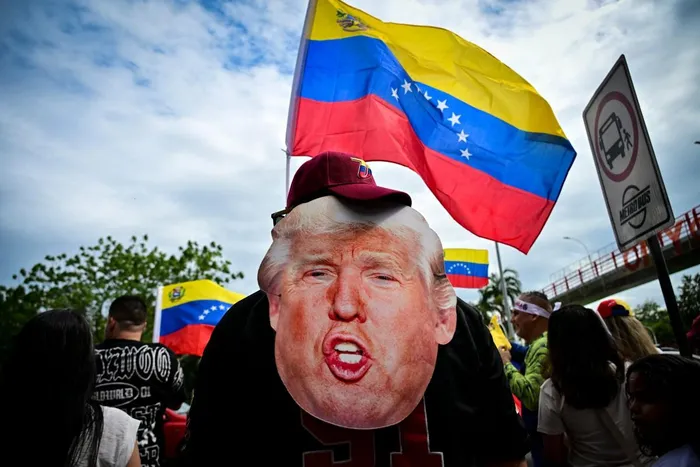
Former South African ambassador to Venezuela, Bheki Gila and analysts believe the reason behind the US's major military operation against Venezuela is the need for access to oil.
Image: Martin Bernetti/AFP
Former South African ambassador to Venezuela, Bheki Gila, has dismissed the allegations of “counter-narcotics” and “narco-terrorism” used by US President Donald Trump as the primary justification to launch a major military operation against Venezuela.
Instead Gila has attributed the US forces “large-scale strike” involving more than 150 aircraft, targeting military and government infrastructure in Caracas and the states of Miranda, Aragua and La Guaira to Venezuela's largest proven oil reserves.
The US captured President Nicolas Maduro and his wife, Cilia Flores with Trump justifying the actions as necessary to combat “narco-terrorism”, accusing Maduro of leading the “Cartel of the Suns” and facilitating the flow of drugs into the US.
Maduro was indicted in the Southern District of New York on charges including narco-terrorism conspiracy, cocaine importation and weapons offences.
Trump also announced that the US would “run” Venezuela temporarily until a “judicious transition” of power could be arranged. He also stated that US oil companies would be involved in refurbishing Venezuela’s oil infrastructure.
Maduro was first indicted on March 26, 2020, for narco-terrorism, cocaine importation conspiracy, and weapons charges, but was not arrested.
He remained in power until he was captured by the US forces.
Gila, who believes that this could result in regime change, said the US would quickly secure the oil reserves and gold mines.
“And the blockade will not be lifted. The American navy will not leave there, just to scare the daylight out of anyone else to try something, he said.
Gila added that the situation could lead to regime change.
Political analyst Zakhele Ndlovu said one of the reasons behind the US operation is that the US wanted to effect a change of regime and Maduro stood in their way.
He added that the US also wanted to have access to oil.
“Even scarier is that the US appears to be sending a strong message that if one threatens its interests, then one is not safe,” he said.
Another political analyst, Professor Theo Neethling, said that although Maduro will be charged with drug trafficking and terrorism, the main issue is the oil.
“In my view, however, the issue is primarily about oil. Venezuela’s modern oil industry was not organically built by the Venezuelan state, but was largely constructed in the early and mid-20th century by foreign capital - above all by US oil companies, alongside British and Dutch interests.”
“This, however, was not a case of direct US state control. The infrastructure was built and operated by private corporations acting under concessions granted by the Venezuelan government. These firms supplied the capital, technology and skilled labour Venezuela lacked at the time, while exercising effective control over production and exports.
"By the mid-20th century, the country possessed one of the most sophisticated oil industries outside the US,” he said, adding that from the 1940s onward, the Venezuelan state steadily reasserted control through higher taxation, regulation and profit-sharing arrangements, culminating in the 1976 nationalisation of the industry.
Neethling said nationalisation did not dismantle the oil system, but it transferred ownership of fully developed infrastructure to the state.
“This is a major issue from President Trump's point of view when he referred to ‘take back’ Venezuela's oil. The subsequent collapse of Venezuela’s oil sector, particularly since the 2000s, is the result of prolonged mismanagement, underinvestment and politicisation of an industry that was once among the world’s most advanced,” he said.
Meanwhile, the International Relations and Cooperation has called on the United Nations (UN) Security Council to urgently convene to address the situation.
Spokesperson Chrispin Phiri said South Africa views these actions as a “manifest violation” of the Charter of the UN, which mandates that all member states refrain from the threat or use of force against the territorial integrity or political independence of any state.
China and India have also joined other countries and condemned the US actions.
India’s Ministry of External Affairs described the situation as a “matter of concern”, calling upon all concerned to address issues peacefully through dialogue, ensuring peace and stability of the region, while China demanded the immediate release of Maduro and his wife, urging the US to stop "toppling the government of Venezuela" and to ensure their personal safety.