

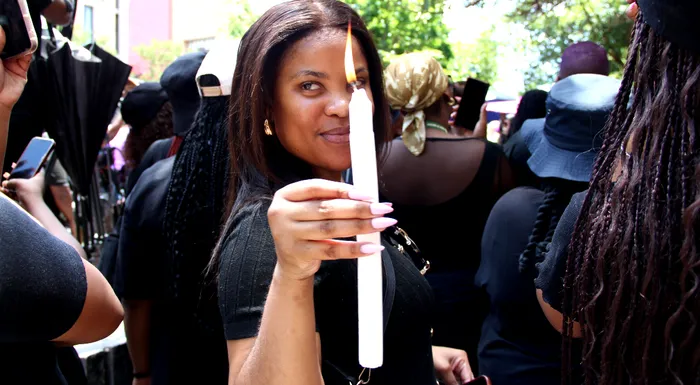
Candles were recently lit in memory of those who died at the hands of domestic violence and GBVF.
Image: Sandi Kwon Hoo / DFA
AS WE MARK 16 Days of Activism for No Violence Against Women and Children, the Democratic Alliance (DA) again acknowledges a crisis that has lived with us for far too long. The fact remains that behind every statistic is an individual whose dignity has been shattered, a family whose peace has been broken, and a community left with wounds that may never heal.
While we welcome President Cyril Ramaphosa’s recognition that Gender-based Violence (GBV) is a crisis, it is a declaration - not a solution. It is a statement rather than action. And 16 days – no matter how important - are simply not enough. They have never been enough. How do we fit a lifetime of trauma into 16 days? How do we compress the fear of millions into two short weeks? How do we address a crisis that haunts our people 365 days a year, by acknowledging it for only 16?
Every single week women are killed in our country. Not one or two. At least 10 to 12 women lose their lives every week at the hands of men who believe they own them, control them or can silence them forever. And behind each murder is a long, invisible trail of unreported assaults, threats, humiliation and terror that these women endured long before they took their last breath.
I am not just a DA member of the KZN Legislature. I am also not just a DA public representative. I am a GBV survivor.
I know the terror of hearing footsteps approaching the door and not knowing what version of your abuser is waiting on the other side. I know the silent prayer you whisper every time a key turns in the lock. I know what it is like to walk on eggshells in your own home, the one place that you should feel safe - yet has become a battlefield. I know what it feels like to watch your body react before your mind even understands, because fear has become your second skin.
GBV does not only bruise the body - it destroys the spirit. It steals confidence, dignity, peace and the sense of being safe in your own skin. And the effects linger long after the violence stops. Long after the abuser is gone or, in many cases, remains free. Women carry this pain quietly. Children carry this pain silently. The elderly carry it helplessly. And men who are victims carry it invisibly.
GBV does not discriminate. But it disproportionately devastates women, who remain the most targeted, the most violated, and the least protected. KZN is in the midst of this crisis with the second highest levels of sexual offences and GBV. In the fourth quarter of 2024, more than 2 127 cases of sexual offences were reported in our province - numbers that continue to rise each quarter.
These are only the reported cases. There are countless others. Even more heartbreaking is that many cases never make it to trial. Many survivors withdraw charges - not because the violence has stopped - but because the system has failed them. And many cases are thrown out due to “insufficient evidence”, which often means insufficient support, insufficient investigation and insufficient political will. How do we expect survivors to stand firm when our justice system is shaky? How do we expect communities to report perpetrators when those very perpetrators walk freely among them? How do we ask women to trust a system that has broken them more than their abusers ever did?
The South African Police Service (SAPS) in KZN is struggling. Not because officers do not care, but because they are overburdened, understaffed, and under-resourced. They cannot keep fighting a war with empty hands. KZN needs special GBV units in every district. KZN need better training, better equipment, and better accountability. KZN needs more forensic specialists so that cases are not lost due to lack of evidence. And our country needs a justice system that treats GBV not as a side issue but as a national emergency.
KZN’s schools must also become safe spaces where children can speak openly about abuse. Our clinics must have trained staff to identify signs of trauma. Our shelters must be properly funded and staffed so that survivors have somewhere to go when they run for their lives. Our courts must not re-traumatise survivors through endless delays and insensitive questioning. And, we must build a society where perpetrators know there will be consequences, real consequences, not just paperwork and postponed hearings. Most importantly, we must build a culture where violence is rejected before it happens, not only mourned after it has taken place.
The DA stands firm with every woman who stayed because she had nowhere to go. Every child who learned fear before they learned to read. Every elderly person who suffers in silence. And every victim who feels invisible.
KZN’s GBV crisis demands unwavering action. Not seasonal action. Not symbolic action. Not action that fades the moment 16 Days of Activism banners are taken down. It demands year-round commitment from every sector, every department, every leader, every community, and every individual. 16 Days of Activism can no longer be a ritual of speeches and orange ribbons - it must be a catalyst.

Shontel De Boer
Image: Supplied
Shontel de Boer, MPL, is a DA KZN Spokesperson on Social Development.
The opinion piece is based on a speech delivered in the KZN Legislature on November 27 as part of the 16 Days of Activism for No Violence Against Women and Children.
** The views expressed do not necessarily reflect the views of IOL or Independent Media.