

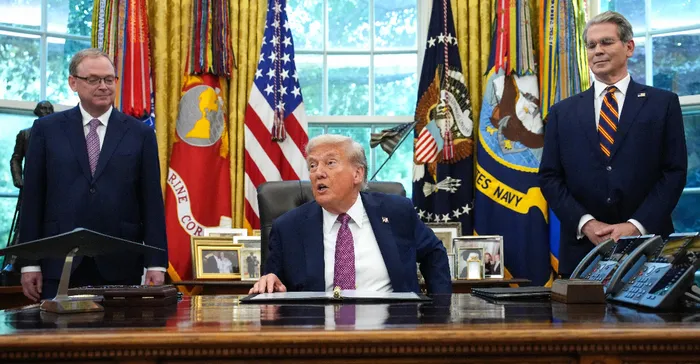
US President Donald Trump announced plans for the 2026 G20 summit as US Treasury Secretary Scott Bessent, right, and Director of the National Economic Council, Kevin Hassett, look on during a press availability in the Oval Office of the White House.
Image: Kevin Dietsch/Getty Images North America/Getty Images via AFP
PRESIDENT Donald Trump announced, a few days ago, that South Africa would not be invited to the 2026 G20 Summit, which would be hosted in Miami in the USA. He included that payments and subsidies to South Africa would cease immediately. On the face of it, this appears to be a symbolic diplomatic snub. Trump cited South Africa's refusal to formally hand over the G20 presidency at the close of the Johannesburg summit. At a deeper level, there lies a potential material fallout not only for South Africa, but also for the G20's credibility, and for economic realignment among Global South nations.
The United States boycotted the G20 summit, and Professor Jeffrey Sachs (US) aptly characterised the American absence as the result of Trump's conduct, which he likened to that of a "four-year-old".
What is the G20? It is an international forum for the world's 19 largest economies, as well as the European Union and the African Union, which convenes annually to discuss and coordinate policy on global economic and financial issues, as well as other challenges such as climate change and development. It was established in 1999 to address global financial crises and is the premier forum for international economic cooperation.
The group's members represent about 85% of global GDP, 75% of international trade, and nearly two-thirds of the world's population. The G20 is not a traditional treaty-based organisation; it is an informal grouping of the world's major economies, operating on a consensus and mutual recognition basis. As noted by analysts, no single member can formally "expel" another; what may be possible is a de facto bar through visa restrictions or refusal to issue invitations, but that undermines the spirit of inclusivity the G20 claims to uphold.
By unilaterally declaring South Africa unwelcome, the USA, with Trump's leadership, runs the risk of turning the G20 into a tool for punitive politics rather than a platform for collective action on global economic, climate, and development issues. US payments and subsidies make a difference to the SA budget, our VAT fiasco, and the three budget speeches confirms how fragile and sensitive the domestic economy is. Cutting aid abruptly may hinder cooperation on development projects, trade facilitation, investment frameworks, and collaborative ventures in areas such as climate change, infrastructure, and public health funding.
Excluding SA is likely to push us closer to BRICS, and even closer to China, India, and Russia, further undermining US strategic economic influence in Africa and the Global South. For many developing economies, the G20 serves as a valuable platform to address structural inequalities, advocate for fairer trade and development frameworks, and secure support for climate finance commitments. Excluding a founding member like South Africa sends a chilling signal that participation in the G20 may hinge less on economic weight or constructive engagement than on alignment with US political narratives.
Trump justified the exclusion by citing alleged human-rights abuses against white farmers in South Africa, which have been labelled as baseless and false by President Cyril Ramaphosa. From an economic vantage point, the US benefits when global economic governance is inclusive, predictable, and rule-based. By contrast, turning the G20 into a tool for unilateral punishment, primarily when the justification rests on contested or false premises, devalues the entire institutional architecture.
South Africa must accelerate diversification of its trade, investment, and diplomatic relations, leveraging its position as a gateway to sub-Saharan Africa, its natural resources, and skilled labour base. This may involve reinforcing ties with European, Asian, and African partners; re-energising regional integration and deepening cooperation with emerging-market powers. To counter disinformation and pre-empt further political pressure, SA should reinforce transparency, strengthen the rule of law, and utilise credible data to expose false narrative
That will help insulate domestic and international investors from external political shocks.
From a broader global-economic perspective, Trump's decision risks setting a dangerous precedent: that membership and participation in multinational forums can be revoked on a whim, based on politicised grievances rather than objective criteria. That undermines the predictability and stability upon which cross-border trade, investment, and cooperation are built. If other major powers follow suit, we may see a fracturing of global coalitions, the proliferation of competing regional blocs, and a retreat from multilateralism, precisely at a time when the world faces acute systemic risks, including climate change, supply-chain fragilities, debt crises in emerging economies, and global inequality.
This action sends a message of fragmentation and instability in the global economic order. International stability and prosperity are deeply interdependent; major powers benefit not just by dominating global institutions, but by keeping these institutions broad, inclusive, and credible. The recent move by the Trump administration sacrifices long-term strategic influence for short-term political spectacle.
It risks alienating partners, rewarding alternative alliances, and destabilising multilateral cooperation. The world is shifting, and global governance cannot be taken for granted simply because of historical ties. Making SA unwelcome at the 2026 G20 table, Trump may have driven a wedge not only between two countries but also between the old paradigm of global order and the emerging reality of a multipolar, demand-driven, and rights-conscious world.
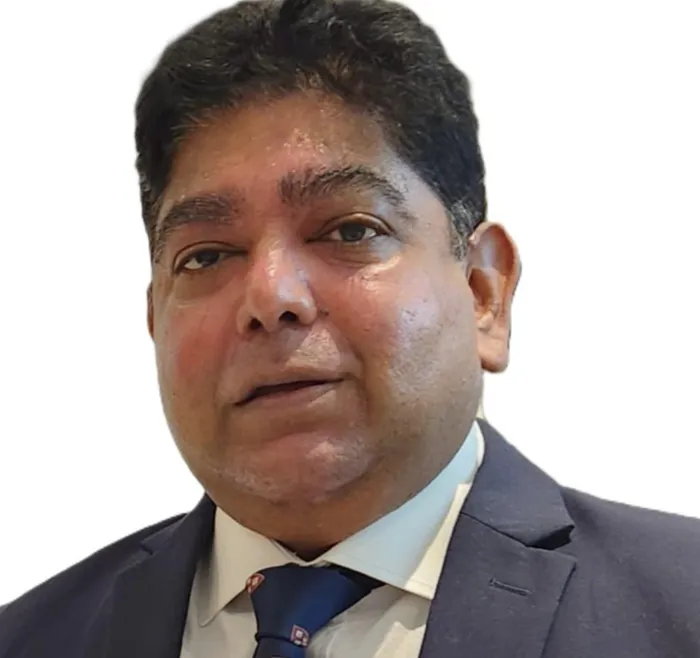
Advocate Lavan Gopaul
Image: File
Advocate Lavan Gopaul is the director of Merchant Afrika.
** The views expressed do not necessarily reflect the views of IOL or Independent Media.