
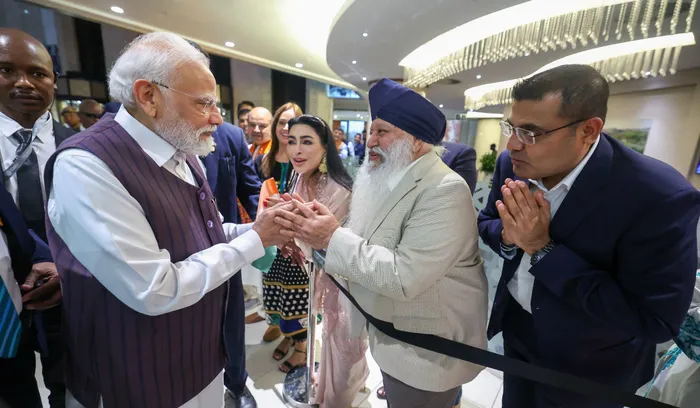
South African actress and entrepreneur Tarina Patel welcomes Indian Prime Minister Narendra Modi to the G20 Summit.
Image: X / Narendra Modi
DEAR Prime Minister Modi
I GREET you in the name of my Indian heritage and my Tamil linguistic identity.
Your presence at the G20 Summit coincided with the 165 th anniversary of the arrival of Indentured workers in South Africa.
India’s deep history with South Africa is well known and so is the contribution of the Indian community to the development of this country.
I wish to bring to your attention an urgent matter that affects not only women in South Africa, but women globally: Gender-Based Violence (GBV). The scourge of GBV in South Africa is primarily focused on the annual 16 Days of Activism for No Violence Against Women and Children campaign, which runs from November 25 to December 10.
Many women can walk away from abuse, but countless others cannot, due to financial dependence, emotional manipulation, fear, shame, cultural pressure, and systemic inequality.
India is a civilisation that reveres the divine feminine especially during the 10 days of Navarathri when Goddess Shakti is worshipped as Durga, Luxmi and Saraswathi. Yet Indian women continue to face widespread violence, discrimination, and inequality.
India’s national crime records reported over 445 000 cases of crimes against women in 2022, a 4% increase from the previous year. Despite legal reforms after the 2012 Delhi gang rape case, in 2021 alone India registered 31 677 rape cases. These numbers represent real women whose lives, dreams and futures were stolen.
Even today, female infanticide continues in pockets of India. As recently as September 2024, BBC investigations showed midwives confessing to decades of killing newborn girls at the instruction of men in the families of those baby girls. This is a painful reminder that ancient misogyny still survives in modern India.
The tragic case of Shahzadi Khan, a baby carer from Uttar Pradesh who was sentenced to death in the United Arab Emirates after reportedly being forced to confess for the death of a baby who received the incorrect vaccine that day, also raises questions about India’s ability to protect its most vulnerable citizens abroad, particularly poor Indian migrant women.
This year the Indian government informed parliament that a total of 54 Indians were on death row in foreign countries, including 29 in the United Arab Emirates. Like Shauzadi’s family who did not have the money to travel abroad and the power to defend the injustice of their daughter, many Indians are in the same unfair situation.
Although outlawed in 1961 by the Dowry Act, dowry remains widely practised even among affluent and educated families. When dowry demands are unmet, many women face harassment, violence, and even death.
Similarly, traditional widowhood customs continue to strip women of dignity after the death of the husband, such as removing kumkum/sindoor and flowers, breaking bangles and enforcing white clothing. Meanwhile men face no comparable cultural expectations after the death of a wife. These practices survive even among global Indian communities.
Indian cinema, including films like Water (2005), has long highlighted the plight of widows, yet the social mindset persists.
Indian women have excelled in every field such as education, business, science, law, and sport, bringing honour to India globally. Yet many still endure humiliation, intimidation, eve-teasing and professional exclusion. Many men fear a woman who excels, who leads, or who becomes a voice.
Teaching men to respect all roles of women begins with understanding that womanhood is not defined by a single identity such as motherhood, marriage, childbirth, or any traditional expectation. Every woman, in every role, deserves equal dignity.
Although society often places motherhood on a pedestal, suggesting that compassion, value, or strength come only from giving birth, it is essential to recognise that every woman, regardless of whether she is a mother, daughter, professional, partner, leader, or friend, carries her own form of wisdom, compassion, and strength.
Respect should not be earned only through roles that society has historically idealised. Respect must be unconditional. Mahatma Gandhi who spent much time in South Africa campaigning for equal rights and thereafter led India to freedom from British rule, taught Ahimsa to refrain from physical harm, hate, harsh words and dishonesty and emphasised dignity, non-violence, and equality.
Inspired by those principles, we ask guidance in building a society where women are respected as full individuals, not only for the roles they play. Men must learn to honour emotional labour, professional achievement, and personal choice.
Progress comes not through blaming either gender, but by transforming mindsets and nurturing mutual respect. As a respected leader of a global power, I beseech you to encourage men to participate equally in caregiving, household work, and emotional support.
Respect grows when responsibilities are shared, not assigned.
Religious, cultural, and community leaders can play a major role by publicly affirming that womanhood is not defined by childbirth and that all roles deserve respect.
There is need for stronger anti-harassment mechanisms; stronger laws on rape, domestic violence and eve-teasing; and support for women who choose not to marry or not to have children.
India has made history with women leaders such as Pratibha Patil and Droupadi Murmu who took office as Presidents of India.
Honourable Prime Minister, during your years in office, what concrete steps have you taken, and what new steps will you take to enhance the safety, dignity, and empowerment of Indian women both in India and across the world?
Your influence on Indian men across all social, economic, and cultural backgrounds is immense. You have the power to reshape attitudes, strengthen laws, and redefine the value of women in our society.
To the Indian women who danced in front of you during your G20 visit in Sandton, I must say you lost a golden opportunity to raise attention to the crises facing women.
Through you Modi-ji, I appeal to India address the behaviour of men who abuse their physical and status power. Laws must be stricter on harassment of women, even eve-teasing. Indian women, nay, all women must be protected and respected wherever they live.
India is a land that worships the Mother. We ask for a future where women are honoured, not merely in divine form, but in human form. Let that sacred respect for Goddess Shakti extend to all women - every daughter, every sister, every wife, every widow.
I thank you.
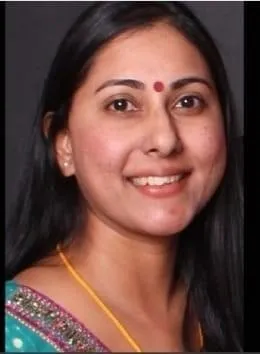
Thiruvernthree Govender
Image: File
Thiruvernthree Govender is a religious and cultural leader, and daughter of the late Swami Sivanantha Navalar, Spiritual Head of the Saiva Sithantha Sungum South Africa, wrote an open letter to Prime Minister of India, drawing attention to GBV.
** The views expressed do not necessarily reflect the views of IOL or Independent Media.