
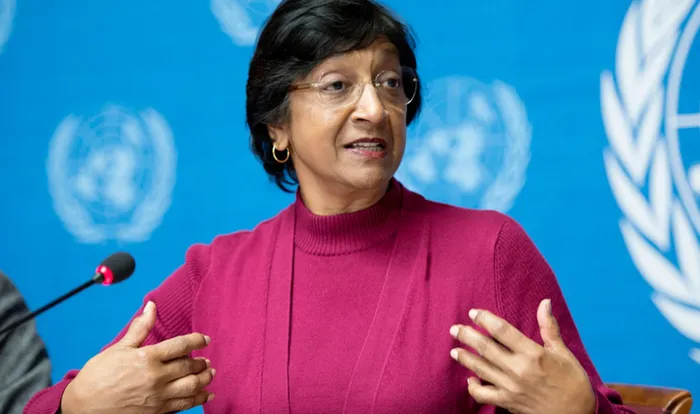
More honours for Judge Navi Pillay Judge Navi Pillay has consistently championed international justice, truth-telling, and the protection of human dignity.
Image: SUPPLIED
Dr Devi Rajab explores the historical contributions of powerful women leaders worldwide and examines how female collaboration across political, religious, and ethnic lines can transform modern society. Drawing on inspiring examples from Africa and beyond, she makes a compelling case for women's leadership as a catalyst for positive social change in South Africa.
IT GIVES me great pleasure to open this important annual conference with a message of support as Democracy Development Program (DDP) first women’s chair. Today, we are proud as an organisation promoting democracy at a regional and national level and to be spearheading the global call for women in politics and in positions of leadership across the globe.
From time immemorial, men have always ruled the world. However there have been some outstanding exceptions. Before Cleopatra’s reign 1 500 years ago, a remarkable woman led Egypt as king and pharaoh: Queen Hatshepsut. Under her leadership, the kingdom opened up new trade routes, commissioned hundreds of important construction projects, and created an environment for innovation and experimentation - yet she was nearly erased from history. In biblical times women led alongside men unobtrusively.
Deborah is a key figure in the Old Testament leading the Israelites to victory over the Canaanites while Khadija bint Khuwaylid the first wife of Prophet Muhammad (PBUH) was one of the most accomplished businesswomen in history. She inherited her father’s trading empire at a time when women had limited financial and social agency, yet she successfully expanded her enterprise across the Arabian Peninsula. Her acumen was unmatched; she employed caravans of traders and established lucrative business ties.
Few would believe that the modern university system owes much to Fatima al-Fihri, a Muslim woman who founded Al-Qarawiyyin University in Fez, Morocco, in 859 CE. Her legacy challenges the misconception that women had no role in shaping academic institutions. In Hindu mythology Gods and Goddesses featured equally in the pantheon of Gods. The two important portfolios of education and wealth are allocated to Goddess Saraswathi and Luxmi respectively. These depictions of strong powerful women operated in a patriarchal world and flourished as outstanding exceptions to the rule of conventional womanhood.
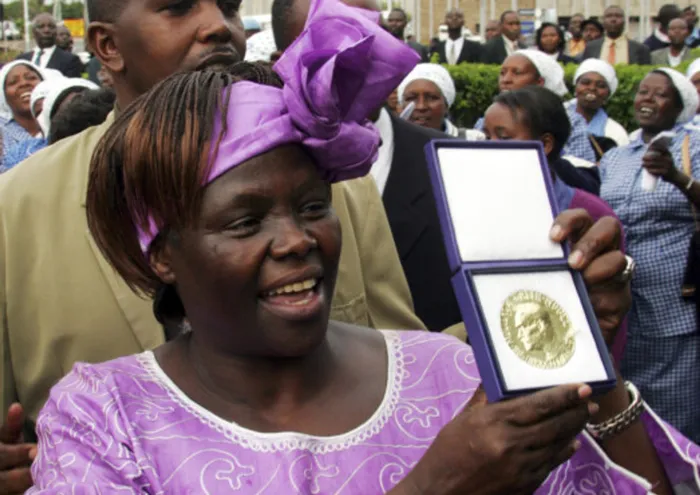
Nobel Peace Prize laureate Wangari Maathai shows her prize to a cheering crowd as she returns from Norway, in Nairobi in this 2004 file photo. Nobel Peace Prize laureate Wangari Maathai showed her prize to a cheering crowd after she returned to Nairobi from Norway in 2004.
Image: supplied
Over the centuries women’s progress towards equality has been steady and significant but very much a work in progress. Hence our topic today urges us to strengthen collaboration in development and leadership for social change. In this regard one may cite the proud examples of productive leaders like Wangari Maathai, the first African woman to receive the Nobel Peace Prize. Maathai played an active part in the struggle for democracy in Kenya, and belonged to the opposition to Daniel arap Moi’s regime.
In 1977 she started a grass-roots movement aimed at countering the deforestation that was threatening the means of subsistence of the agricultural population. The campaign encouraged women to plant trees in their local environments and to think ecologically.
The so-called Green Belt Movement spread to other African countries, and contributed to the planting of over thirty million trees. Maathai’s mobilisation of African women was not limited in its vision to work for sustainable development; she saw tree-planting in a broader perspective which included democracy, women’s rights, and international solidarity.
In the words of the Nobel Committee: “She thinks globally and acts locally.”
She has written several books.
Yet another example of an effective and impressive leader is Ellen Johnson Sirleaf, Africa’s first democratically-elected female head of state. She was elected two years after Liberia’s decade-long civil war came to an end, and promoted democracy, peace, justice, and women’s empowerment.
She went on to lead Liberia through reconciliation and recovery after the war, as well as the
country’s most recent Ebola outbreak. Sirleaf is one of just two African women to have won the Nobel Peace Prize for her efforts in reconciliation and rebuilding the country. The Amujae Initiative, which means “we are going up” in Liberian local dialect, is the flagship programme of the Ellen Johnson Sirleaf Presidential Centre for Women and Development, which Johnson Sirleaf established after leaving office in 2018.
In Egypt Jehan Sadat the wife of President Anwar Sadat first foray into public service began in the late 1960s, when she was inspired to help several women she had met in a rural village called Talla in the Nile Delta region, who were desperate for money. She set up a co-operative that enabled them to become skilled in sewing and economically independent from their husbands. What started out as 25 sewing machines in an abandoned building turned into a much larger scale production line, with over 100 women making 4 000 uniforms a day for factory workers. She micro financed small projects and economically empowered women.
She realised that if women are economically empowered, then they will also be politically empowered. The Talla Society was the start of several projects Jehan led - she went on to form a rehabilitation programme designed for disabled army veterans and civilians and set up orphaned children’s projects in a number of cities.
A decade later, Jehan helped lead a campaign to reform Egypt’s status law which would go on to grant women new rights to divorce their husbands and retain custody of their children. In her book, she recounted the difficulties of convincing Anwar to back the reforms.
“Over half our population are women, Anwar. Egypt will not be a democracy until women are as free as men,” she told him.
“As leader of our country, it is your duty to make that happen.” Despite a backlash from conservative Muslims, in the summer of 1979 President Sadat granted her wish and issued decrees improving the divorce status of women, as well as a second law that set aside 30 seats in parliament for women. These measures, which were later passed through parliament, became known as “Jehan’s laws”.
Her actions and her work changed the world’s views on Arab women and it paved the way for future First Ladies to play a more active role in politics.
It is significant that in the more than 30 years of our democracy our first ladies have been silent, well dressed and out of touch with the masses. Governing a country is not seen as a partnership of spousal commitment.
However, under apartheid, South African women in their struggle for freedom led the way and fought bravely alongside their men and even in areas where men were reticent to go, such as challenging the pass laws they were unafraid to do so.
Indian women also had a proud history of fighting for their rights when at Mahatma Gandhi’s bidding they came out in large numbers from the shelters of their homes to join in the passive resistance campaign in defiance against the immigration laws. Many women went to jail where they were harassed, poorly treated and abused.
In contemplating our role in politics and in leadership the challenge is to recognise that although we have had a sad history of oppression, we now have a rich legacy of outstanding women that apartheid and post-apartheid inadvertently produced, worthy of emulation for their strength conviction and morality. I am thinking of Advocate Thuli Madonsela who first alerted us to the fact that we were a captured state under the corrupt influence of Jacob Zuma and the Guptas. She advocated for transparency stating in her powerful words: “I would like to see South Africans recognising that corruption hurts; it eats away the soul of the nation, it distorts the economic and financial environment, it reduces the efficiency of government and business by enabling people to assume positions of power through patronage rather than ability. Lastly, it introduces inherent instability into the political process… Also, I would like to get to a stage of realising that we all have a role to play in combating corruption; every time people act, they should ask themselves…
“Am I adding to the problem of corruption or am I helping solve it?”
Another powerhouse is Judge Navi Pillay former UN High Commissioner for Human Rights who recently received the Sydney Peace Prize for a lifetime of advocating for accountability and responsibility in the face of crimes against humanity. A former judge on the International Criminal Tribunal for Rwanda, the International Criminal Court, and the first woman of colour to serve as UN High Commissioner for Human Rights, Judge Pillay has consistently championed international justice, truth-telling, and the protection of human dignity.
She is at the forefront of calling for Israel’s genocide culpability in the destruction of Palestine and the Palestinian people.
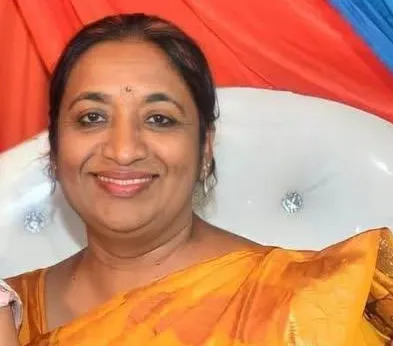
The murder of whistleblower, Babita Deokaran, who courageously flagged suspicious payments, underscores the deadly consequences of corruption and the urgent need for systemic reform.
Image: Supplied
And finally, Babita Deokaran who gave up her life for exposing corruption at the Tembisa Hospital by a syndicate of criminals in the health care department stands as a symbol of courage and unflinching principles. Jeff Wicks, an investigative journalist, tells Deokaran's story in his book, The Shadow State, which every South African should read to know what is really happening in our country.
If women want to progress they must begin to reflect on their r collective situation as women as mothers as sisters as daughters. Indeed, it is said that when women get together anything is possible. Today I would like to pay tribute to each and every one of you for having overcome the obstacles of gender discrimination so endemic in society today. I want to pay tribute to you for having emerged glorious in all of your endeavours - be it in the home or in the workplace- you are certainly an integral part of our nation. If we ruled the world there would be less violence and fewer senseless wars.
And indeed, I think it is time that we give sense to our men rather than obediently and thoughtlessly emulate their behaviour when we take up positions alongside them. Our focus should be like that of Waangari Maathis, Elllen Johnson Sirleaf and Jehan Sadat on strengthening our collaborative efforts across political, religious ,ethnic and racial lines to achieve real social change for a better South Africa.
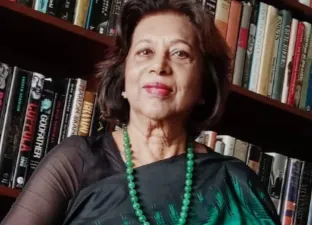
Dr Devi Rajab is a psychologist, award-winning columnist and author.
Image: Nadia Khan
Dr Devi Rajab is a psychologist, award-winning columnist and author.
She delivered the keynote address at the Democracy Development Program (DDP) Women in Politics Conference at the Edward Hotel recently.
** The views expressed do not necessarily reflect the views of IOL or Independent Media.