

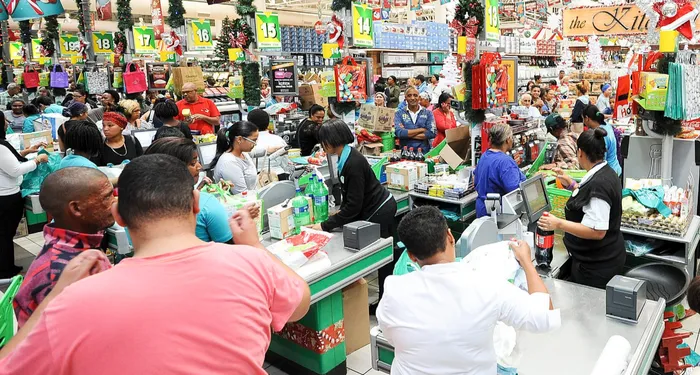
Festive season intoxication, combined with early salary payments and bonuses, creates the perfect storm for financial recklessness, says the writer.
Image: Leon Lestrade
THE festive season has arrived, and with it, the familiar pattern: bonuses hit bank accounts, shopping carts overflow, and credit cards swipe with abandon.
We have all been here before. Yet somehow, January always catches us off guard – that endless month where the rent is due, school fees loom, and the refrigerator seems perpetually empty.
But what if this year could be different?
Recent data reveals a sobering reality: 73% of South Africans planned to spend the same or less during the 2023 festive season, yet household debt-to-income ratios reached 70% – the highest since 2017.
We know we should spend less but knowing and doing remain worlds apart.
The problem is not lack of information. We are drowning in budgeting advice. The real issue?
One-sixth of South Africans – roughly 10 million people – are three months or more behind on debt repayments or facing legal action. These aren't statistics; they're our neighbours, colleagues, and perhaps even ourselves.
Every December, we're bombarded with the same tired tips: "Create a budget!" "Make a list!"
"Avoid impulse buying!" These aren't wrong, but they miss something fundamental – they assume we are rational actors who simply need better information.
We are not. We are human beings navigating intense social pressure, cultural expectations, and a financial system specifically designed to make spending feel painless.
The convenience of online shopping and the rise of BNPL "Buy Now, Pay Later" schemes have made overspending easier than ever, with retailers extending discount periods from single days to entire months.
December transforms the country into a peculiar state of suspended animation.
Offices operate on skeleton staff, deadlines evaporate, and the phrase "we'll deal with it in January" becomes a national mantra.
This collective relaxation, while psychologically necessary after a demanding year, creates a dangerous financial vulnerability.
When nobody is really working, when the mood is euphoric and carefree, our financial guard drops.
We make decisions we'd never make in March.
We justify purchases with "I deserve this" or "it's only once a year."
This festive intoxication, combined with early salary payments and bonuses, creates the perfect storm for financial recklessness.
Small business owners face a unique December dilemma: rewarding loyal staff while ensuring the business survives January's inevitable cash flow drought.
The pressure to match competitors' bonuses can be overwhelming, yet overextending can cripple your operation. The solution lies in year-round planning.
Instead of treating bonuses as a sudden December expense, set aside a small portion of revenue each month in a separate business savings account.
This transforms bonuses from a crisis into a managed expense.
Send out invoices well in advance and consider offering 2-3% discounts for early payment to shore up cash reserves before the festive spending begins. If cash flow is genuinely tight, consider non-monetary rewards: extra paid leave, gift vouchers, or a company-sponsored festive lunch.
Your employees value recognition and appreciation; the monetary amount, while important, isn't everything. Honest communication about business realities often earns more respect than unsustainable generosity that leads to retrenchments in February.
Rule one - pay January first: this is not about budgeting – it's about time travel. The moment your December salary or bonus arrives, immediately transfer funds for January's essentials into a separate account. Prioritise rent or bond payments, groceries, school fees, utility bills, and municipal rates before allocating any funds to festive spending. Consider it a non-negotiable appointment with your future self.
Rule two - the 80/20 power play: Use 80% of any bonus or windfall for essentials like debt repayment or January expenses and allocate only 20% for festive spending. This is not deprivation; it is liberation from February's panic attacks.
Rule three: cash is your conscience: paying with physical cash or debit cards makes expenses feel more real than credit cards, acting as a natural brake on overspending. Leave credit cards at home. Withdraw your budgeted amount in cash. When it is gone, it's gone.
Rule four: question everything "free": most "free" offers come with hidden costs – BOGO (Buy-One-Get-One) free deals often have inflated prices, and no-cost instalments frequently carry concealed charges. If something is marketed as free, spend five minutes finding the catch.
While you are planning your spending, criminals are planning too. December's unique combination of empty homes, distracted minds, and social media oversharing creates a feeding frenzy for thieves and cybercriminals.
Before you leave for that coastal getaway, secure your property properly. Install timers on lights to simulate occupancy, ensure alarm systems are functional, and ask trusted neighbours to collect mail and newspapers.
Visible accumulation screams "nobody's home."
More insidiously, resist the urge to broadcast your whereabouts on social media. That perfectly filtered photo of your champagne in Switzerland is not just making your friends envious - it is providing criminals with a detailed itinerary of your absence.
Thieves actively monitor social media, tracking who's away and when properties are vulnerable. Post your holiday photos in February, not real-time.
Cybercrime also escalates during December's distracted state. Phishing emails disguised as festive deals or charity appeals proliferate. Never click suspicious links, verify banking communications directly with your institution, and monitor your accounts obsessively during this period.
The festive mood makes us less vigilant precisely when we need to be more alert.
Despite our best intentions, January often brings financial strain. Here is your recovery roadmap:
The debt hierarchy: focus on high-interest debt first using the Debt Avalanche method – paying off the highest interest rate debt while making minimum payments on others saves the most money over time. Alternatively, the Debt Snowball method – clearing smallest debts first – provides psychological wins that build momentum.
The experience over things principle: when recalling celebrations, we remember experiences and quality time rather than expensive material objects. A handmade gift, a shared meal, or a family game creates lasting memories without lasting debt.
The kindness clause: in a country with significant income inequality, ostentatious displays can be cruel to the underprivileged. True generosity isn't about grand gestures; it's about thoughtful consideration within your means.
Here is what the advice columns won't tell you: This system only works if you accept one fundamental truth – you cannot have everything.
Not this December, not next December, probably not ever. And that is okay.
The question is not whether you can afford that premium holiday or designer gift.
The question is: what will it cost you in February, March, and beyond?
An investment of R100 000 in the market over past festive seasons would have grown to R733 000, providing a 13.2% annual return.
Every rand spent on impressing others – or worse, broadcasting to criminals – is a rand stolen from your future security.
This December, give yourself a different kind of gift: the gift of waking up in January without dread, without fear that someone has emptied your home or bank account while you posed for Instagram.
The gift of knowing your children's school fees are sorted.
The gift of financial dignity and physical security.Your future self is counting on you. Do not let them down.

Sanjith Hannuman
Image: File
Sanjith Hannuman is the managing director of Avinash Consultants & Actuaries.
** The views expressed do not necessarily reflect the views of IOL or Independent Media.