

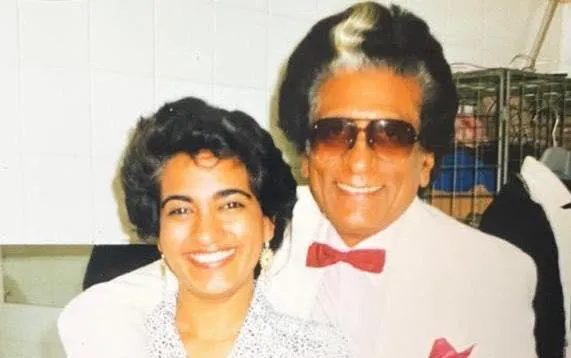
Zakia Ahmed-Siddiqi and Safee Siddiqi.
Image: Facebook
YOU have heard of enduring love stories. They abound in daily life and more so in works of fiction and poetry. Among others we had Adam and Eve, Samson and Delilah, although that was short-lived, especially his hair, Caesar and Cleopatra, Romeo and Juliet, Heathcliff and Catherine of Wuthering Heights fame. Of more recent we had the likes of Richard Burton and Elizabeth Taylor, Michael and Shakira Caine, Sean Connery and his beloved Micheline, to name a few.
However, that is delving into the giddy world of stars. Let’s get down to earth with a resounding bump and let me tell you the captivating story of our local people. Yes, we are capable of love stories, many that transcend even death. This is a couple that had a profound impact in my life and I loved and respected them till the sad passing on of both.
When I began my incursion into radio broadcasting, this wonderful duo, basically took me through the rites of passage, albeit unknowingly. It was by accepting this novice, and leading by example. What better role models could I have had other than the saintly Safee Siddiqi and the wowsome Zakia Ahmed- Siddiqi? I looked forward to standing in on the talk shows on Lotus FM on a Wednesday evening at 8pm. it was because Safee Bhai ended his shift then and I could spend a few precious moments in his warm company.
When I entered the studio, he would move to an advert or spin a disc so that he could greet me and welcome me with a hug. He would enquire about my day, my parents and my health. In his presence, you felt like the most important person in the world.
“Grrrrrrrrrreeeeetinnnngs!”
When that was heard, it heralded another special hour on radio with the uber-talented poet, playwright and presenter Safee Siddiqi. It was a special, precious time which you spent with the much-loved doyen of radio. Where did the legend begin? It happened on April 21, 1930, in the KwaZulu-Natal town of Dundee.
Mohammed Zakria Siddiqi, known later as Safee Siddiqi, was born to Mohammed Basheer and Naseebah Siddiqi. He did not spend his childhood in Dundee as he moved to Maputo, where he spent a year. Remarkably, he went for the traditional Hajj at the age of two, and thereafter he stayed in Ganj Muradabad, his mother’s home village in India. His exposure to life and changing environments certainly did much to enhance the young boy’s perspective on life. In the midst of studying a variety of Islamic subjects and languages, he returned to South Africa in July 1940 due to threatening war initiated by the expectance of a Japanese invasion.
To learn English and get a secular education, he studied at Anjuman Madressah, followed by a two-year stint at Greyville School. Thereafter, he studied via correspondence and achieved the highest mark in mathematics in the country. The young Siddiqi began composing poetry at the tender age of six. He did not write his compositions down, but committed them to memory. In 1942, in the Grey Street Mosque, he recited his own poetry composition in public for the first time. Between 1944 to 1950 he taught, including in Ahmedia, where pupils were older than him.
There he wrote a composition which was performed for King George. He always credited Farouki Mehtar, a Gujarati-speaking man who composed Urdu poetry and wrote as a journalist for the newspaper “Indian Views”, as being his role model. Together with Mehtar, he performed at many Mushairas, which were poetic symposiums. They decided to have their own Mushaira, and so they formed a society and registered it. Thus, in 1965, the Buzme Adab was born, with Mehtar and Siddiqi as joint secretaries.
Finally, having achieved chairman status, Siddiqi was instrumental with the Adab for getting Urdu taught in schools, for many music concerts and bringing down international poets to South Africa. So, where did the name Safee originate? Siddiqi found his two forenames particularly unwieldy, and therefore assumed the name Safee, after a much admired and famous poet of the 19th century. Then along came radio.
In 1972, a station reserved for Indians was opened on the AM band. It was broadcast from Swaziland for two hours on a Sunday. Siddiqi was appointed manager of the station called Radio Swazi. It became highly popular and since the majority of Indian listeners were from Durban, the transmitter was faced there. Siddiqi approached the owners to give it a more acceptable Indian name. After a competition was held, it was renamed Radio Truro. Listenership grew and it began broadcasting throughout Sundays. Advertisers flocked to the station. SABC began to challenge, knowing they had the superior FM bandwidth.
This finally led to the demise of Radio Truro in 1982. SABC launched Radio Lotus and many announcers from the former Truro jumped ship. Siddiqi, himself, was offered a vacancy left by a former presenter and began doing the Qawali and Urdu programmes which he did for decades. Back to poetry and writing, Siddiqi did not confine his poems to only Urdu. He wrote holy songs for other faiths too and these are recited widely. He had also written pop songs in Urdu, Hindi and other languages and even a composition for the great Mohammed Rafi, which he performed in Durban during one of his concerts.
He wrote many Qawali songs, one of which, based on the Zulu “Shosholoza”, he did for the Khan Brothers. He deemed another song which he composed for the Khan Brothers as being his favourite. This was the widely accepted “Aliahu”. This was considered one of his greatest achievements and can still be heard worldwide. Somewhere along the busy road of life, there appeared the vivacious Zakia Ahmed. The two met at Radio Truro in 1981 and became best friends. They married in 1987 and enjoyed 25 happy years together until "Safee Bhai", as he was fondly known, passed away on November 23, 2012.
Two children were produced out of this marriage: Safee-Naaz, who is in the legal fraternity, and son, Bashaarath.
The legend called Safee Siddiqi was known throughout the world. The world mourned his passing. But we have collective memories of this great, yet humble soul, in his poems and songs. Khuda Hafiz, Safee Bhai! What could one say about the legend named Zakia Ahmed Siddiqi? Her bubbly voice and tone conveyed her zest and verve for life that was always infectious. My interactions with her were always delightful and memorable. She made one feel like you were meeting royalty.
Of course, to me Safee Bhai, the man who “could bring words to life” and Zakia Behn “the nightingale who could make music with words” were my idea of royalty. Our dear Zakia passed on two weeks ago, her bubbly voice silenced forever, but her memories will never fade. You know the mind-boggling factual testament to the eternal love of these two legends? Safee Bhai passed away on November 23 (2012) and his beloved Zakia on November 21 (2025). Almost a day apart literally. Tell me that was not a love forged in gold.
Ravi Govender
Image: File
Ravi Govender is a former POST sub-editor and Lotus FM radio presenter. He is a published author of four books, a freelance editor and film producer in training. He can be contacted at: [email protected]
** The views expressed do not necessarily reflect the views of IOL or Independent Media.