

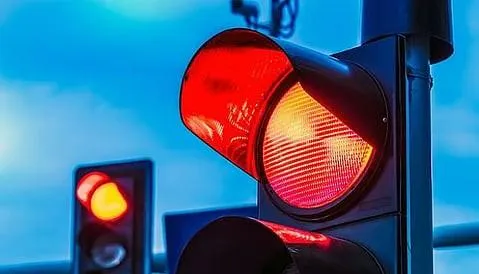
Jumping red robots warrants a higher penalty than South Africa has at present, says the writer.
Image: Supplied
"AVOCADO on seeded bread, a poached egg and a mango juice please,” my guest rattled off to the waiter, eyes glued to his phone.
I was still scanning the breakfast menu at the restaurant high up on Durban’s Berea, but it was near impossible to ignore the worried look that suddenly bathed my visitor’s face.
Durban held him for a week’s work, and our hurried reunion was confined to just 45 minutes. Still, the shadow of unease was unmistakable, and I gently asked if something was amiss.
“I got a traffic fine for shooting a red light,” he sighed, laying the phone aside, finally conceding that our conversation mattered more.
“A traffic fine? Is that all? I was bracing myself for something far more grave,” I said.
And that’s how the subject for this week’s column was born.
My friend had driven through a red traffic light in Dubai and had received the traffic fine on his phone. In Dubai, running a red light carries a fine of 1 000 dirhams. This is equivalent to R5 000.
Given the current exchange rate, R5 000 in Dubai is about equal to the R1 000 that a red-light violation will set you back by in South Africa, I thought. So what’s the big deal? Why doesn’t my friend just forget about the fine and start digging into his food?
I was wrong. In addition to the fine, the vehicle is impounded for a mandatory 30 days, denying you of your means of transport. And here comes the crunch. Violators must pay a staggering 50 000 dirhams which is R250 000 (yes, two hundred and fifty thousand rands) to get the vehicle back.
I wondered whether it could get worse than this. Yes, it can. The vehicle may remain in impound for up to three months or until the fine is paid. If the owner is not able to cough up within three months, the car may be auctioned publicly.
And if that is not bad enough to make you think thrice about skipping a red robot, the penalty in Dubai includes 12 demerit points on the driver’s record.
I could tell the traffic offence weighed on my friend, dulling his appetite for food, as he explained that black points remain on your driving licence for one year from the date of the violation.
Accumulating 24 points in a year in Dubai can lead to suspension of your driving licence and even mandatory retraining courses.
The UAE’s strict approach reflects its zero-tolerance policy toward dangerous driving. Running a red light in the UAE – as it is in several other countries - is considered one of the most dangerous traffic violations.
How nice it would be if only South Africa can follow Dubai’s example but adapt it to local realities. A combination of higher fines, stricter enforcement, and public education could reduce red-light violations and save lives. However, penalties must be proportionate to South Africa’s economic conditions to avoid being punitive without impact.
However, the current R1 000 - R2 000 fines for serious traffic violations in South Africa are much too low. It is not enough to prevent a life being lost in a serious collision. Penalties for red-light violations must be increased to R10 000 - R20 000 for first offences. For repeat offenders, fines must escalate to R30 000 and above with vehicle impoundment and licence suspension, much like Dubai.
There was a time when only Mad Max dared to cross the line. Red meant stop, and the idea of deliberately running a light was reserved for the stuff of wild fiction. Ordinary drivers wouldn’t dream of it. There existed the fear of consequences, respect for the rules, and a basic sense of civic duty kept intersections orderly.
Today, that discipline has collapsed. Minibus taxi drivers are the most visible offenders, but they’re far from alone. Running red lights has morphed into a reckless habit, a cultural shrug at danger. And the tragedy is that this isn’t about a lack of resources. Cameras are rolling. Officers in cars with lights are standing right there. Yet the law is treated like background noise.
Intersections have become so dangerous that I slow down to a crawl and check left and right even when the light is green for me. I stop at red lights even at 2am.
Public campaigns have tried to stem the tide by parading grim accident statistics, survivor testimonies, and bloodstained billboards. But the message barely lands. Drivers see the carnage, hear the warnings, and put foot on the accelerator. Education without enforcement is just theatre.
Similar to the early 20th century Futurism movement which glorified speed, technology, power, and modern life, today’s drivers seem to romanticise risk. In reality, however, this recklessness results not in progress, but in dangerous and sometimes tragic outcomes for everyone on the road.
What we’re witnessing at our traffic lights is a silent pact between reckless motorists and passive authorities: you break the law, we look away. The result? Intersections that feel less like controlled systems and more like freeforall battlegrounds.
South Africa doesn’t suffer from a shortage of rules or resources. It suffers from a shortage of will. Until traffic officers treat redlight running as the crime it is, until consequences are swift, visible, and unavoidable, this culture of indifference will keep growing. And every ignored red light is another roll of the dice with human lives.
Penalties for lifethreatening offences should sting hard enough to make drivers think twice. Yet in South Africa, they remain laughably affordable.
Look at the numbers: the price of bread, milk, meat, chicken, petrol, and electricity has soared tenfold over the past two or three decades. Everyday essentials have kept pace with inflation, but fines for blasting through a red light? They have barely budged.
The result is a grotesque imbalance: it costs more to fill your grocery basket than to gamble with human lives at an intersection. When the price of recklessness is cheaper than the price of dinner, deterrence evaporates.
South Africa doesn’t just need stricter enforcement; it needs penalties that bite as hard as the risks they’re meant to prevent. Until fines rise to match the true cost of danger, red lights will remain optional, and the public will keep paying the price in blood.
Speak to parents who have lost children when red lights were violated; speak to children who have lost parents who died because of murderous drivers. The pain and anguish that is experienced will convince you of the urgent need for extremely high deterrent fines and stricter enforcement. It must not be possible for a motorist to settle the problem of shooting through a red light by parting with “KFC Streetwise and a Coke money”.
It is a joke that President Ramaphosa boasts of a successful G20 Summit and we speak of a National Dialogue while tolerating daily lawlessness. How can we expect respect for a new ethos when respect for the simplest rules has collapsed?
This is not just about traffic. It is about trust. It is about whether South Africans believe that rules matter, that laws are enforced, and that lives are valued. Every red-light violation is a symbol of something deeper: the erosion of accountability, the silence of authority, and the fragility of our social contract.
If we are serious about a National Dialogue, then let it begin here, at the intersection. Let it begin with the courage to say: rules matter. Lives matter.
Consequences matter.Because a society that cannot enforce its traffic lights will struggle to enforce its vision. And if we want to build a new ethos, we must first prove that we can uphold the old one.

Yogin Devan
Image: File
Yogin Devan is a media consultant and social commentator. Reach him on: [email protected]
** The views expressed do not necessarily reflect the views of IOL or Independent Media.