

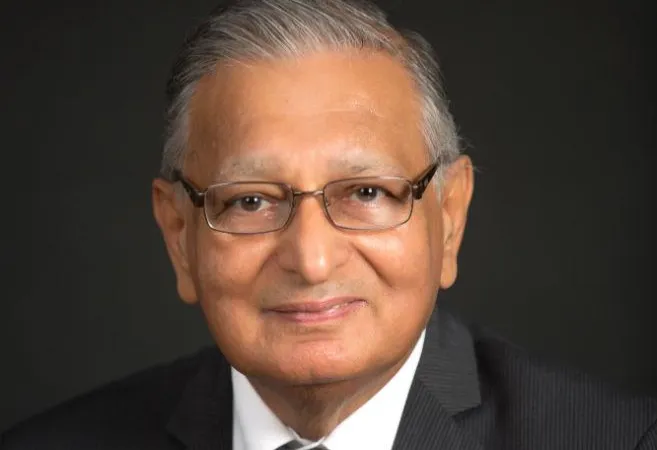
Professor YK Seedat
Image: Supplied
INTERNATIONAL hypertension authority, Professor YK Seedat, described by his colleagues as “an intellectual giant in the field of medicine”, has passed away in Durban at the age of 92.
The University of KwaZulu-Natal’s Emeritus Professor in Medicine will be best remembered for his deep humility; his distinguished role in shaping medical academia; a mind that retained and retrieved with astonishing clarity; and thinking unclouded by bias, guided instead by openness and clarity.
Described as a doyen of medicine in practice and academia, Professor Seedat’s research on hypertension and renal medicine spans 400 articles, 41 chapters in books and over 350 lectures at international level and in national congresses.
He made a notable contribution to studies in hypertension (high blood pressure) prevention and control in sub-Saharan Africa. Professor stressed hypertension was more common in black people living in sub-Saharan Africa than any other racial group, and only around 5% to 10% of the population had adequate control of their blood pressure. There were multiple factors that caused hypertension, including excessive salt intake, obesity in middle aged black Africans, and stress. Hypertension was a key cause of strokes, heart failure and kidney failure in people from sub-Saharan Africa.
Professor Seedat's research during and after apartheid highlighted significant "racial" differences in the causes and prevalence of renal (kidney) disease, arguing that these disparities were linked to environmental, socioeconomic, and lifestyle factors, which were in turn a result of apartheid policies. He did not claim race was irrelevant; rather, he linked observed differences to social and environmental inequalities.
Yackoob Kassim Seedat was born on February 7, 1934, in Durban. After matriculating from Sastri College where he was a good debater, he studied in Dublin, Ireland, as an undergraduate and returned to South Africa as a qualified doctor. Though born into privilege and afforded the option of pursuing wealth through medical entrepreneurship, he chose instead a nobler path. Devoting his life to medical academia, he worked tirelessly to uplift the nation’s health, with a special devotion to those from disadvantaged backgrounds.
He initially worked at King Edward VIII Hospital, the historic stamping ground where non-white doctors persevered through apartheid. He later trained in nephrology at the Royal Infirmary in Manchester and attained a doctorate in medicine on renal tubular acidosis. He rose through academia and became head of medicine at the University of KwaZulu-Natal’s Medical School (now the Nelson R Mandela School of Medicine).
Professor Seedat was president of the Southern African Hypertension Society, 1981-1983; and chairman of the Faculty of Physicians within the broader Colleges of Medicine of South Africa (CMSA), a key body setting postgraduate medical standards in South Africa, and overseeing training and exams. He donated a house in Glastonbury Place in Durban to the CMSA, who used it for administration purposes. The hall in the CMSA building is named after him.
In his speech at the dedication ceremony, Professor Seedat made a plea to the medical profession to safeguard medical institutions through donating to organisational bodies such as the CMSA.
He said medical students must not think of entering the profession just to accumulate massive wealth. Rather, they should expect to help people and give back to the profession and the communities in which they work.
Most doctors and specialists in KwaZulu-Natal earned enormous personal wealth, he said, but were notoriously tight-fisted when it came to giving back to their profession.
“We need to improve the image of our profession as it is a widely-held belief that it is a profession that is only interested in accumulating wealth for themselves.”
In the same speech he recalled the days when family doctors made home visits and took the trouble to learn the family backgrounds of their patients - the doctor was respected by the patient, the family and the community.
“So what had changed? There is less caring for the patient by doctors. Many have become monetary-minded and infectious greed has become pervasive in all segments of our society. Doctors are more interested in the financial gain than rejoicing when the patient is healed from illness,” Professor Seedat said.
He displayed unbridled respect for the Hippocratic Oath.
Speaking at the memorial service of his fellow medical academic Professor Dennis Pudifin in December 2013, Professor Seedat appealed to doctors not to forget the duty they owed to humanity.
“Medicine consists of two components, the scientific aspect and the humane aspect. In spite of scientific and technological advances, the doctor of today does not enjoy the same respect as in the past. Before the days of antibiotics the general practitioner in many a small town made house calls. He or she had very few effective drugs yet was a highly respected member of the community. How was this respect earned, and why is it disappearing?
“The doctor cared for the patient and the family. He comforted the patient, and if the patient died, he comforted the family. He applied ethical principles to his practice: do no harm to the patient (primum non nocere), practise beneficence, refrain from maleficence, and maintain patient confidentiality. Respect in life is earned, not endowed because of position,” Professor Seedat said.
Professor Seedat was also recipient of numerous international awards from prestigious institutions in more than two dozen countries for his contribution to medicine. These include a special award for research from the Medical Research Council of South Africa; a lifetime achievement award from the International Forum for Hypertension in Africa; the Pioneer Award from the International Society of Nephrology, making him the first African recipient; and the International Society of Hypertension Developing World Award. In 1990, he was bestowed with a national Order for Meritorious Service.
In a tribute, retired Professor of General Surgery at UKZN’s Nelson R Mandela School of Medicine, Bhugwan “Bugsy” Singh, said Professor Seedat would long be remembered among the medical pantheons of South Africa for his trailblazing contributions to academic medicine and loyalty to the public health sector in our country.
“A legend in the classic mould, he left many templates and footprints for others to follow. His views on medical practice and education and research were promethean, crafted on his widely admired perspicaciousness which gave him a sharp, penetrating, and quick mind.
“Professor Seedat's remarkable corpus of research, contributions to medical education and his commitment to public service have ensured the showering of rich encomium, locally and internationally.
“His legacy will long continue to inspire the medical fraternity in respect of knowledge generation, medical education and a commitment to public service," said Professor Singh.