

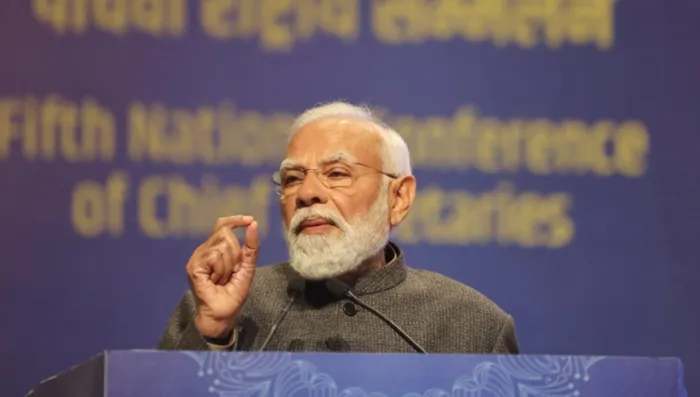
Indian Prime Minister Narendra Modi recently addressed a conference of chief secretaries. On a Facebook post, Modi shared his thoughts on how India could collectively work to empower the poor and realise their dream of a Viksit Bharat. (Developed India).
Image: Facebook
“The world is not just watching India, the world is betting on Delhi,” says PM Modi.
During my recent visit to India last year, I noticed its impressive progress in growth and infrastructure. By surpassing Japan in nominal GDP to become the world’s fourth-largest economy, India has established itself as a significant global economic force. With an economy exceeding four trillion dollars and projections indicating it could soon surpass Germany, India’s growth demands attention from both advanced economies and developing nations like South Africa, which face their own growth challenges.
This achievement did not happen overnight and was sustained despite sanctions and tariffs that have affected much of the global economy. India’s economic transformation is the result of sustained structural reforms, strategic investments, and demographic advantages. Over the past decade, India has recorded some of the fastest growth rates among major economies, even as global markets have struggled with inflation, geopolitical uncertainties, and post-pandemic volatility.
The country has successfully expanded its output while keeping inflation relatively low, a rare combination that has boosted investor confidence and supported domestic consumption. Significant investments in infrastructure, modernisation of tax systems, targeted manufacturing incentives, and the expansion of digital public infrastructure have collectively transformed the country’s economic landscape.
India’s growth is supported by its vast domestic market, a rising middle class, and a youthful workforce. Nearly 70% of India’s GDP is driven by domestic consumption. The rapidly expanding middle class increases demand for goods and services, making it a primary driver of GDP growth. As consumption has increased, industrial capacity and services output have also expanded. Key sectors contributing to this growth include technology, financial services, pharmaceuticals, renewable energy, and manufacturing. However, challenges such as income inequality, skill mismatches, and regional disparities persist. Nevertheless, the overall trend is clear: India has moved from the outskirts to the center of the global economy, achieving this transition intentionally.
Looking to the future, the possibility of India overtaking Germany to become the world’s third-largest economy is no longer just a speculative idea. It is increasingly seen as a matter of timing rather than feasibility. Germany remains a powerful economic force, anchored by high-value manufacturing and exports. However, demographic challenges and slower growth in Germany contrast sharply with India’s momentum. If India continues its current pace of development, maintains its appeal to investors, and upholds macroeconomic stability, it is well-positioned to rise further in the global rankings in the coming years.
For South Africa, India’s ascent presents both opportunities and points for reflection. On the opportunity front, a larger and more influential Indian economy paves the way for deeper trade, investment, and collaboration as members of BRICS and the G20; South Africa and India share diplomatic and economic platforms that can be leveraged effectively. India’s increasing demand for commodities, energy solutions, financial services, and agricultural products offers tangible prospects for South African exporters and investors. Strengthened bilateral ties could also support skills exchange, technology transfer, and cooperation in areas such as renewable energy and infrastructure development.
India's recent success invites a necessary yet uncomfortable comparison with South Africa. Bringing our analysis back home, despite having substantial natural resources, a sophisticated financial sector, and a strategic geographic position, South Africa's economic growth has remained disappointingly low. Several factors contribute to this stagnation, including structural constraints, policy uncertainty, energy instability, and high unemployment, all of which undermine confidence and competitiveness. India's experience highlights the crucial role of decisive reform and consistent policy. By simplifying regulations, enhancing the ease of doing business, and providing clear signals to investors, India has successfully attracted significant amounts of both domestic and foreign capital.
Demographics also offer important lessons. India has effectively leveraged its large, young population by expanding access to education, technology, and job opportunities. Although challenges remain, focusing on skills development and workforce participation has contributed to productivity gains. In contrast, South Africa struggles with one of the highest youth unemployment rates globally. Without continued investment in education, vocational training, and digital skills, the country risks wasting an entire generation of potential. India’s progress demonstrates that demographics can be either an asset or a liability, depending on the policies implemented.
Economic diversification has played a central role in India's rise. Instead of relying on a narrow range of industries, India has pursued growth across multiple sectors, thereby reducing vulnerability to external shocks. In contrast, South Africa's economy remains heavily concentrated, with mining and finance dominating. To build resilience and unlock new sources of growth, South Africa must expand into higher-growth areas such as technology, renewable energy, advanced manufacturing, and value-added exports.
India's experience highlights the ability to achieve growth while maintaining macroeconomic stability. High growth is inadequate without controlling inflation and fiscal stability. Indian policymakers have successfully balanced expansion with fiscal discipline, enhancing credibility in global markets. This approach is relevant for South Africa, which faces fiscal pressures and debt concerns. Sustainable growth demands both ambition and sound economic management.
India's overtaking of Japan highlights a shift in global economic power, demonstrating the impact of reform, investment, and vision. For South Africa, the key lesson is that progress demands courage, consistency, and adaptability. In a world driven by emerging powers, decisive action is essential for shaping the future, while hesitation may leave one behind.
As India continues its ascent and eyes the next rung on the global ladder, the implications will be felt far beyond its borders. For South Africa, this moment should serve as both an invitation and a warning: an invitation to engage with a rising economic partner, and a warning that growth is neither automatic nor guaranteed. The choices made today will determine whether South Africa participates fully in the next chapter of global growth, or merely observes it from the sidelines, or worse, gets left behind.

Jennifer Reddy
Image: Supplied
Jennifer Reddy is the CEO, Morar Incorporated.
** The views expressed do not necessarily reflect the views of IOL or Independent Media.