

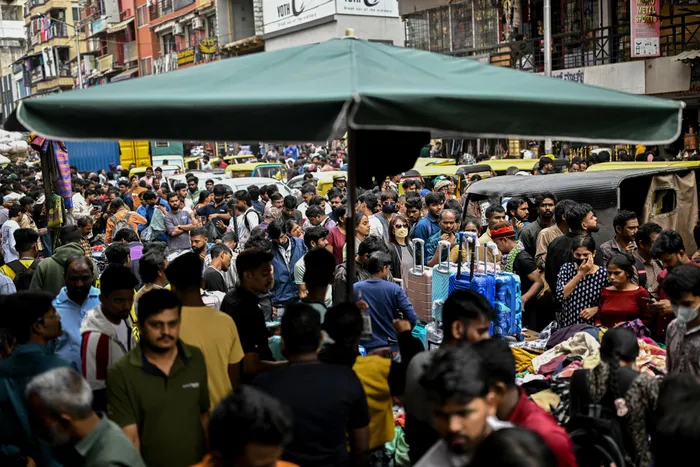
People gather to shop amidst traffic ahead of the Pongal festival at Chickpet market in Bengaluru.
Image: IDREES MOHAMMED / AFP
EVERY society that has lived close to the land has, in one form or another, paused to give thanks for the harvest. These moments of gratitude are never merely agricultural milestones; they are deeply spiritual, cultural, and communal occasions that affirm humanity’s relationship with nature, ancestry, animals, and collective wellbeing.
Harvest festivals emerge from lived experience and indigenous knowledge systems, reflecting how communities understand sustenance, survival, and continuity. As the Tamil community across the world prepares to celebrate Pongal from January 14, it provides an important opportunity to reflect on how this ancient festival resonates strongly with African indigenous traditions, particularly the Zulu first‑fruits ceremony known as Umkhosi Wokweshwama.
Though rooted in different cultural landscapes and histories, these traditions reveal remarkable similarities in meaning, symbolism, and purpose.
Pongal is a four‑day harvest festival observed by Tamils globally and is deeply embedded in agrarian life and cosmological rhythms. The festival coincides with the sun’s northward movement, symbolising renewal, hope, and prosperity. Each day of Pongal carries a distinct significance, yet together they present a holistic worldview in which nature, humans, animals, and spirituality are inseparable.
The festival begins with Bhogi, a day dedicated to cleansing and renewal. On this day, households discard old, broken, or unused items and thoroughly clean their homes. Bonfires are often lit to symbolise the burning away of negativity, stagnation, and the past. Bhogi is not merely about physical cleaning; it represents an inner readiness to welcome new beginnings, abundance, and positive change.
The most important and central day of the festival is Surya Pongal, dedicated to the Sun, the primary source of energy and life. On this day, freshly harvested rice is cooked outdoors in a clay pot with milk and jaggery. As the milk begins to boil and overflow, families joyfully exclaim “Pongala Pongol!”, celebrating abundance, prosperity, and gratitude. This moment is rich in symbolism. The overflowing pot represents the hope that sustenance, happiness, and blessings will overflow into the household and the community.
Rice, as the staple food and product of the harvest, becomes a sacred offering, acknowledging the interdependence between the sun, rain, soil, animals, and human labour. The act of cooking together and offering the first harvest reinforces the belief that food is sacred and should never be taken for granted.
Surya Pongal is followed by Mattu Pongal, a day dedicated to honouring cattle. In traditional agrarian societies, cattle are indispensable partners in farming, assisting with ploughing, transport, and sustaining rural livelihoods. On this day, cattle are bathed, decorated, fed special food, and venerated. Mattu Pongal reinforces an ethical worldview in which animals are respected as co‑contributors to human survival rather than treated merely as property. It affirms the interconnectedness of all living beings within the ecosystem and reminds communities of their responsibility towards animal welfare and ecological balance.
The festival concludes with Kannum Pongal, a day centred on social cohesion, family visits, community gatherings, and the sharing of food. Families visit relatives, exchange meals, and strengthen social bonds. Kannum Pongal emphasises the belief that the harvest has meaning only when it nurtures relationships and collective harmony. It is a celebration of togetherness, reminding people that prosperity is incomplete without social solidarity.
Among the Zulu people, Umkhosi Wokweshwama reflects a strikingly similar philosophy. As a sacred first‑fruits ceremony, it marks the moment when the new harvest may be consumed, but only after ritual acknowledgement of the Creator and the ancestors. Traditionally presided over by the king, the ceremony affirms spiritual order, continuity of leadership, and respect for the land. No one is permitted to eat from the new harvest before the ritual is completed, highlighting the belief that food is sacred and must be received with humility and gratitude.
The ceremony reinforces discipline, collective identity, and continuity between the living, the ancestors, and future generations. When viewed comparatively, the parallels between Pongal and Umkhosi Wokweshwama are unmistakable. Both centre on gratitude for nature’s abundance and the first fruits of the land. Both emphasise ritualised consumption of the harvest as a sacred act rather than an economic one. Both honour the interconnected roles of humans, animals, ancestors, and the natural world.
Community participation is central to both traditions, highlighting that wellbeing is collective rather than individual. Renewal, continuity, and moral order lie at the heart of each festival, reflecting indigenous knowledge systems that prioritise balance, sustainability, and respect over exploitation. In a modern world increasingly disconnected from the land and driven by consumerism, these traditions carry profound relevance. They remind us that food security, environmental sustainability, and social cohesion are inseparable.
Harvest festivals teach restraint, gratitude, and responsibility, values that are urgently needed in an era of climate change, inequality, and social fragmentation. For a diverse society like South Africa, recognising the shared values between Pongal and Umkhosi Wokweshwama helps foster mutual respect, intercultural dialogue, and social cohesion. These traditions demonstrate that while rituals may differ in form and expression, their underlying philosophy is often aligned. Ultimately, Pongal and Umkhosi Wokweshwama teach us that harvest is not simply about crops; it is about gratitude, humility, and responsibility.
They affirm that sustenance is sacred, nature deserves reverence, and community is central to human flourishing. In celebrating these festivals and reflecting on their similarities, we are reminded that humanity shares a common heritage rooted in the earth itself. Different cultures may express this truth in different ways, but the spirit remains the same: life thrives only when we live in harmony with the land, with one another, and with the values passed down through generations.

Dr Rajendran Govender
Image: File
Dr Rajendran Govender is a Social Anthropologist and Researcher; An IBSA and Ford Fellow; Commissioner in the Cultural, Religious and Linguistic Rights Commission; Board Member of the Pan South African Language Board; Global Coordinator of the Repository for Ancient Cultural Endeavours; Chairperson of the Africa Kingdoms Diaspora Alliance. He writes in his personal capacity.
** The views expressed do not necessarily reflect the views of IOL or Independent Media.