

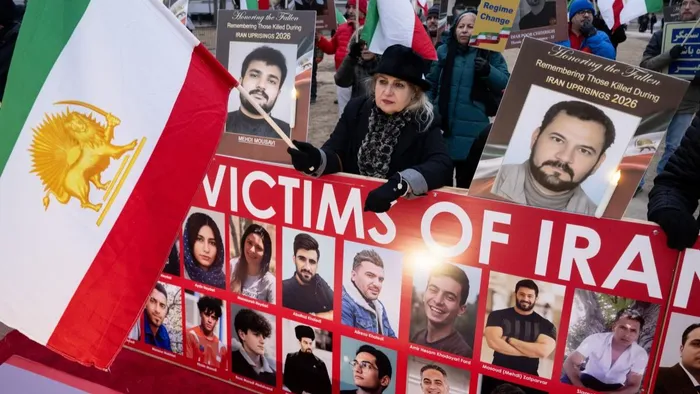
Iranian Americans hold a rally and vigil in honor of the thousands of protesters killed in Iran and to call on policymakers to support the people of the country, outside the White House in Washington, DC.
Image: SAUL LOEB / AFP
RECENT events in Iran, marked by widespread protests and internal strife, have once again placed the Islamic Republic under the global spotlight. While mainstream media often focuses on the narrative of civilian-led demonstrations, a provocative online exchange, highlighted by Dorothy Lennon, has pulled back the curtain on a far more realistic and potentially destabilising narrative.
This narrative is further complicated by emerging claims of direct technological warfare and a fiercely contested account of the protests' nature, bringing into sharper focus the tension and the threat of a "pending war" that has long shadowed US-Iran relations, one which is, currently, typified by US sanctions which are weaponised to create favourable trade agreements for American interests. Years of sanctions have devastated the economy of Iran.
Lennon's observation zeroes in on a critical moment as the protests began. Mike Pompeo’s tweet, which seemed to imply Mossad involvement alongside Iranian protesters, wasn't merely a political jab from a former CIA director. It carried the weight of someone familiar with international espionage. Adding to this, a Farsi-language X account linked to Mossad openly urged Iranians to demonstrate, claiming its agents were "with the crowds". The Israeli media was surprisingly honest about Israeli involvement in various articles, and clearly, they do not fear accountability. These revelations suggest active, on-the-ground participation by external forces.
The Iranian government's response to these protests and the alleged foreign intervention has been brutal and severe. Officials, including Professor Seyed Mohammad Marandi, have presented a starkly different account from Western media reports. Marandi asserts that certain factions of the protest movement were far from peaceful, alleging they were responsible for the deaths of 150 police officers and horrific acts of violence, including burning people alive. He contends that these violent elements were directly coordinated with foreign intelligence.
A critical turning point, according to this narrative, was when Iran, reportedly with Russian technical assistance, succeeded in disabling SpaceX's Starlink satellite internet service, which was allegedly being used to coordinate between Mossad and operatives on the ground. Once this communication link was severed, the protests, particularly their violent core, rapidly lost momentum and fizzled out.
Furthermore, Professor Marandi points to widespread footage, largely ignored by mainstream Western networks like CNN and BBC, which he says shows millions of Iranians subsequently taking to the streets in massive pro-government rallies. These demonstrations, he argues, were a genuine display of popular repudiation of foreign instigation and support for national sovereignty. This perspective builds a case that the underlying motive for the destabilisation campaign extends beyond regime change. It aligns with a broader geopolitical struggle.
An effort by Israel, supported by factions in the U.S. still aligned with the Trump-era "maximum pressure," to thwart Iran’s integration into economic blocs like BRICS that challenge Israel's military dominance in the Middle East. The drive to abandon the petro dollar, particularly for oil trades, directly threatens a foundation of American financial power. For Netanyahu’s government, the goal is seen as crippling a primary regional adversary.
This combination of varying interests, including the neo conservative brigade in America which includes the majority of both Democrats and Republican politicians favoring the military industrial complex that engineer war for resource control and arms profits, the desire to protect the petrodollar, and Israel’s genocidal agenda, creates a powerful pathway for warmongering and destabilization which is not the best outcome for ordinary Jews or American citizens, but its incredibly profitable business for the oligarchy class.
Some analysts offer an alternative reason for Trump's decision not to bomb Iran after telling Iranians that help was on its way. They believe it was because internal dissent in Iran had been suppressed. With no viable uprising to implement regime change in Iran, military intervention became strategically pointless. Critics thus view the unconfirmed official explanation that Trump received agreement that arrested protesters won't be executed as a mere excuse, masking a more pragmatic calculation that military action was futile without internal collapse.
When discussing such foreign interventions, a curious double standard often emerges. Imagine, in Minnesota, USA, if mass protests erupted in America after the shooting of a mother of 3 in the face by an ICE officer. What would happen if, in the midst of ensuring nationwide protests, a foreign power like China launches cyber-attacks to disable domestic communications and openly brag about embedding agents among demonstrators to overthrow the American government. The reaction would be one of universal condemnation as a grave violation of sovereignty. Yet, similar actions against Iran are frequently framed in some quarters as support for "freedom," highlighting startling hypocrisy and a paradigm that suggests that a "White West" is always right.
It is crucial to acknowledge that Iran faces genuine domestic grievance, economic hardship, and social restrictions, although one can link them to American sanctions. To ignore these would be misleading. However, the claims highlighted by Lennon and articulated by voices like Marandi suggest a dangerous convergence where authentic discontent is potentially exploited, amplified, and violently hijacked by external actors pursuing war for profit goals. This creates a volatile mix where legitimate protest can be weaponised, increasing the risk of catastrophic miscalculation.
The unrest in Iran is not a simple issue of people versus regime. External powers, motivated by ideology, profit, and strategic supremacy, appear deeply engaged in manipulation. This keeps alive the unsettling spectre of a pending war, one that could erupt not solely from a nuclear facility, but from the shadows of cyberspace and the chaotic streets of a nation under relentless, multi-fronted attacks.
Now, let's connect this to our own lives here in South Africa. When we hear about global events like this, we may hold strong views that our government should not have a view if the great Trump does something wrong. Indeed, as Indian South Africans, where many feel marginalised, Indians might vote for a party like the DA to fix service delivery. But this situation in Iran shows us we are dealing with a "Trumpian world", a world that openly questions the need for a constitution, where leaders try to protect only their own "tribe" or group, and ignore everyone else.
Imagine South Africa without our Constitution. Today, thankfully, no one is really afraid of the ANC. People can criticise freely, worship freely, and vote freely. That's because our Constitution protects us. Chris Hani's died for these amazing rights that even as an immigrant community, we are protected by an incredible Constitution. But a "Trumpian world" is different. It's about power for a select few, not equal rights for all. As Indians ICE police would be arresting us and deporting us to India. The ANC gave us state capture but also a constitution that fixes state capture and remove them from majority power. Let us not take this for granted. When we see figures like Helen Zille, Gayton Mackenzie, and Jacob Zuma seemingly support a Trumpian vision where only their tribe or political group are protected, we need to be very wary.
For us, as Indian South Africans, this has huge implications. The return of an apartheid-like system, where one group dominates and others are suppressed, would not serve our community. A return to power by Ali-Reza Pahlavi, son of Iran's deposed dictatorial Shah, would be as profoundly regressive as PW Botha's son reinstating apartheid, allegedly to suit a corrupt new global order attributed to Trump. Besides, Iran, Venezuela, and South Africa must elect their own leaders. Not have America or Israel fund new parties and religious organisations in order to implement regime change from within, only because we choose to align to BRICS.
These global conflicts and the local political visions that echo them are not about simple choices. They are about the very foundations of our freedom and equality. We have to take a step back and carefully think about what and who we support, understanding that the choices we make today have far-reaching consequences for our future and the kind of society we want to live in.
Roshan Jainath
Image: SUPPLIED
Roshan Jainath is a community activist and writer.
** The views expressed do not necessarily reflect the views of IOL or Independent Media.