

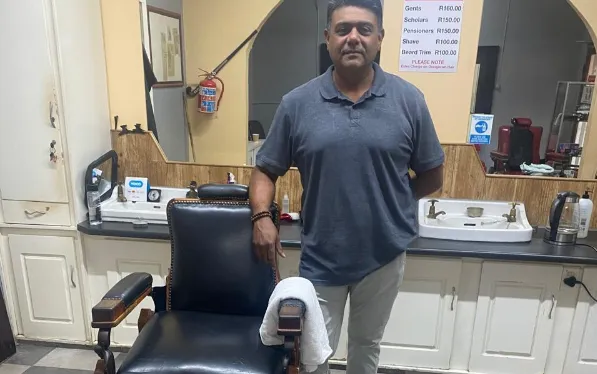
Kiran Ramkylas is one of the last local "old school" barbers still located in downtown Durban.
Image: Supplied
WHEN Mahatma Gandhi was shot dead; when the Salot and Crimson League gangs clashed violently for territorial control in Durban; when apartheid’s guru Prime Minister Hendrik Verwoerd was fatally stabbed; when Dr Chris Barnard performed the first heart transplant; or when Pakeezah star Meena Kumari’s troubled marriage and alcoholism led to her early death, there was no TV to tell these stories in South Africa.
Yet there was a simpler yet surprisingly effective way to stay updated on national and world events long before television, internet or social media transformed the way people consumed information: it was by simply sitting in a barber’s chair.
Barbershops were more than just places to get a haircut. They were vibrant social hubs, buzzing with conversation, speculation, and storytelling. You could learn about the latest political developments, sporting triumphs, or even international crises. News travelled fast in these spaces, and barbers became trusted purveyors of information and gossip alike.
In the '50s and '60s, there were more than two dozen hairdressing salons in Durban’s Grey Street complex alone, and customers from all walks of life passed through daily, each bringing stories, rumours, and titbits of information from their workplaces, neighbourhoods, or travels. Barbers often had sharp social skills and a knack for conversation. While customers waited their turn, chatting, and exchanging opinions, barbers kept their ears open and absorbed all the details.
They remembered and retold stories with flair - and for free, doing decades ago what news anchors and investigative journalists such as Dasen Thathiah, Devi Sankaree Govender, Leanne Manas, Sakina Kamwendo, Cathy Mohlahlana and Stephen Grootes do as a full-time job today.
I have vivid memories of barbershops in the city centre and the suburbs when I was growing up. The air would be thick with the scent of Old Spice aftershave and Brylcreem hairstyling cream battling the alcoholic smell of methylated spirts for dominance. The latter would be used to quickly sterilise clippers and scissors, although I am now convinced it must have been an inadequate method for preventing cross-contamination, given how prevalent barber’s rash was.
The walls of the barbershop were covered in bright, shiny oil paint and would be lined with faded posters of boxing champions, Durban City and Durban United football clubs, and glossy cutouts from Scope magazine of bikini-clad women frozen in poses of playful seduction. A radio in the corner had its dial permanently tuned to Radio Port Natal, predecessor of East Coast Radio. Above, a timeworn ceiling fan churned noisily, its tired blades struggling against the heat.
Some barber shops like Rajsons Hairdressers in Valbro Chambers in Victoria Street (now Bertha Mkhize Street) were neat and tidy, while some, without mentioning any names, were downright dirty. The hygiene standards were concomitant with the prices charged for a haircut. By pumping on a foot pedal, the barber could raise the bulky chair (most were imported from England in days gone by). A wooden board was placed across the chair armrests to provide height when screaming toddlers were brought in.
I dreaded going to the barbershop with my mother for two reasons. The old hand clippers, stiff with neglect, would sometimes jam and cruelly pinch the skin when 3-IN-ONE lubricating oil had not been used. I would wince when nipped by the clippers and the clearly culpable barber would make as if I was complaining for no reason. Also, my mother would insist that I be given the regulation dish cut which was a plain bowl haircut with no box cut or sideburns, and though I longed to look fashionable, that simple trim became the unmistakable mark of every schoolboy.
When barbers closed their businesses in the city and relocated to the suburbs, my father would take my brother and I to a barber by the name of Moonsamy in Westcliff, Chatsworth. He cut hair under a peaches tree in his sandy backyard. When my father’s back was turned, we would whisper our pleas to the barber for a box cut, but he always shook his bald head, too afraid my father would be angry. What stuck with me most wasn’t just the disappointment of the haircut, but the way Moonsamy the barber punctuated his work every few minutes, sending a sharp stream of spit sailing through the gap in his front teeth, a habit I found utterly detestable.
While researching information for this column, my knowledgeable friend Bobby Pillay told me that Rajsons was by far one of the most popular barber shops in the city, run by brothers Ramie and Hans who hailed from Candella Road, Mayville. He recalled that the show promoter Doorghepersadh Mothie worked at Rajsons before opening his own D Mothie’s Hairdressing Salon in the passage in the Victoria Heights building.
Former POST news editor Khalil Aniff said in his younger days, he was a regular customer at Ossie’s Hairdressing Salon in Durban’s Grey Street (now Dr Yusuf Dadoo Street), opposite the old Himalaya Hotel. He said owner Osman who once worked at Rajsons, was also much in demand over weekends to play the clarinet to lead the bridal couple at weddings, specifically the baraat procession. Ossie would also boast that he had cut the hair of Basil D'Oliveira, a top Cape Coloured cricketer who played for non-racial teams in South Africa before moving to England because of apartheid.
Khalil said: “There would be long queues in most of the city barbershops because there were not many barbers for the community, unlike today where we have so many Pakistani barbers who have set up shop.”
Retired photojournalist Puri Devjee grew up in a flat opposite Bob’s Hairdressers which was in a passage in Valjees Building in Victoria Street. He said the barber shop of yesteryear was equally popular for a shave as it was for a haircut. For some men, it was a status symbol to have a daily morning shave at a barber shop. A cut-throat shave was a traditional shaving method using a straight razor (sometimes referred to as a “Jack Razor”), known for delivering an exceptionally close and smooth finish.
Hot water and shaving cream would be applied with a brush to produce lather on the face. The razor would be kept sharp by stroking it on a leather strop. Two long-standing barbers in Durban’s southern suburbs five or six decades ago were Gajraj or “Motorcycle Barber” in Umhlatuzana Township, and “Gulu Barber” in Erica Avenue, Kharwastan, both of whom cut two or three generations of hair.
For the post 20 years, Kiran Ramkylas who runs an old-school barber shop, Top Hat Gents Hairdressers in Gordon Road, off Durban’s bustling Florida Road, has been taking care of my once black, and now grey, hair. He has also fed me with intelligence I would not have picked up easily elsewhere, despite my nose for news. Combining tradition and craftsmanship with the latest hair fads, Kiran who is one of the few local barbers left in downtown Durban, must have hairdressing in his genes. His grandfather Bulawan Ramkylas opened Hygienic Hairdressers in Clairwood 126 years ago. His father, Dawpaal Ramkylas, followed in the footsteps and the business ran in South Coast Road with other family members until six years ago.
The legacy of Hygienic Hairdressers lives on through Kiran at Top Hat Hairdressers which is a community hub with a nostalgic atmosphere, offering classic cuts, straight razor shaves, hot towels, and camaraderie. When the Covid-19 pandemic forced barber shops to shut their doors, trusted Kiran came to my house to cut my hair.
Durban’s Grey Street complex of yesteryear also had its fair share of hairdressing salons that were more oriented toward women, offering longer styles, colouring and chemical treatments. Pravina’s Hair and Beauty Salon had its humble birth in Durban’s Victoria Street and over the decades has transformed into a premium brand, establishing a strong presence in major shopping malls. Manju’s Hairdressing Salon in Bassa Chambers, off Grey Street, apart from being extremely popular among women desiring upstyles, especially beehive buns in the '70s, also ran a busy hairdressing school. Owner Manju Naidoo would arrange a gala graduation ceremony at the Island Hotel at Isipingo Beach annually.
Talented hairstylist Jay Naidoo owned the unisex Salon Soraya in Victoria Street. Durban restaurateur Eggy Naidu of Saagries fame was a regular customer, so regular in fact, that he fell in love with Jay and married her. When Jay closed her business, she donated all the salon equipment to the hairdressing training school at the then ML Sultan Technikon.
The closure of many traditional hairdressing establishments over the years has robbed society of a vital social ritual, where chairs became confessionals and mirrors reflected more than just appearances. Old school hairdressing shops thrived on familiarity. You didn’t just walk in for a haircut; you walked into a relationship.
As we rush through modern life, perhaps we should pause and remember the lessons of these spaces. A haircut may last a few weeks, but a story shared in the barber’s chair can last a lifetime. In the end, grooming was only the excuse. The real service was connection.
Yogin Devan
Image: File
Yogin Devan is a media consultant and social commentator. Reach him on: [email protected]
** The views expressed do not necessarily reflect the views of IOL or Independent Media.