

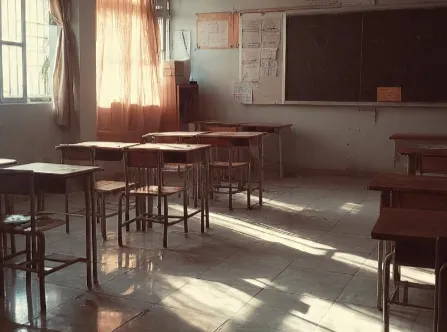
While the imperative for municipalities to collect revenue and ensure financial sustainability is understood and acknowledged, such enforcement measures must never come at the expense of pupils’ constitutional right to education, says the writer.
Image: Meta AI
THE recent disconnection of water and electricity services to several public schools in Phoenix and across the greater eThekwini Municipality is a deeply troubling development that raises serious constitutional, moral, and policy concerns. These disconnections arise from arrears in municipal rates, water, and electricity accounts. While the imperative for municipalities to collect revenue and ensure financial sustainability is understood and acknowledged, such enforcement measures must never come at the expense of pupils’ constitutional right to education.
The affected schools are predominantly located in township and low-income communities where high unemployment, poverty, and social vulnerability remain persistent challenges. These communities already contend with structural inequality, limited access to resources, and constrained household incomes. In this context, punitive measures that undermine the functionality of schools risk compounding existing social inequities rather than addressing them.
Section 29(1)(a) of the Constitution of the Republic of South Africa, 1996, guarantees everyone the right to a basic education. Unlike other socio-economic rights that are subject to progressive realisation, the right to basic education is immediately realisable. This means that the State bears a direct and ongoing obligation to ensure that no pupil is denied meaningful access to education.
The denial of essential utilities such as electricity and water directly impairs the ability of schools to operate. Without electricity, teaching aids, digital learning tools, lighting, security systems, and administrative processes become compromised. Without water, sanitation, hygiene, and basic health standards collapse. Such conditions are not merely inconvenient; they undermine the dignity, safety, and developmental prospects of learners.
In this regard, service disconnections to schools constitute a constructive denial of education, thereby conflicting with the constitutional mandate to protect and fulfil pupils’ rights.
Beyond Section 29, several additional rights enshrined in the Bill of Rights are implicated:
- Section 10: The Right to Human Dignity: Learners subjected to unsafe, unhygienic, or dysfunctional learning environments experience an erosion of their dignity.
- Section 24: The Right to an Environment Not Harmful to Health or Well-Being: Schools without water and sanitation expose children to health risks.
- Section 28: Children’s Rights: The Constitution affirms that the best interests of the child are of paramount importance in every matter concerning the child.
- Section 195: Principles of Public Administration: Public institutions are required to act ethically, transparently, and in the public interest.
Disconnecting schools from essential services contradicts these principles and reflects a failure to balance fiscal enforcement with constitutional responsibility.
From an educational and pedagogical perspective, the effects of utility disconnections are profound and far-reaching. Teaching and learning are not merely intellectual exercises; they depend on stable infrastructure, supportive environments, and consistent institutional functionality.
Key impacts include:
- Loss of instructional time due to disrupted school operations.
- Deterioration in pupil concentration, morale, and motivation.
- Reduced access to technology-enabled learning, which is increasingly essential in modern education.
- Health and safety risks arising from inadequate sanitation and unsafe premises.
- Increased absenteeism among pupils and teachers.
- Widening of educational inequality, particularly affecting already marginalised communities.
Educational research consistently demonstrates that poor learning environments directly correlate with lower academic performance, increased dropout rates, and reduced long-term socio-economic mobility. Thus, these disconnections risk perpetuating cycles of poverty rather than breaking them.
It is neither reasonable nor sustainable for municipalities to operate without collecting legitimate revenue. Schools that have adequate financial capacity and operational budgets should indeed meet their financial obligations. Responsible financial management within educational institutions must be encouraged and upheld. However, it is critical to recognise that public schools are not ordinary consumers. They are extensions of the State’s developmental mandate. Where financial challenges arise, the burden of operational costs must not fall on pupils or local school governing bodies in under-resourced communities.
The responsibility for funding public education lies squarely with the provincial Department of Education, in terms of the South African Schools Act (Sasa) and broader intergovernmental fiscal frameworks.
The municipality should pursue structured, intergovernmental engagement with the KwaZulu-Natal Department of Education to recover outstanding payments. This aligns with the principles of cooperative governance outlined in Chapter 3 of the Constitution, which requires spheres of government to support one another and resolve disputes without harming public welfare.
Rather than disconnecting schools, the municipality should:
- Negotiate service-level agreements with the Department of Education.
- Establish ring-fenced billing arrangements at departmental level.
- Develop payment plans that protect continuity of educational services.
- Implement early-warning financial systems to prevent arrears escalation.
Punishing pupils for institutional funding gaps represents a governance failure rather than a solution.
The distinction between Section 20 (non-fee-paying and limited-function) schools and Section 21 (self-managing) schools under the South African Schools Act presents practical and policy challenges.
Section 21 schools may be granted authority to manage finances and procure services, yet this autonomy does not necessarily equate to financial sustainability. Meanwhile, Section 20 schools often lack the administrative and financial capacity to manage municipal liabilities effectively.
Current legislative arrangements create ambiguity regarding responsibility for operational costs, including municipal services.
This ambiguity results in:
- Unequal treatment of schools across socio-economic contexts.
- Financial strain on school governing bodies.
- Increased risk of service disruptions in poorer communities.
To prevent future crises and ensure equitable educational access, the following reforms should be considered:
- Legislative clarification: Amend Sasa to explicitly assign responsibility for municipal service costs to provincial education departments, not individual schools.
- Ring-fenced operational funding: Establish dedicated provincial funding streams for utilities and municipal services.
- Prohibition on school disconnections: Introduce statutory protections preventing municipalities from disconnecting essential services to public schools.
- Intergovernmental billing frameworks: Require municipalities to invoice provincial departments directly for school-related services.
- Differentiated support for low-income Schools: Expand subsidies and exemptions for schools serving vulnerable communities.
- Monitoring and early intervention systems: Implement provincial oversight mechanisms to prevent arrears accumulation.
These reforms would reinforce constitutional compliance, protect pupils, and promote sustainable intergovernmental collaboration.
Beyond law and policy, this issue raises profound moral questions. Education remains one of the most powerful tools for social mobility, nation-building, and economic empowerment. To undermine schooling through administrative enforcement measures is to erode the future prospects of an entire generation.
Denying schools essential services is not merely a financial enforcement mechanism; it is socially unjust, morally indefensible, and ethically irresponsible. The State must lead with empathy, foresight, and a commitment to the long-term wellbeing of children.
While fiscal accountability remains necessary, it must be pursued in a manner that protects constitutional rights, preserves educational continuity, and upholds the dignity of pupils. Schools should not be collateral damage in intergovernmental financial disputes.
The Inkatha Freedom Party calls for urgent policy reform, cooperative governance, and immediate remedial action to restore services to affected schools. We reaffirm that education is not a privilege- it is a constitutional right. The protection of that right must remain paramount in every decision taken by government.

Dr Jonathan Annipen
Image: File
Dr Jonathan Annipen is a councillor of the eThekwini Municipality for the IFP. He serves as the whip of the IFP in the finance committee.
** The views expressed do not necessarily reflect the views of IOL or Independent Media.