

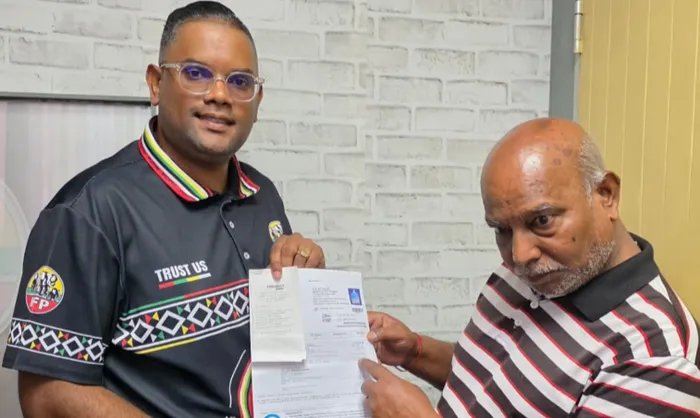
Krishna Moodley, who lives with his wife, had been struggling under the weight of a long-standing municipal "Unity Account" debt, while managing chronic health conditions on a pensioner’s income. With the intervention of IFP councillor Dr Jonathan Annipen, Moodley's debt of R165 000 had been written-off.
Image: Supplied
OVER the past several years, I have assisted hundreds of residents across Phoenix and the broader eThekwini Municipality with municipal utility accounts that have fallen into arrears. Many of these residents approach my office after exhausting all other political and administrative avenues, often having received limited or no meaningful assistance elsewhere. This has led to a recurring question: how are these outcomes achieved?
The answer lies in a disciplined, policy-driven, and systems-based approach to public service. Effective intervention in municipal billing disputes and debt resolution requires a deep understanding of municipal policy frameworks, by-laws, and regulatory instruments. Each case is assessed within the legal boundaries governing revenue collection, indigent support, debt relief mechanisms, and municipal credit control. Rather than relying on ad hoc discretion, my work emphasises the correct application of existing policy provisions, ensuring both fairness to residents and institutional integrity for the municipality.
A critical component of this work is political will and determination. Advocacy on behalf of vulnerable residents demands persistence, patience, and a refusal to abandon complex cases.
Many resolutions require sustained engagement over extended periods - often months or even years. These are seldom overnight victories. Utility account corrections, debt write-offs, and payment restructuring processes frequently involve audits, internal approvals, documentation reviews, and multi-departmental coordination. The results, while meaningful, are the product of consistent effort rather than quick intervention.
Equally important is an informed understanding of municipal budgets and fiscal constraints. Revenue collection is essential for the sustainability of public services, and any request for relief must balance compassion with financial accountability. By comprehending how municipal revenue systems operate, it becomes possible to propose solutions that are fiscally responsible while still protecting low-income and vulnerable households.
My approach also prioritises advocacy for policy reform where existing regulations fail to adequately address social realities. While I enforce current by-laws and policies, I also recognise when these frameworks require modernisation or expansion. Cases that fall outside permissible relief mechanisms are not ignored; instead, they become evidence-based inputs into broader policy discussions, ensuring that lived community challenges inform institutional change.
A further pillar of this work is a strong understanding of the municipality’s social assistance and indigent support packages. Many residents qualify for relief but remain unaware of available programs. By aligning qualifying households with these mechanisms, we ensure that support reaches those most in need while maintaining compliance with municipal standards. This requires not only technical knowledge but also structured coordination with municipal officials, billing departments, legal services, and finance units.
Effective service delivery is impossible without efficient intergovernmental and institutional engagement. Resolving complex municipal accounts often requires collaboration across local government departments and, in some cases, engagement with provincial and national structures. Maintaining professional working relationships with municipal administrators and technical staff enables faster information flow, procedural clarity, and credible advocacy on behalf of residents.
Operational capacity also matters. My office maintains a high-performance, competent administrative structure capable of managing significant demand. On average, I engage directly with between 30 and 50 residents daily at my office, while also responding to approximately 700 inquiries and requests across multiple social media platforms. Each case is documented, tracked, and followed through systematically to ensure continuity and accountability. Importantly, this work is not a one-size-fits-all process.
Every household’s financial situation, billing history, and eligibility status differs. There are cases where assistance is not possible - not due to unwillingness, but because legal and policy restrictions prohibit intervention. Transparency in these instances is essential. Residents must understand that I do not create policy; I apply it faithfully, and where policy limits fairness or effectiveness, I advocate for its reform.
Ultimately, the results achieved are the product of policy literacy, institutional discipline, political resolve, strategic advocacy, and an unwavering commitment to community service. The objective is not only to resolve individual cases but to strengthen systems that deliver equitable, lawful, and sustainable outcomes for all residents of eThekwini.
Dr Jonathan Annipen is a councillor of the eThekwini Municipality for the IFP. He serves as the whip of the IFP in the finance committee.
** The views expressed do not necessarily reflect the views of IOL or Independent Media.