

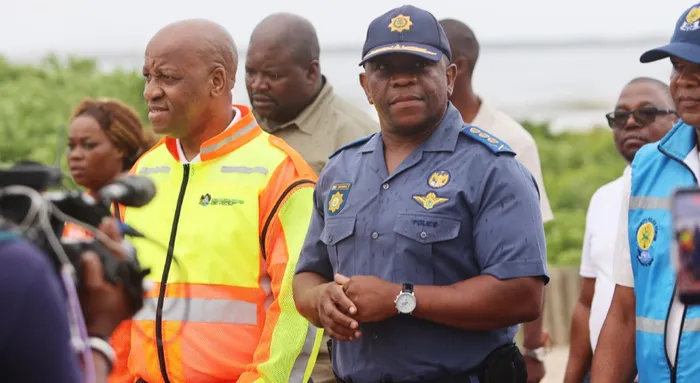
As of January 2026, KwaZulu-Natal (KZN) Premier Thami Ntuli has officially endorsed the renewal of Lieutenant General Nhlanhla Mkhwanazi’s contract for a second term as the provincial police commissioner.
Image: TUMI PAKKIES
Lieutenant General Nhlanhla Mkhwanazi has transformed policing in KwaZulu-Natal through his confrontational approach to corruption and crime. While many admire his courage and transparency, others worry his polarising style undermines institutional cohesion. As discussions about extending his term emerge, NIRMALA GOPAL examines the complex legacy of a leader who has become both a symbol of reform and a source of controversy.
KWAZULU-NATAL Police Commissioner, Lieutenant General Nhlanhla Mkhwanazi's leadership has become both symbolic and controversial, admired by many and resisted by others, precisely because he has chosen confrontation over quiet accommodation.
From the outset, Mkhwanazi distinguished himself as a commander who believed policing must be visible, assertive, and morally unambiguous. He cultivated a reputation as a “cop’s cop” and a leader who understands the dangers of the street and governs without relying solely on ivory tower rooms. His operational style prioritised intelligence-driven interventions, targeting organised syndicates rather than relying on reactive policing. A type of policing that is universally celebrated.
In a province plagued by hit squads and contract killings, this focus resonated with both officers and communities desperate for decisive action.
One of Mkhwanazi’s most defining characteristics has been his willingness to openly challenge corruption within the policing system. Undoubtedly not without controversy.
Unlike many senior officers who prefer internal processes and guarded language, he chose to speak publicly about political interference, compromised investigations, and criminal infiltration of SAPS structures. This approach earned him significant public trust, particularly among citizens who had grown discontent about the state’s ability to police itself.
For supporters, Mkhwanazi represented rare institutional courage. He was perceived as a senior officer prepared to risk his career to defend the integrity of policing and was likely seen as a “martyr.” His communication style further reinforced this image.
Mkhwanazi speaks plainly, credibly, and forcefully, avoiding bureaucratic evasions. In public briefings, he projected certainty and resolve, reassuring communities that someone at the helm was neither indifferent nor afraid. In a province where fear often dictates silence, this visibility became a form of leadership in itself. It signalled to criminal networks that the commissioner was present, attentive, and personally invested. Yet these same qualities have also generated significant controversy.
Mkhwanazi’s honest and confrontational approach has strained relations within SAPS leadership and political structures. Critics argue that his public disclosures, while morally compelling, undermine institutional cohesion and blur the line between policing and politics. Policing, they contend, requires discretion as much as bravery. Public battles may erode command unity and expose the organisation to further instability.
Concerns regarding the sustainability of leadership in the South African Police Service (SAPS) arise in the context of Mkhwanazi’s tenure as KZN Poilce Sommissioner. While strong leadership can rejuvenate institutions facing crises, it also risks creating a centralised authority that may overly depend on a single individual.
Mkhwanazi’s management style is deeply personal, with significant aspects of his credibility tied to his individual presence and assertiveness. This raises critical questions about succession planning and institutional resilience. Has the organisational structure been fortified beyond Mkhwanazi’s command, or is it still reliant on his leadership?
These tensions come to the fore when evaluating the implications of potentially extending Mkhwanazi’s term.
On one hand, continuity could provide institutional stability in an environment characterised by volatility, where organised crime thrives amid leadership changes and administrative flux. A renewed term would enable Mkhwanazi to further develop long-term investigative strategies, reinforce intelligence frameworks, and advance complex cases through the judicial system. His accumulated institutional memory, nuanced local knowledge, and established operational networks are invaluable assets that may not be easily replicated by a successor.
Additionally, extending his tenure could bolster morale among law enforcement personnel who perceive him as a principled advocate for ethical policing. In a policing environment often undermined by fears of political repercussions, Mkhwanazi’s leadership has underscored the possibility of principled governance. An abrupt departure could be construed, whether accurately or not, as punitive for those advocating reform, potentially deterring whistleblowing and stifling progressive leadership.
From a public perception standpoint, Mkhwanazi is one of the few SAPS leaders with significant recognition and credibility among citizens. In a period of tenuous public trust in policing institutions, consistent leadership could reassure the community that the commitment to combat violent crime and corruption remains robust and unwavering.
Conversely, the prospect of extending Mkhwanazi’s term is accompanied by significant risks. His polarising leadership style has fostered entrenched factions within and outside SAPS. An additional term could exacerbate these divisions, complicating collaboration with national leadership, prosecuting authorities, and political entities. Effective provincial policing requires inter-institutional coordination; ongoing leadership-level conflict can hinder or completely obstruct this essential cooperation.
There is also the potential for diminishing returns. Leadership that is initially both disruptive and reformist may, over time, devolve into a state of perpetual adversarial confrontation. If excessive energy is spent on institutional conflict, less may remain for strategic renewal and capacity enhancement. Critics express concern that prolonging Mkhwanazi’s term might reinforce a siege mentality, leading to a reactive rather than proactive form of governance.
Finally, there’s the essential question of precedent. Renewing the term of a commissioner who actively challenges political authority may be warranted on grounds of demonstrated merit, but it also raises critical issues of civilian oversight and accountability. Democratic policing hinges on achieving independence while maintaining a delicate balance. The challenge lies in ensuring that principled resistance does not morph into a concentration of personalised power.
Ultimately, Mkhwanazi’s leadership encapsulates the complexities of contemporary policing in South Africa. He is both a manifestation of crisis and a response to it. His strengths, courage, clarity, operational focus, and moral conviction render him a formidable leader in a province that necessitates strong governance. Conversely, his weaknesses, confrontation, polarisation, and institutional friction are inextricably linked to those same strengths.
Determining whether another term would benefit KwaZulu-Natal hinges on the strategic priorities at stake. If the focus is on short- to medium-term stability, the disruption of criminal networks, and public confidence, extending his term presents discernible advantages. However, if the aim is to cultivate long-term institutional reform, depersonalization of leadership, and reconciliation within SAPS, a thoughtfully orchestrated transition might be more prudent.
What remains clear is that Mkhwanazi has reshaped the discourse surrounding policing in KwaZulu-Natal. He has demonstrated that silence is not a requisite, that senior officers can engage candidly, and that leadership remains pivotal in strained institutions. Whether his legacy is one of enduring reform or unresolved discord will depend not only on the decision regarding another term but also on how the system chooses to learn from and transcend his tenure.

Professor Nirmala Gopal.
Image: File
Professor Nirmala Gopal is an academic leader: School of Applied Human Science at the University of KwaZulu-Natal.
** The views expressed do not necessarily reflect the views of IOL or Independent Media.