
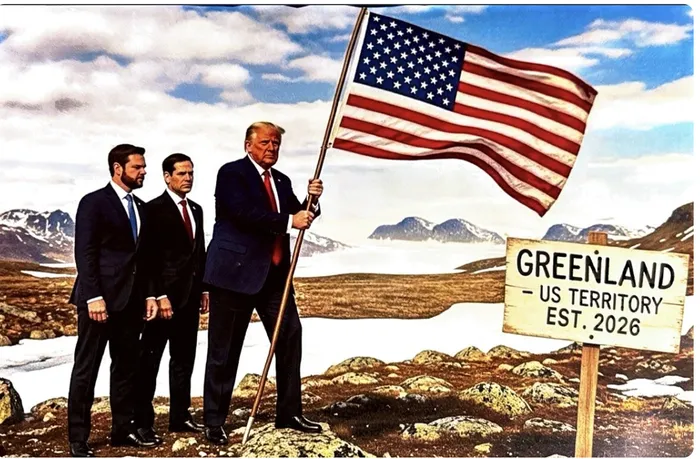
Trump recently posted AI-edited images on his platform Truth Social, one showing an expanded US map that included Canada, Venezuela and Greenland and another depicting him planting an American flag on Greenland, labeled “US territory.”
Image: Trump Truth Social
PROFESSOR DASARATH CHETTY traces the unbroken line of American expansionism from 19th century land grabs through economic imperialism to modern-day Trumpism in 2026. He argues that while rhetoric has changed over time, the fundamental drive to acquire territory, resources, and global influence remains constant regardless of which party holds power.
THE USA is an expansionist state. It has always been one. This history of United States expansionism is often taught as a series of separate chapters, such as Westward expansion, the World Wars, and the Cold War.
However, viewed from the perspective of the Global South in 2026, it is a single, continuous narrative of power.
Whether through the gun, the dollar, or the tweet, the goal has remained constant: the acquisition of territory and resources to ensure American primacy. This is not Trumpian exceptionalism but a consistent historical trajectory of imperial land grabs and hubris, regardless of whether Democrats or Republicans were in power.
So, the sabre rattling we are currently witnessing in the drive to “acquire” Greenland, Venezuelan oil, and even Canada must be viewed in this historical context. Expansionism began not as a “foreign” policy, but as a domestic one.
In the 19th century, the ideology of “Manifest Destiny” provided the moral cover for what was essentially a military land grab. The United States tripled in size in just 70 years, but this growth was built on a foundation of state-sanctioned violence.
The Indian Removal Act of 1830 was the blueprint. It formalised the dispossession of Indigenous nations, forcibly relocating tens of thousands in what became known as the Trail of Tears. This was not a diplomatic move; it was a military expulsion designed to “clear” land for white agricultural and extractivist expansion.
Similarly, the US War on Mexico (1846–1848) was an offensive war of choice that allowed the US to seize 55% of Mexico’s territory, including modern-day California, Arizona, Colorado, Nevada, New Mexico, Utah and Texas.
During this era, expansion was literal: the map was redrawn through blood and iron.
Before these overt acts of aggression against Mexico and genocide against indigenous peoples, the so-called “Louisiana Purchase” from France in 1803 added 15 New states and doubled the size of the United States. The “Alaska Purchase” from Russia in 1867 added a massive expanse of territory and great natural reserves to the US Treasury.
By the 1890s, the continental frontier was declared closed, and U.S. expansionism turned outward. The Spanish-American War (1898) served as the pivot point. Under the guise of “liberating” Cuba, the US acquired its first overseas colonies: Puerto Rico, Guam, and the Philippines.
In the Philippines, the U.S. engaged in a brutal counter-insurgency war to suppress the local independence movement, proving that the “Empire of Liberty” was willing to use the same colonial violence it had once rebelled against in 1776. This period also saw the annexation of Hawaii, where a sovereign monarchy was overthrown by US - backed businessmen to secure a strategic naval and trade outpost.
Following World War II, the method of expansion shifted from “territory” to “influence”.
This is referred to as the Informal Empire. Instead of governing foreign lands directly, the US used its economic might to ensure that foreign markets remained open to American interests.
The Monroe Doctrine was updated for the 20th century: any nation that attempted to nationalise its resources for the common good (like Iran in 1953 or Guatemala in 1954) faced US -backed coups. Diplomacy became “Gunboat Diplomacy” - the threat of force was always present, even if the primary weapons were now the IMF, the World Bank, and the U.S. dollar. This “rules-based order” was expansionism by another name, ensuring that the Global South remained a provider of raw materials and a consumer of American goods.
In 2026, we are witnessing a return to the more overt, transactional expansionism of the 19th century, now described as Trumpism. The current administration’s focus on “acquiring” Greenland, or threatening “to run” Venezuela, or claiming that Canada exists because of the US, is not a departure from history, but a stripping away of the Obamaesque diplomatic politeness that characterised the 1990s and early 2000s; albeit backed up by 750 military bases in 80 countries to project power around the globe without the burden of governance.
Trumpism argues that international institutions, like the UN or NATO, are constraints rather than tools. In the Global South today, the implications are stark:
The “Trump Corollary”: A revival of the idea that the Western Hemisphere is The “backyard” of the U.S., where the U.S. has the right to intervene militarily to stop migration or secure resources.
Transactional Diplomacy: The expiration of AGOA and the imposition of 30% tariffs on South African goods show that trade is now used as a punitive weapon.
Resource Capture: The race for “Critical Minerals” in Africa (cobalt, lithium) is being framed as a security necessity, leading the US to demand bilateral deals that bypass local development needs.
The central argument contained herein is that Trump’s approach is fundamentally the same as his predecessors; only the rhetoric has changed. Former presidents used the language of “spreading democracy”, “humanitarian
Intervention” or “free trade” to justify the expansion of American power.
When Bill Clinton pushed for NAFTA or George W. Bush invaded Iraq, they used high-minded ideals to cover strategic and economic goals. Barack Obama’s “Pivot to Asia” was a strategic expansion to contain China, though it was phrased in the language of “multilateralism”.
The destabilisation of Iraq, Libya, Afghanistan, Yemen and Syria, amongst other sovereign nations, can be viewed through this lens. Trump simply says the quiet part out loud. He does not use the language of “civilising missions” or “global stability”.
He speaks in terms of “deals” and “taking the oil” and “America First”.
While, critics call this a “break” from tradition, the underlying mechanism is identical: the use of American leverage to subordinate the Global
South, and even US allies in the global north, to US interests. Whether a president uses diplomacy or tariffs, threats and violence, the intent is the same.
From the 1830 expulsion of the Cherokee to the 2026 pressures on Iran, Venezuela, South Africa, China, Russia or Greenland, US expansionism has always been about the accumulation of power and real estate. With a real estate mogul in the White House, the Global South today faces a Washington that is less interested in the theatre of international cooperation and more focused on the raw exercise of strength.
The so-called “Board of Peace”, which Trump intends to control for life, is open to US allies at a joining fee of a billion dollars. Invited members will then have a say in the rebuilding of Gaza into a planned playground for the rich, whilst Gazans will be confined to dormitory villages. This should sound familiar to South Africans and to those who know the history of Apartheid and that of the British and Dutch East India Companies.
By understanding that Trumpism is a continuation of a two-century-old project, nations in the Global South can better prepare for a world where “might is right” is clearly the explicit rule of the game.

Professor Dasarath Chetty
Image: File
Professor Dasarath Chetty is the President of the International Sociological Association’s Research Committee on Participation, Organisational Democracy and Self-Management and a Visiting Professor at the Centre for the Study of Childhoods and Societies at the University of Wuppertal, Germany.
** The views expressed do not necessarily reflect the views of IOL or Independent Media.