

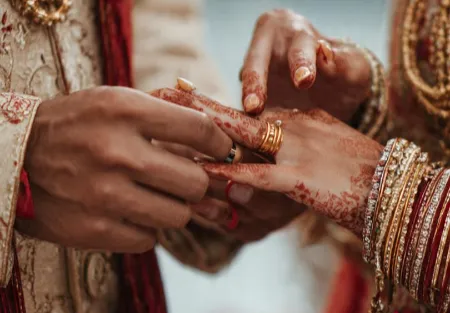
Marriage is the easy part as you are in love, and through the rose-tinted glasses you see that beautiful life ahead of you, says the writer.
Image: Meta AI
I CAME across a plaque-frame years ago which said, “Marriages performed by the Captain are valid only for the duration of the voyage."
This could not be truer when it comes to parties going through matrimonial discord. Parties are happy, content and are able to make decisions together, financial or otherwise while they are together. Somehow the termination of the relationship brings about the change in personalities, the children start belonging to only one spouse, expenses increase exponentially and likewise decrease phenomenally, and so the list goes on.
For those of you who have been in litigious divorces, you know exactly what I mean, as you have experienced some or other “symptoms”.
Most often lawyers will propose settlement at the beginning to save the pain, time and money, and most times either party wants revenge so a settlement is not on the cards, but after years of fighting, being alienated from their children, having spent hundreds of thousands of rand on advocates and attorneys, they accept the settlement that was initially proposed by the lawyers or the other spouse.
Marriage is the easy part as you are in love, and through the rose-tinted glasses you see that beautiful life ahead of you.
Divorce, separation or termination of relationships bring about the worst in people, and this can either shape your life and make you aware of life lessons, or it can erode and destroy who you are. As with everything, we have choices, and the choices you make when you are faced with the prospect of divorce will set the tone for who you will become thereafter and the legacy you will leave for your children.
It can also shape your relationship with your ex-spouse, which is important, especially where you have a long way ahead with your children and commitments. You may have made bad choices in the marriage. This does not mean you cannot change or be better. That said, the legislation also throws curve balls your way.
There are different types of marital regimes, ANC, ANC without accrual, COP, religious marriages, customary marriages, partnerships. There has been a surge in the divorce rate with the Constitutional Court introduced significant changes to the legal landscape surrounding marriages concluded out of community of property without the accrual system. This judgment opened the floodgates for spouses who felt they would leave the marriage with nothing, so they stayed.
What this judgment allowed was for spouses married out of community of property without the accrual to claim for a redistribution of assets despite the marital regime. Many parties who were married Islamically were not only able to claim civilly but where they concluded an ANC without accrual this permitted them to claim for a redistribution of assets.
The Constitutional Court has again delivered a landmark judgment that identifies and protects the rights of parties who entered customary unions, VVC v JRM and Others.
This judgment has invalidated the ANC contracts that are entered into post the customary marriage. Parties who enter into a customary marriage are usually regarded as being married in community of property. The parties were unable to change their matrimonial regime unless they entered into a contract which had to be entered into prior to the conclusion of a civil marriage. What then happened is the party’s civil union was recognised and in the event of a divorce, the parties were entitled to claim under law what the contract specified.
One brave woman with the assistance of her highly competent legal team challenged the validity of this legislation and slated it as being unconstitutional. The high court too examined the argument and recognised some aspects as being unconstitutional. The high court identified that without judicial oversight in respect of the termination of customary marriages and the conclusion of contracts, this created an inequality.
The Constitutional Court however had to deal with the validity of the ANC that was entered into some years after the customary marriage. It also had to look at the impugned provision in regard to an ANC altering the matrimonial regime, and then it had to deal with the constitutional validity of the impugned provision together with finding a remedy.
In 1988, the Black Administration Act was amended to allow partners in a customary marriages to enter into a civil union with each other. This amendment made it possible for a man and a woman in a customary marriage to conclude a civil union, provided that the man was not a partner in another customary marriage with another woman. There were no specific guidelines for the consequences of the civil marriage on the customary union. Many commentators believed that the customary marriage just evolved into a civil marriage with civil law applicability.
It is important to note that SA did not recognise dual marriages. Customary marriages did have some level of protection but in general it was regarded as a union and not a marriage. Section 7 of the Recognition Act deals with the proprietary consequences of customary marriages and the contractual capacity of spouses. It set out the framework where a party could change their matrimonial regime. While this allows a party to change the regime, it did not factor in the proprietary imbalances and focused more on form rather than substance.
Customary marriages could only be dissolved by death or a decree of divorce based on irretrievable breakdown of the relationship. What it did not spell out is what happens to a customary marriage when the parties subsequently enter into a civil marriage. Clearly the legislature did not have regard to this irrespective of it being so fundamental. In customary marriages, the matrimonial assets are only divided at the termination of the relationship unless there is a specific contrary provision. The division of assets unless a contract existed was 50/50. This meant that if a wife married in a customary union then entered into a civil union with a marriage contract, she abandoned her claim for assets accumulated during the customary marriage.
The case before the Constitutional Court involved parties who entered into a customary marriage, who then subsequently registered a civil marriage and signed an ANC with accrual. When they were divorcing the husband wanted the division to be in accordance with the ANC with accrual. The wife stated that they accumulated assets, which were joint property during their customary marriage and as such she cannot be excluded to benefit. At the time that they concluded the civil marriage , the parties did not divide the assets that they accumulated in their customary marriage.
The Constitutional Court found that the signing of an ANC after a customary marriage is invalid and unenforceable, unless proper legal judicial procedures are adhered to. Plainly this means that a customary marriage will have community of property status and is not merely changed to another regime just because parties signed a contract.
The ruling makes the following changes;
This judgemnt has far reaching consequences as those who believe that their subsequent civil marriage protects their assets are in for a rude awaking and clearly the invalidity of their contracts will affect their high-net-worth estates.
There is going to some ongoing debate about the fairness of the ruling. There are also going to be issues that parties at the time of the ANC were aware of its applicability and enforcement now seek benefits. This is something that our courts will have to deal with.
What is remarkable however is the fact that our young Constitutional Court is making such inroads in relation to the rights of individuals. This is to create fairness where imbalances lie. The Constitutional Court has given rights and recognition to those that need it the most. It also highlights the imbalances of the past and the determination to undo such imbalances.
Marriages are easy. What is difficult is dealing with the other factors that come in the mix - money, assets, in-laws, infidelity, children and very often in that order. If people remember the reasons, they exchanged vows and committed to each other and if they placed their love and the ability to do the right thing above greed, then divorces would be a little less acrimonious.
What is fundamental however is that both parties should always have equal power in a marriage so we have to salute our courts when they recognise this and put it right.

Shamla Pather
Image: Supplied
Shamla Pather is director at Shamla Pather Attorneys Inc. She has been in practice for over 26 years and a member of several local and international organisations.
** The views expressed do not necessarily reflect the views of IOL or Independent Media.