

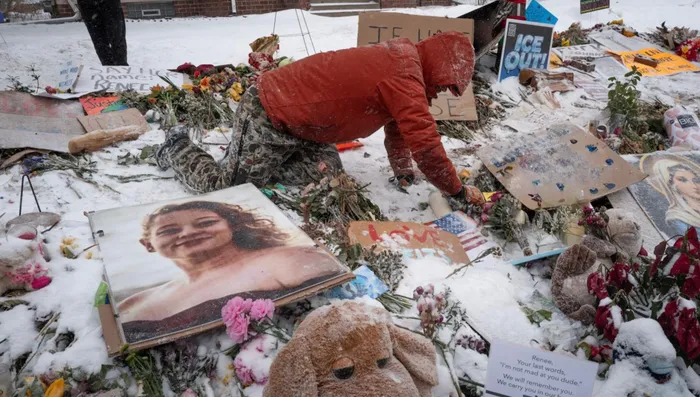
Snow falls as people visit a memorial dedicated to Renee Good in Minneapolis, Minnesota. Anger in the city continues to grow over Donald Trump's administration immigration policy after Good's death on January 7 and the death of Alex Pretti on January 24, both shot and killed by federal immigration agents.
Image: Scott Olson/Getty Images/AFP (Photo by SCOTT OLSON / GETTY IMAGES NORTH AMERICA / Getty Images via AFP)
IN THE quiet cold of Minneapolis, a new, unsettling chapter is being written in American history. What began as protests against federal actions has escalated into a stark confrontation, leading to the tragic deaths of two citizens, Renée Good and Alex Pretti. These events, as highlighted by Kathleen Parker in a recent Washington Post opinion piece, are not just local headlines. They are sparking a profound re-evaluation across the country, potentially uniting a deeply divided nation against a common, unexpected adversary. It's own government.
For decades, Americans have grappled with political divisions that often felt insurmountable. Yet, history shows that shared adversity can forge powerful bonds. Think of the unity that followed the 9/11 attacks – a moment when a common enemy brought people together. Now, Parker suggests, a similar, perhaps even more critical, moment is upon us, with the "enemy" appearing closer to home.
The situation described in Minneapolis is chilling. The city saw what Parker calls a "3 000-strong federal invasion," featuring agents employing "stormtrooper tactics." The immediate trigger for much of the public outcry, and the central tragedy, was the use of lethal force against peaceful protestors. Good and Pretti are now names associated with this profound shift, their deaths fueling outrage and a call for accountability.
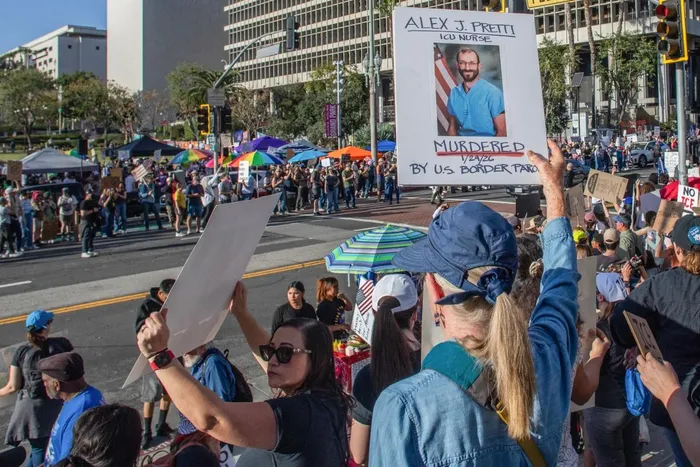
A woman holds a sign with a picture of Alex Pretti, who was killed by ICE agents in Minneapolis, in a protest against immigration in an "ICE Out of Everywhere" National Day of Action follow-up in front of the City Hall in downtown Los Angeles, California.
Image: APU GOMES / AFP
Eyewitness accounts, often captured on citizen cameras, paint a disturbing picture. Masked, armed federal agents, dressed in military-style gear, were seen dragging people from their homes into the freezing streets. Women were reportedly thrown to the ground, and children were detained. Pretti’s death, in particular, drew sharp focus. He was reportedly holding his phone, filming, when agents used pepper spray on him, then beat him, and ultimately shot him multiple times. The sheer brutality described has shocked many, regardless of their political leanings.
The core question reverberating across the country is whether such lethal force was ever justified. Parker, echoing the sentiment of many, states her conviction that it was not. Esteemed columnist George F Will, quoted in the article, even suggests a radical approach: "it is good citizenship to assume that everything ICE says, and everything the administration says in support of its deportation mania, is untrue until proved to be otherwise." This reflects a deep erosion of trust in official narratives, pushing citizens to rely on their own observations and recordings.
Parker’s analysis delves deeper, suggesting that the chaos in Minneapolis isn't random. She ties it to President Donald Trump's second term, hinting at potential political motivations linked to upcoming midterms and even the 2028 election. The theory is that by creating widespread unrest, an "unrestrained president" could justify imposing stricter controls, possibly leading to a wider military presence across the nation. This, she implies, could be a tactic to obstruct the electoral system itself – an echo of the January 6th Capitol incident, which "didn't quite do the trick" in halting democratic processes.
This pattern of behaviour has led some prominent voices to use strong, once-unthinkable labels. Jonathan Rauch, a respected writer for The Atlantic, has now openly described Trump’s policies as "fascism," moving past his previous term, "patrimonialism." Rauch argues that while patrimonialism describes a governing style, fascism is an ideology which is aggressive, revolutionary, and often glorifying violence, driven by a might-is-right worldview.
When one observes armed agents using extreme force against civilians, detaining children, and suppressing protest, the concerns raised by such terms become chillingly clear.
In the face of mounting public outcry, the administration has made some gestures, but these have largely been seen as insufficient. President Trump reportedly "sidelined" Homeland Security Secretary Kristi L Noem, whose dismissive comments, including labelling Pretti, a "domestic terrorist" for filming, only fueled public anger.
Parker suggests that Noem should be "sent home to South Dakota," highlighting the perceived disconnect and insensitivity from official channels.
Additionally, the top Border Patrol commander in Minnesota, Gregory Bovino, was replaced by border czar Tom Homan, who has promised to "draw down" agents in the area. However, Parker dismisses these actions as "cold comfort." For many, the minimum expectation is not just a reduction in force, but full accountability. The article strongly argues that the ICE agents involved in the killings should face charges rather than merely suspensions.
This call for justice is amplified by broader concerns about the White House. There are reports of officials posting "racist and antisemitic coded messages on social media," painting a picture of an administration that, far from seeking reconciliation, seems to thrive on discord. This environment, Parker suggests, means that Trump "likes chaos," seeing it as a means to achieve his "self-serving goals."
Amidst this darkness, however, there are signs of hope, "a slice of light".
The article notes that "the worm seems to be turning."
A significant majority of Americans are now reportedly opposed to what is happening in Minneapolis. The outrage isn't confined to national borders either, with "other countries" filing formal protests and even issuing travel warnings to their citizens considering visits to the US.
Perhaps most significantly, Parker observes that even "some MAGA voters must loathe what they’re seeing".
This suggests that the actions in Minneapolis transcend traditional political divides, touching on fundamental American values of civil liberties and due process. When the government itself becomes perceived as an unchecked power, it creates a common cause that can unite disparate groups.
The arrests of journalists, including former CNN anchor Don Lemon and independent journalist Georgia Fort, while covering anti-ICE protests, further underscore the erosion of freedoms and the urgency of the moment. These actions directly challenge the public's right to information and a free press.
Ultimately, Parker issues a powerful call to action: "America’s partisans, and all of those trapped between, have a common enemy and a unifying mission to stop the madness. It’s time to take a stand."
The events in Minneapolis are not just a local tragedy; they are a pivotal moment, forcing Americans to confront difficult questions about governance, liberty, and who they are as a nation. The hope is that this shared outrage can indeed become a unifying force, compelling the country to reclaim its democratic principles and ensure accountability for those who transgress them.
What do these events mean for South Africa. The Trump Israel axis of international dominance seeks to extend the demonisation of blue states in America to various countries in the world that refuse to bow to President Trump and his personal prime minister, Benjamin Netanyahu.
Venezuela applied for BRICS membership. Their president was kidnapped. Iran is a BRICS plus member, and they are likely to be bombed.
Will South Africa get bombed? Unlikely. However, SA is being attacked from within. Most opposition political parties in South Africa are funded by Israel. Churches are the main target, and Christian Zionism is part and parcel of the Pentecostal theology. Religion, in general, often focuses on differences, although many exceptions exist. South Africa's best prospect of success is our inclusivity in the context of constitutionalism.
This is under attack. Media, religious leaders, and political parties that are explicitly xenophobic and fascist are funded by the same source of evil intent.
We must strenuously navigate together for an inclusive future, which is rooted in our Constitution.

Roshan Jainath
Image: SUPPLIED
Roshan Jainath is a writer and community activist.
** The views expressed do not necessarily reflect the views of IOL or Independent Media.