

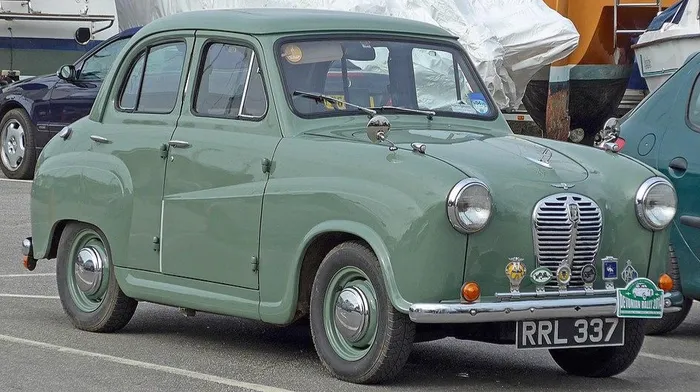
The writer yearns for an Austin A30 like this one.
Image: https://en.wikipedia.org/Tim Green
CALL it age, call it sentimentality, but I’ve always had a soft spot for stories of yesteryear. My daughter, very much a child of the modern age who lives in a world of streaming playlists, smartphones, and instant everything, chides me for too often harking back to the way things were.
“Boring Pa; you’ve told me this story so many times before,” is her recurrent refrain.
But in a fast-paced, often stressful world, looking back offers me a mental escape. Revisiting the past feels safe and familiar compared to the uncertainty of the present. For me there’s something irresistible about recalling the satisfying click-click of a rotary phone, the rhythmic clatter of a typewriter that accompanied my first steps into journalism, or the ritual of rewinding a cassette tape with a pencil.
Recalling these stories aren’t just entertainment; they’re little time machines that carry us back to moments when life felt slower, warmer, and somehow more vivid. They remind us of where we’ve come from, and in doing so, they add richness to where we are today.
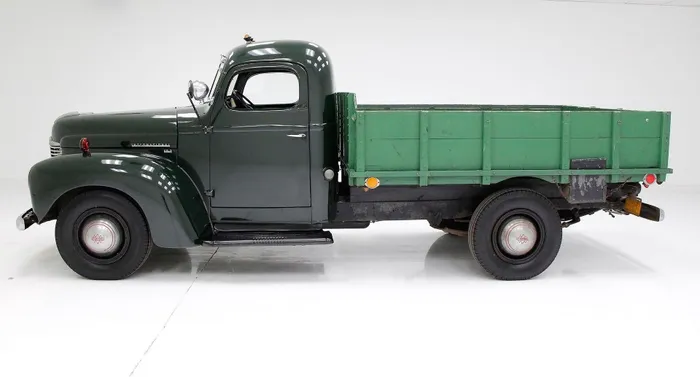
The writer says his uncle had an International KB lorry similar to the one in his photograph.
Image: Supplied
Thus, when my friend Jay Naidoo from Melbourne, Down Under, sent me photos of his family’s old cars from decades ago when he lived in Asherville, the inspiration for this column flowed effortlessly. Nostalgia has a way of sneaking in through the smallest details - whitewall tyres, the sweeping fin tails of a Chevy, and gleaming chrome hubcaps - not just car parts but statements of an era and symbols of pride and personality on four wheels.
Thinking back about cars of yesteryear stirs feelings, connects generations and sparks memories of people who have passed on and places long forgotten. My earliest recollection of a vehicle is a dark green International KB lorry - we never heard the word “truck” then - that was owned by my paternal uncle. It was used to carry bananas from our farm to the market. When I was growing up in Cavendish - a part of old Chatsworth – most farmers owned the International KB series lorries and almost all were painted a dark green and had a wooden load bin.
My siblings and I would romp in the thick carpet of dried banana leaves at the back, our laughter rising above the steady rumble of the lorry. Each bump in the road sent us tumbling into one another as the vehicle swayed from side to side as my uncle carefully negotiated potholed dirt tracks. Heady from the faint sweetness of the leaves that I can still recall, for us children those short rides were pure adventure.
Farmers also used their trucks to take their families and workers - and metal biscuit containers of Jutland sardine sandwiches and andas (large cooking pots) of chicken breyani - for the annual picnic at the beach in Isipingo, Park Rynie or Umkomaas. Cars today are sleek computers on wheels, equipped with digital dashboards, autonomous driving aids like parking assist, 360-degree cameras and lane control. Yet, for all the convenience and innovation that come with a hefty price tag, there lingers a wistful affection for the machines of yesterday.
The smell of gasoline, the clatter of a stick shift, and the artistry of handcrafted interiors evoke a romance that technology can never fully replace. Little wonder then that Cars in the Park expos are so popular around the world.
A few days ago, my car battery went flat. It was just over two years old. There was a time when a car battery lasted at least 10 years. Car tyres also lasted forever. When the rubbers eventually became bald, retreading the tyres was mandatory for those who could not afford new wheels. Back in the day, car bench seats that stretched across the front row were so ridiculously roomy that after a Saturday night of wining, dining, and dancing at the Himalaya Hotel, Gaysands or Island Hotel, they doubled as canoodling couches - and some folks even started families in their sedans.
Anybody out there by the name of Zephyr or Zodiac?
While today’s cars are packed with advanced gadgets, many features that once defined the driving experience have quietly disappeared. How I miss the quarter glass or vent windows that my lime green VW Beetle had. The small triangular windows could be pivoted open to let in fresh air and flick our cigarette ash. Automatic climate control has replaced this lovely feature. Most cars had manual door locks and crank windows. Decades ago, remote door locking was, actually, a remote idea. A driver had to use a key in the door, manually push or pull locks and roll windows with a crank. Today all cars, even the teeny-weeny budget models, have remote and central locking and power windows.
In the early '60s, my mother and I would travel often in long, spacious taxis from Durban to holiday with my grandparents in Pietermaritzburg. Adult fare was R1 and half price for under 12s. The Dodge, Plymouth and Chevrolet were the most popular taxi models and some had special in-car record players made by Philips. The turntable sat on springs to smooth out bumps so that the record stylus did not jump from the Beatle’s A Hard Day’s Night to Hey Jude. Later music lovers carried boxes of eight-track tapes and cassette tapes for in-car music.
I remember the eight-track system in my car gave rich, immersive audio that gave a powerful sense of presence. The “Mohammed Rafi Live in SA” two-set tapes, the “Pithukuli Murugadas Live in SA” recording and the Elvis Presley, Roger Whittaker and Bee Gees albums offered continuous play but the cartridges were bulky. Then followed cassettes that were smaller in size; CDs and MP3s with better sound quality; USBs that stored loads of music and had recordability; and today’s Bluetooth streaming with Spotify.
The cars of yesteryear had glossy paint finish. Metallic colours came much later. Elegant chrome accents and timeless hood ornaments enhanced the allure of vintage automobiles. Today, streamlined, aerodynamic designs with subtle branding dominate. Thus, even the sun visor which extended outward from the front edge of the car’s roof, just above the windshield and resembling the brim of a fedora pulled low, is now a relic of a time when cars oozed personality.
Classic dashboards featured analogue clocks and rolling-number odometers. They were less precise and harder to maintain; thus digital clocks and infotainment screens with outside temperature and fuel cruising range are now the standard feature. Car owners often struggled with carburettor and distributor problems. The carburettor filter would clog, the needle and seat tended to stick, and the distributor’s points and condenser frequently caused trouble. Inefficient fuel delivery has seen the electronic fuel injection system knock the carburettor off its pedestal.
Drivers once had to manually adjust fuel-air mixtures with a choke knob or crank engines by hand when the starter misbehaved. Modern motoring is effortless - pushbutton ignition and automatic fuel management work flawlessly and have sadly put many backyard mechanics out of their jobs. Drum brakes with brake linings have been replaced with discs and brake pads, giving more efficient and safer braking. Cars used to go in for a lube service when grease would be pumped into nipples on suspension joints. Missed lube services resulted in costly car repairs.
Today the joints come lubricated for life. Few cars today carry a full-size spare tyre in the boot. The added weight reduced fuel efficiency. To ensure space-saving and ensure less weight, a narrow spare tyre – often referred to as a Marie biscuit tyre - and run-flat tyres come in most of today’s cars. Once a mark of elegance, whitewalled tyres are long gone from everyday roads and today they linger only on some lovingly maintained minibus taxis, echoes of a bygone motoring era.
When he was Minister of Health, Dr Aaron Motsoaledi, strengthened tobacco control laws, including regulations that prohibited smoking in private vehicles when children under 12 were present. Thus cigarette lighters and front and rear ash trays reflecting the prevalence of smoking, were snuffed out in keeping with the decline in smoking culture. The modern replacement are USB charging ports and cup holders for coffee addicts.
Before indicator lights became standard, cars relied on charming little arms. Mounted on the centre post, they would pop out to the right or left, a quaint mechanical gesture announcing the turn ahead. Gone too are pop-up headlights that folded into the body. Mechanical failures caused them to be replaced by LED and adaptive headlights. Cars of yesteryear were defined by simplicity, personality, and mechanical ingenuity.
Modern vehicles, by contrast, emphasise safety, efficiency, and digital integration. While progress has brought undeniable benefits, nostalgia for the lost features of classic cars makes me wish I win the LOTTO one day so that I can buy an Austin A30 or Ford Anglia with the reverse-rake rear window. Yes, technology may have reshaped the road, but the time when driving felt raw, imperfect, and deeply human still steers my heart.

Yogin Devan
Image: File
Yogin Devan is a media consultant and social commentator. Reach him on: [email protected]
** The views expressed do not necessarily reflect the views of IOL or Independent Media.