

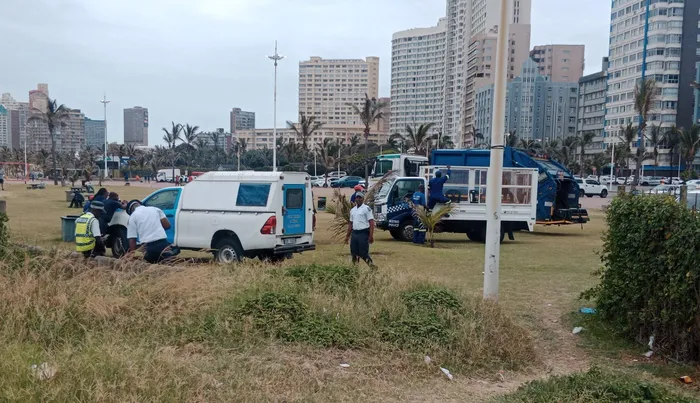
Law enforcement units and the local Community Policing Forum conducted an enforcement operation in the sand dunes where they uncovered illegal dwellings being used as a hideout for criminals. “We found that hidden dune settlements were being used as hideouts for criminals, posing a danger to residents, visitors and tourists. Authorities have since conducted enforcement operations, uncovering makeshift living structures in the dunes. The dunes had effectively become living spaces.
Image: Supplied
THE POST recently reported on a local businesswoman who was violently assaulted and robbed while walking along the beach near Suncoast. It was a shocking story. But it is also one that can be a reminder of the virtue in our city as well as the vice.
The woman involved, reflecting on the incident a few weeks later, spoke to me not just about the one criminal who attacked her but also "the many angels" who came to her rescue: the security at Suncoast who gave her a safe space to recover and protected her car; the medics there who tended to her wounds; the medics at Casualty at St Augustine’s Hospital who patched her together again; and even the staff at MTN who sorted out her SIM swap.
She wanted to make the point that, when re-telling an incident like this, it was too easy to highlight the bad guy – and suggest that there is a whole army of bad guys – and fail to credit the good guys as well.
I was able to hear this first hand because the woman concerned in the incident happens to be a dear friend of mine – indeed she was at my flat for dinner last week before I realised that the article was about her! Preferring to remain anonymous, it is worth noting that she is no innocent who runs scared of the city. She is active, involved and a vital part of the fabric of Durban, and her business is a great contributor to the life of the city. She has also been a loyal supporter of the Denis Hurley Centre.
This is relevant because the temptation, with an incident like this, is to blame “the homeless”. It is true that there are homeless people living in the sand dunes. But the woman concerned admits that she cannot be sure if her assailant was a homeless man or just someone who was using the dunes as cover for his crimes. But even if the person was a homeless man, that does not mean that all homeless people are criminal.
Of course, some of them are – and so are some business people, some police officers, some city officials, and indeed some faith leaders. The temptation is to tar everyone with the same brush. But I know from interacting with homeless people in Durban, every day for the last 11 years, that many homeless people are themselves victims of crime – they get robbed by other homeless people, they get exploited by unscrupulous local businesses, they are violently assaulted by the police.
Painting one group as saints and another as devils achieves nothing – unless you are just looking for a scapegoat to blame all your problems on. Incidents such as this one on North Beach, or the rise in begging on street corners, or the problems with the informal settlement at the bottom of Che Guevara Road tend to fuel a generally bad perception of homeless people. And sometimes police officers, politicians and keyboard warriors are then tempted to blame the homeless for all the ills in the city.
As an unexpected counter to processing all these stories, I was greeted in the car park at the Atrium last week by a young man in a smart security uniform. "Morris" reminded me that he had been a homeless man eating at the Denis Hurley Centre. We had secured him a spot as a car guard at the Atrium, and he had now, through his own efforts, upgraded himself to a qualified uniformed, formally employed security guard.
It is only one example. But it is a not a game of numbers: which is the larger group? the homeless people capable of transformation or the ones set on playing havoc with our lives? We could ask the same question of our politicians. But to write off all homeless people as criminals or good-for-nothings is to fall into the same trap of racism or sexism or tribalism that dismisses a whole group of people based on general and unsubstantiated judgements.
It is true that we have a problem with homelessness in Durban. Does that mean that we have a problem with homeless people? Yes and no. We do have a problem with people who rob, who assault, who dirty our streets – and some of them are homeless, and many are not. And there are also many homeless people who do not do those things. They may well be living in places where we do not want them to – whether it is sand dunes or street corners – but in Durban do they have an alternative?
Most Metros around the country provide or subsidise shelters for homeless people – eThekwini does not. Many Metros have invested in creating Safe Open Sleeping Spaces for homeless people in their CBDs. But since Covid-19, eThekwini has been reducing its investment in these, despite actually promising to scale them up. The Metros that actually want to make a lasting difference to their homeless situation spend money on social workers, rehabilitation programmes and harm-reduction initiatives: eThekwini spends money on dispersing people who just end up somewhere else (or in the same place again a few days later).
They do that when the public are outraged – as (justifiably) after my friend’s assault – and say "something must be done". Indeed, something must be done. And something can be done which is constructive, which actually addresses the underlying problem. But a futile knee-jerk reaction is not what is needed. I am pleased that the Mayor, Honourable Cyril Xaba, has indicated that he is open to learning from other cities about solutions that have actually worked. And we can also learn from what has worked in Durban in the recent past.
I recall a senior officer at Metro Police telling me after Covid-19 how pleased he was that the emergency shelters were continuing as Safe Open Sleeping Spaces.
“Finally, when we move people, we actually have somewhere to move them to,” he said.
He recognised at that time that you do not solve a problem by scapegoating people; you solve it by working with them and finding a solution that is good for all parties.
Mayor Cyril Xaba will be a guest of honour at the Denis Hurley Centre Annual Stakeholders Meeting on Saturday, February 14, at 2pm. All are welcome! Contact [email protected]
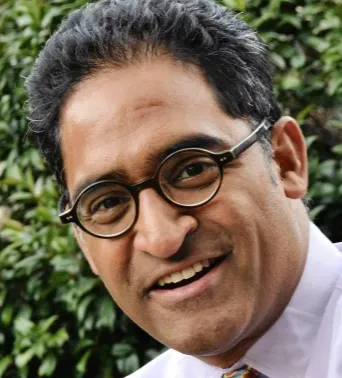
Dr Raymond Perrier
Image: Supplied
Dr Raymond Perrier is Director of the Denis Hurley Centre in Durban, and Chair of the National Homeless Network.
** The views expressed do not necessarily reflect the views of IOL or Independent Media.