
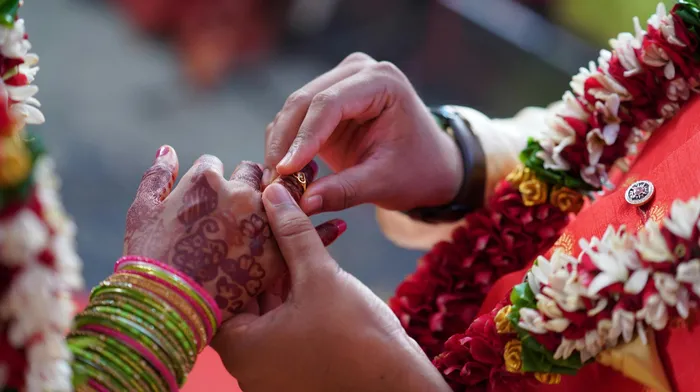
SOUTH Africa's failure to legally recognise Hindu marriages is a lingering legacy of apartheid that continues to harm women and families within the Hindu community.
Image: Vinod puli/Pexels.com
SA's failure to legally recognise Hindu marriages is a lingering legacy of apartheid that continues to harm women and families within the Hindu community. As the country undertakes comprehensive marriage law reform, SIMI SHARMA examines how the proposed New Marriage Bill aims to rectify historical injustices and finally provide equal legal protection to Hindu spouses.
IN SOUTH Africa, three forms of marriage are currently recognised in law: civil marriages, civil unions and customary marriages.
Hindu religious marriages, however, remain outside the scope of statutory recognition. Legal scholars and case law consistently highlight that the absence of recognition disproportionately harms women who marry solely according to Hindu rites, as they are denied the full range of protections available under registered civil or customary regimes.
The roots of this legal exclusion lie in apartheid-era policies, where Christian norms were positioned as the benchmark for valid marital institutions. Hindu marriages were deemed incompatible with these norms, resulting in their systemic exclusion. This structural inequality continues to affect Hindu spouses – particularly those from Indian communities historically subjected to discrimination, economic marginalisation and legal invisibility.
The consequences of non-recognition are profound. Because Hindu spouses are not legally acknowledged as “wives” or “husbands” under current law, they face significant obstacles in accessing marital rights related to divorce proceedings, inheritance, spousal maintenance, pension benefits and matrimonial property. This has been especially detrimental for Hindu women, who face heightened vulnerability in cases of marital breakdown or spousal death.
To address these inequities, South Africa is undertaking comprehensive marriage law reform to create a unified, inclusive marriage statute. This reform process seeks to replace the currently fragmented legal framework – comprising the Marriage Act 1961, the Civil Union Act 2006 and the Recognition of Customary Marriages Act 1998 – with a single consolidated statute.
The proposed New Marriage Bill, alongside the pending Marriage Act Amendment, signals a decisive move toward full legal recognition of Hindu marriages.
The South African Hindu Maha Sabha (SAHMS) has played a central role in this reform process. Since November 2020, the SAHMS has formally engaged with the Department of Home Affairs, submitting detailed representations outlining the legal, cultural and religious implications of excluding Hindu marriages from statutory recognition.
Their participation forms part of a broader constitutional project aimed at achieving equal treatment of religious communities within family law.
Another key component of the SAHMS's submission concerned the training, examination and registration of Hindu marriage officers. The SAHMS noted that priests who solemnise Hindu marriages often faced bureaucratic obstacles in becoming legally authorised marriage officers under the current regime. These difficulties result in Hindu couples being required to undergo a second civil ceremony at Home Affairs in order to have their marriages legally recognised, even after marrying religiously in a temple.
The SAHMS argued that such a requirement placed Hindu religious practices at a disadvantage compared with Christian denominations, where authorised pastors were allowed to solemnise a marriage that was immediately valid in civil law.
The submission urged the state to create a more coherent and equitable system for authorising Hindu priests as marriage officers, thereby eliminating the duplication of ceremonies and affirming equal respect for Hindu religious rites.
Currently undergoing public consultation and parliamentary review, the New Marriage Bill expressly seeks to recognise all marriages – civil, customary and religious – Including those historically excluded, such as Hindu marriages. The bill promises to provide equal legal protection for inheritance, property rights, dissolution and maintenance.
Its overarching aim is to eliminate the disparities that have long disadvantaged Hindu spouses, and to harmonise marriage regulation within a single modernised statute.
A key feature of the bill is its emphasis on parity across all forms of union, irrespective of religion, culture, gender or sexual orientation. The bill proposes a uniform system under which traditional and religious leaders – Hindu priests included – will be eligible to apply for designation as marriage officers, subject to appropriate training.
Once designated, a Hindu priest will be able to solemnise a marriage that is automatically legally valid, eliminating the need for dual registration and avoiding the costly litigation that some couples faced when seeking to prove the validity of their union.
While Hindu marriages in South Africa are predominantly monogamous, the bill includes explicit provisions for religious or customary marriages involving multiple spouses. It defines how matrimonial property systems, maintenance obligations, and dissolution mechanisms will apply across such unions, ensuring legal clarity and consistency.
The longstanding non-recognition of Hindu marriages has resulted in tangible and often severe harms, especially for women who have been denied marital protection by virtue of statutory exclusion. The New Marriage Bill and associated legislative reforms – expected to be finalised by the Constitutional Court’s deadline of June 27 this year – are designed to remedy these constitutional shortcomings by recognising religious marriages, including Hindu marriages, on equal footing with civil and customary marriages.
The reforms include detailed provisions on designation, registration, matrimonial property regimes and dissolution processes.
As South Africa transitions toward this unified marriage system, courts and policymakers must ensure that Hindu spouses receive immediate and practical legal protection during the reform period. Only through such measures can the state fully realise the constitutional commitment to equality, dignity and non-discrimination in family law.
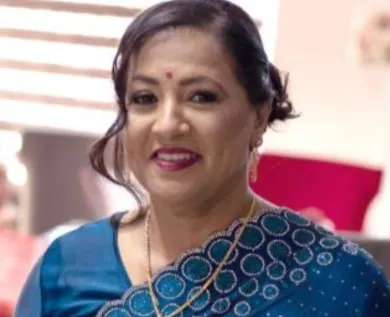
Simi Sharma is the Chairperson of the South African Hindu Maha Sabha's legal team.
Image: Supplie
Simi Sharma is a practising attorney and Chairperson of the South African Hindu Maha Sabha’s legal team.
** The views expressed do not necessarily reflect the views of IOL or Independent Media.