

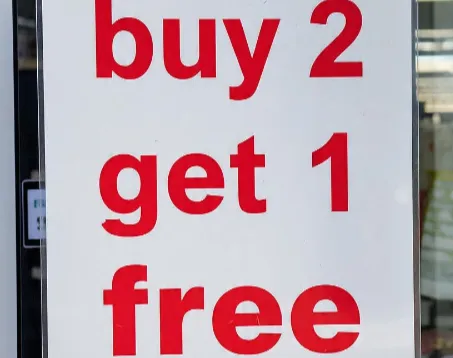
Shoppers are forced into multi-buys – buy two, buy three, buy more than you need, says the writer.
Image: Meta AI
MY WIFE sent me to the supermarket with the simplest of instructions: pick up some salad stuff. A bunch of carrots, a head of lettuce, two tomatoes – that was the list. I came back, however, not with a modest bag of greens, but with enough produce to stock the salad cooler at the local branch of Nando’s. Why? Because in order to qualify for the discount, I had to buy three bunches of carrots, three heads of lettuce, and three kilograms of tomatoes.
Instead of feeding my family, I’d bought enough to keep a rabbit colony happy for a week. Supermarkets call it savings. I call it forced waste. Waste of money that can well be used for other necessities. And waste of food that spoils if kept for some time. This is the new reality in South Africa’s supermarkets. Discounts are no longer offered on single items. No more can you find “1kg Tastic rice was R40, now R30”. Instead, shoppers are forced into multi-buys – buy two, buy three, buy more than you need.
Globally, this is part of a retail playbook.
In the UK, regulators have warned that multi-buys encourage food waste and mislead consumers. In the US, “buy one, get one free” has morphed into “buy two, save 20%”, shifting the burden on to shoppers. In South Africa, chains like Pick n Pay, Spar, Shoprite and Woolworths are adopting these tactics wholesale, aligning with international strategies that prioritise basket size over affordability.
The same sleight of hand is entrenched in travel. Holiday packages and hotel specials are almost always quoted “per person sharing”. That means the advertised rate assumes you’re sharing a room. If you’re single? Then you must pay a “single supplement” which is often 30% to 50% more for the privilege of not sharing. If you don’t want to share? Tough luck. The advertised deal was never meant for you. It’s absurd enough to make you wonder: must you start speed-dating just to qualify for a weekend getaway discount at Sun City or a MSC sea cruise to a Mozambican island?
This pricing model emerged internationally as hotels sought to maximise occupancy and make packages look cheaper in marketing campaigns. A weekend getaway advertised at “R1 500 per person sharing” sounds affordable, but only until you realise it’s R3 000 for the room, and even more if you’re alone.
And then there’s Facebook Marketplace, where second-hand car sellers have perfected their own brand of marketing trickery. I cannot believe some car sellers' audacity to think they can make certain claims and get away with it, such as “doctor’s car”. Immaculate, thanks to a maintenance budget funded by your last check-up bill, paid jointly by medical aid, gap cover, and whatever was left of your savings account.
“One lady owner.” Though the car’s bumpers suggest she thought parking bays were bumper-car arenas such as at old Newton’s Amusement Park on Durban’s beachfront. “Aircon blows ice cold.” Oh sure – so “ice cold” you’ll think you’ve accidentally booked a road trip through Antarctica. “Engine never been touched.” Untouched by mechanics, tools, or even hope. “Sunday car.” True – it only ran on Sundays, but every trip was to church via gravel roads, and that too after being repaired on all the other days.
“Accident-free.” Unless you count the number of times it kissed a light pole, a gate, and a shopping trolley. “Low mileage.” Low only when stacked up against a minibus taxi that’s run between Empangeni and Durban twice daily since 1994. “Needs minor TLC.” This actually means bring a priest, a mechanic, and possibly a tow truck. “Collector’s item.” Yes, because no one else wanted to collect it. “Urgent sale.” Urgent, because the gearbox is plotting its escape and the licence registration disc is a week away from expiry.
Scrolling through car ads sometimes feels less like car hunting and more like reading bad fiction. Do sellers really think buyers are gullible enough to fall for their creative writing? The way they describe these vehicles, you’d swear they were auditioning for a literary prize rather than trying to offload a clapped-out VW Golf that’s clocked more mileage than a Takealot courier van, been patched up with duct tape after every fender-bender, and rattles like a toolbox in the boot on a Chatsworth road.
South African consumers deserve honesty. Discounts should apply to one item, hotel rates should reflect the cost of a room, and car ads should tell the truth. Who needs three bags of carrots? Much of it ends up in the bin. Lower-income households, already stretched, can’t afford to spend more upfront just to unlock savings. The “discount” often masks a quiet price hike on single units. Discounts should reward frugality, not force excess. The death of the single-item discount is not progress, but sheer exploitation. There is no generosity on the part of supermarkets – it's manipulation, dressed up as marketing.
And consumers are being taken for a ride. The more I see shoppers being ripped off, the louder I kick and complain. My wife insists I’m rude, that I pick fights everywhere, and that the store manager is just following orders from head office. Maybe so, but I couldn’t care less if I’m a nightmare to shop with. Better difficult than duped. I purchase two bunches of roses (one red) every week of the year from a store whose name is shortened to what we wear in winter. But I will not do so in the week leading up to Valentine’s Day because I will not be exploited.
Last week the price of a bunch of the best red roses, usually R200, blossomed into R300. A 50% jump? Outrageous. I’d sooner prove my love the other 51 weeks than the one week when retailers turn romance into daylight robbery. Another marketing trick is the endless redesign of product holders. Every few months, manufacturers tweak the bracket just enough so you’re forced to buy the whole kit again instead of a simple refill.
Car air fresheners are the classic example: the first time, it’s R40 with the holder; refills are R30. Then, surprise, surprise, the refills change, the old bracket is useless, and you’re back to spending R40. It’s daylight robbery dressed up as innovation. Honestly, there should be a law against this. The time has come to break free from marketing tricks that chain us. Why should we play the obedient slaves of retail spin? Why should anyone be bullied into buying three packets of carrots when one is plenty?
Until retailers abandon their gimmicks and return to fair, single item discounts, the public will keep footing the bill, quite literally. It’s time to push back. We demand fair play. One packet of muffins should qualify for a deal. One tin of baked beans should be priced honestly and transparently. Every shelf should show the true cost per item, so consumers can see whether multi-buys are genuine savings or smoke and mirrors.
Award-winning consumer journalist Wendy Knowler has called for this many times. Do marketers ever listen? Internationally, regulators have already raised alarms. In the UK, watchdogs have warned that multi-buys fuel food waste. In Europe, unit pricing transparency is mandatory. South Africa must follow suit. Now. Because at the end of the day, this isn’t about carrots, rice or roses – it’s about respect. Respect for the shopper’s pocket, respect for the shopper’s intelligence, and respect for the shopper’s right to choose. One item. One discount. One fair deal. Anything less is exploitation dressed up as marketing theatre. And consumers – and I – have had enough.
** The views expressed do not necessarily reflect the views of IOL or Independent Media.