

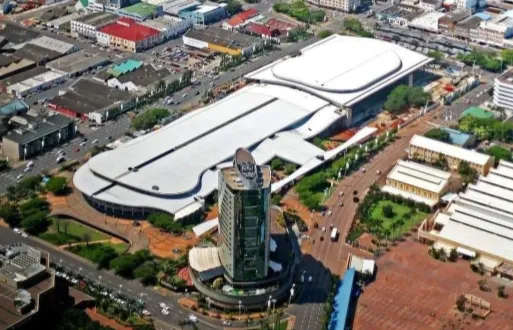
The Durban ICC and Hilton Hotel were strategically located.
Image: Supplied
DURBAN'S tourism and the business event sector faces a significant setback following the severing of ties between the Hilton Durban and the Hilton international group.
For decades, the Hilton brand represented stability, prestige and logistical certainty for global conference organisers, multinational corporations, heads of state, and international delegations visiting our city.
Its proximity to the Durban International Convention Centre (ICC) made it an indispensable component of Durban’s business tourism ecosystem.
The implications of this development extend far beyond the loss of a hotel flag. It directly affects Durban’s competitiveness in the global Meetings, Incentives, Conferences and Exhibitions (MICE) market.
The Durban ICC and the five-star Hilton Hotel were never accidental developments. They were products of strategic foresight under the ambitious Operation Jumpstart initiative of the early 1990s. Operation Jumpstart emerged around 1990 and became particularly active between 1992 and 1998. It was conceived during a critical period of political transition and economic uncertainty.
In 1990/1991, leaders from business, civic organisations and political structures began structured dialogue to reposition Durban’s economy after years of instability. By 1992, this coalition formally established Operation Jumpstart to craft a shared development vision for the city.
The initiative was driven by three core imperatives:
One of the most significant outcomes of this vision was the development of the Durban ICC.
Constructed on the site of the former Old Fort Prison, the ICC broke ground in November 1994 and officially opened on August 8, 1997. It was conceived not merely as a building, but as an economic engine.
The ICC repositioned Durban as a global conference destination. Crucially, its success depended on complementary infrastructure – including world-class five-star accommodation within walking distance. The Hilton Durban fulfilled that role. Together, the ICC and Hilton enabled Durban to attract and successfully host major international events, including:
World Conference Against Racism (UN WCAR / Durban I)
August 31 – September 8, 2001
Approximately 18 000+ delegates
XIII International Aids Conference (2000)
July 9 – 14, 2000
Approximately 12 000 delegates.
XXI International AIDS Conference (2016)
July 18 – 22, 2016
Approximately 18 000 delegates.
17th UN Climate Change Conference (COP17 / CMP7)
November 28 – December, 2011
Approximately 15 000 to 20 000 participants.
World Economic Forum on Africa (2017)
May 3 – 5, 2017
Approximately 1 000 high-level delegates from over 100 countries.
ITU Telecom World 2018
Approximately 8 000 delegates.
Africa’s Travel Indaba (annual flagship event)
Approximately 10 000 participants in peak years.
United Cities and Local Governments Congress (2019)
Approximately 3 000 delegates.
Durban also hosted the 5th BRICS Summit (2013), the 2010 Fifa World Cup preliminary draw, and major international sporting and diplomatic events. The logistical, security and accommodation requirements for such gatherings are exacting. In many cases, world leaders and senior executives were based at the Hilton due to its security configuration and immediate adjacency to the ICC. The Hilton was not simply a hotel; it was a strategic asset.
Operation Jumpstart’s legacy extended beyond the ICC and Hilton. It laid the groundwork for:
The ambition at the time was bold: to stimulate sustained economic growth (targeting up to 8% annually) and generate large-scale employment in a city confronting structural unemployment. Perhaps more importantly, Operation Jumpstart shifted Durban from fragmented planning to co-ordinated strategy. It demonstrated that collaboration between public and private sectors could produce transformational infrastructure and long-term investor confidence.
The loss of the Hilton brand sends a signal – and perception in global market matters. International event organisers assess destinations based on a matrix of criteria:
Durban still possesses a world-class ICC. However, the absence of a flagship five-star hotel brand within immediate proximity weakens our competitive proposition. In the Mice industry, perception can determine whether a city makes the shortlist.
This moment calls for more than short-term fixes. It calls for strategic renewal. Durban requires a new Operation Jumpstart – adapted to contemporary realities, but grounded in the same principles:
The original Operation Jumpstart emerged during a period of profound uncertainty. Yet, it delivered tangible results because leaders across sectors chose collaboration over fragmentation. Today, Durban faces economic pressures, infrastructure challenges and intensified competition from other cities. But the fundamentals remain strong: a globally-recognised convention centre, a strategic port, a major international airport, and a city with proven capacity to host the world.
What is required now is leadership, urgency and co-ordinated action.
The Hilton Durban must be reopened as a five-star international-standard establishment sooner rather than later. Our conferencing ecosystem depends on it. Durban has done this before. We can do it again. The time for another Operation Jumpstart is now.
** The views expressed do not necessarily reflect the views of IOL or Independent Media.