

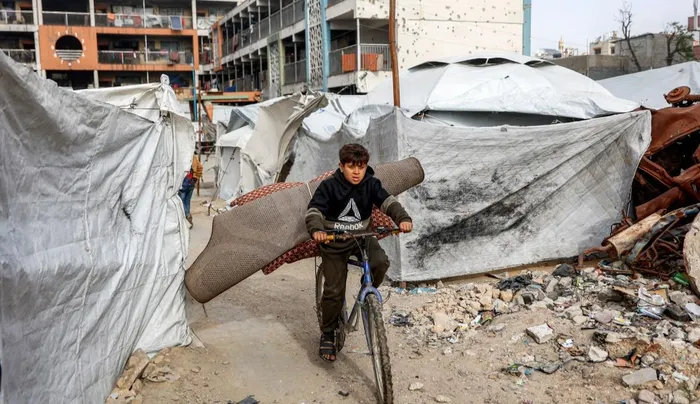
A BOY rides a bicycle loaded with carpets and mats past tent shelters at a makeshift camp for people displaced by conflict in Al-Rimal school run by the United Nations Relief and Works Agency for Palestine Refugees in the northern Gaza Strip.
Image: OMAR AL-QATTAA / AFP
THERE is a dangerous habit in modern discourse, which is the reflexive accusation of being "anti-Semitic" against anyone who dares to criticise the state of Israel. It is a tactic designed to shut down conversation, conflate people with a government, and shield policy from scrutiny. As a human being, first, I refuse to accept this conflation.
I write this because I believe we are witnessing a genocide in Gaza, and I refuse to remain silent. Let me be absolutely clear. If the International Court of Justice (ICJ) eventually rules that Israel has indeed committed genocide, I must ask: will my dearest Christian friends who confuse the Christian faith with the modern state of Israel apologise to the victims? Surely, opposition to genocide is a moral stance. It is a stance rooted in the very faith we profess.
Father Bishop Neil Frank, a bishop of the Catholic Church in South Africa, expresses this profoundly. He reminds us that his Lord and Saviour, Jesus Christ, was a Jew. He prayed as a Jew, taught as a Jew, and worshipped the God of Abraham. To claim that hating Jews is compatible with following a Jewish Jesus is an absurdity. I cannot hate Jews. But I do hate the killing of children. These two things are not the same, and insisting that they are does a disservice to the integrity of Jewish tradition, which holds life as supremely sacred.
This leads us to a necessary conversation about Zionism which is a political ideology. It is not a religion. The word itself has become a grenade, thrown in arguments to wound rather than to illuminate. We must be capable of nuance. If Zionism simply means the belief that Jews, having faced two millennia of persecution and the unimaginable horror of the Holocaust, deserve a safe haven, then Zionism is not wrong. Why should Jews not have a refuge? Why should they not determine their own destiny? That aspiration, in its essence, is not immoral. However, we must distinguish between aspiration and implementation. If Zionism is practised in a way that requires the theft of land and the ethnic cleansing of a people who lived on that land, then we must call it a grave injustice, which it is.
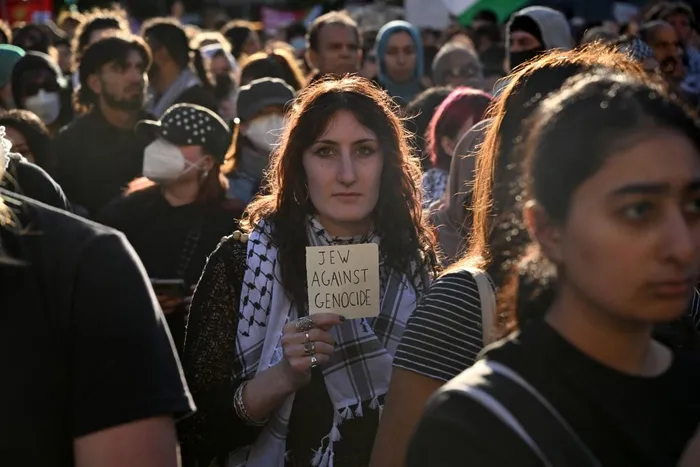
A protester holds a small sign as they march with others during the visit of Israel’s President Isaac Herzog in Melbourne.
Image: WILLIAM WEST / AFP
Occupation is wrong. The denial of self-determination to Palestinians is wrong. And genocide, regardless of who commits it or who the victims are, is an absolute evil. We do not honour Jewish safety by making Palestinians unsafe. We do not honour the memory of the Holocaust by repeating the dynamics of displacement. This brings me to a wound that runs deep. Judaism is a beautiful religion. Its teachings on justice, law and charity have enriched the world. The Holocaust – the Shoah – was real. It was not a political metaphor. It was the systematic, industrial murder of six million human beings. From that hell, emerged survivors who rebuilt lives, wrote testimonies, and taught the world about resilience.
Elie Wiesel, Viktor Frankl and Anne Frank are not political tools. They are witnesses to human darkness and human hope. They inspire a belief in the human spirit, and they personified a spiritual spark that defined their resistance. Having said that, the Holocaust must not be abused. When the memory of gas chambers is invoked to justify the bombing of refugee camps, something has gone terribly wrong. When the starved bodies of Bergen-Belsen are used as moral cover for the starvation of civilians in Gaza, we have inverted the lesson entirely. The lesson of the Holocaust is "never again" for anyone. It is a universal vow, not a selective one.
To weaponise the suffering of Jewish ancestors to justify the suffering of Palestinian children is a desecration of their memory. I do not say this lightly. I say this because I believe that if we do not hold to universal standards, our morality is merely tribal. What is lacking in this world is what I can only describe as love consciousness. We have data consciousness. We have security consciousness. We have nationalist consciousness. But we are starving for a consciousness rooted in love. This is not sentimentality. It is a prerequisite for survival.
Love consciousness is the recognition that the child killed in Gaza is as precious to God as the child killed in Tel Aviv, Kyiv or Darfur. It is the recognition that the mother weeping in a bombed-out home is the same as the mother weeping at a funeral in Jerusalem. It demands that we see the image of God in the stranger, especially the stranger we have been taught to fear. This applies to all groupings, all tribes and all nationalities. It applies to Israelis and Palestinians, to Republicans and Democrats, to Russians and Ukrainians. As long as we prioritise our tribe over our shared humanity, we will continue to build walls, drop bombs and write obituaries.
There is a strange, uncomfortable truth I have observed, one that convicts me deeply. The poor are often more loving and more giving. In my life, I have seen that those who have the least are often the first to share what they have. It is the wealthy who build gates and guard their surplus. It is the comfortable who rationalise the suffering of distant others. There is something about the experience of scarcity that, for many, opens the heart rather than hardens it. This is a mirror held up to those of us in the West and to those in positions of power anywhere. We claim to want peace, but we are unwilling to share. We claim to value life, but we value our lifestyle more.
The poor, in their vulnerability, often embody a love that the rest of us preach, but do not practice. I do not expect my words to end wars. I do not expect them to sway the ICJ or alter geopolitics. But I write them because silence is complicity. We must hold one single standard of justice. We cannot decry the killing of Ukrainian children while justifying the killing of Palestinian children. We cannot mourn Jewish suffering while ignoring the suffering of Muslims and Christians in Gaza. We cannot claim to love humanity while refusing to see the humanity of those our governments designate as enemies.
I am a human above my religion. Actually, I am a spiritual being before I am a human being. I read in the Bible of St James about a Jewish messiah who taught us to love our enemies, to welcome the stranger, and to feed the hungry. He taught us to love thy neighbour and commanded us that thou shall not kill.
Jalāl al-Dīn Muḥammad Rūmī, a Sufi saint, said: "I belong to no religion. My religion is love. Every heart is my temple."
And Rabindranath Tagore beautifully articulated: "To love God in the right way is to love man, and to love man in the right way is to love God."
As a spiritual being, that then has to be my moral compass. It does not point toward hatred. It points toward a love consciousness that transcends borders and flags. Until we embrace that consciousness, we will continue to fail our higher purpose by committing acts of war in the name of the God of our tribe. And the poor, the ones with nothing left to lose, will continue to show us the way.
** The views expressed do not necessarily reflect the views of IOL or Independent Media.