

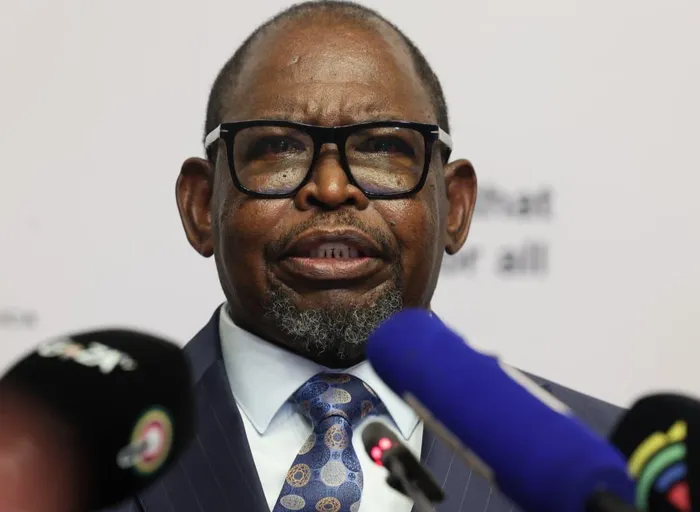
Finance Minister Enoch Godongwana tabled the 2026 Budget in the Joint Sitting of Parliament on Wednesday.
Image: Supplied
EVERY year, South Africans sit down to watch the finance minister deliver the National Budget Speech - and every year, the same question gets asked around kitchen tables from Durban to Limpopo: "But what does it actually mean for me?"
This year, for a change, the answer is largely a positive one. Finance Minister Enoch Godongwana stood before Parliament in Cape Town yesterday and delivered what commentators are already calling a "no surprises" budget - and in our current economic climate, no surprises is very good news indeed.
Think of the National Budget as a household budget - just on a national scale. The government has income (from taxes you and I pay) and expenses (salaries for teachers, nurses, police officers, roads, hospitals, and social grants). When government spends more than it earns, it borrows money - just like using a credit card.
The problem is that when you borrow too much, the interest keeps rising and eats into what you have available to spend on the things that matter. South Africa has been living with exactly that problem for years. As STANLIB's Chief Economist Kevin Lings has highlighted in his analysis of the budget, government debt has grown from a manageable 23.6% of our total national output (GDP) in 2008, to a concerning 78.9% today.
In simple terms, the country has racked up a very large credit card balance and servicing that debt now costs taxpayers more than R1.2 billion every single day - more than the annual budget allocations for public safety or housing (National Treasury, Budget Review 2026). The good news is that this year's budget shows the debt has finally stopped growing - and that represents a meaningful turning point.
Here is where things get genuinely encouraging for working South Africans. For the past two years, government did not adjust income tax brackets for inflation. This is a practice economists call "bracket creep" - a quiet, unofficial tax increase that happens when your salary goes up slightly because of inflation, but the tax brackets remain frozen.
As a result, you end up paying a larger slice of your income in tax, even though you are no better off in real terms (Emile Du Plessis, Econometrica, cited in Bizcommunity, February 25, 2026).
On Wednesday, the minister corrected that.
Income tax brackets have been adjusted in line with expected inflation of 3.4%, delivering R13.7 billion in relief to taxpayers - primarily benefiting lower- and middle-income earners (National Treasury, Budget Speech 2026). To put this in concrete terms, a person earning R250,000 a year will pay R1,225 less in income tax. Someone earning R1 million will save R3,991.
It is not a windfall, but it is meaningful, real relief. Medical scheme tax credits - which help offset the cost of belonging to a medical aid - have also been increased for the first time since 2023. They move from R364 to R376 per month for the first two adult members, and from R246 to R254 for additional members. A family of four on medical aid will now receive R1,260 per month in medical tax credits, up from R1,220 (Daily Maverick, Budget Survival Guide, February, 25 2026).
There is more good news for savers. The annual Tax-Free Savings Account (TFSA) limit has been increased from R36,000 to R46,000. If you are not yet using a tax-free savings account, this budget is a timely reminder that it is one of the most effective savings tools available to ordinary South Africans.
Not everything in the budget is good news for your wallet. The general fuel levy, which had been frozen for three years, will increase from April 2026. Petrol goes up to R4,10 per litre and diesel to R3,93 per litre.
The Road Accident Fund levy also increases by 7 cents per litre (National Treasury, Budget Speech 2026). These increases are modest and below inflation, but they will add to monthly transport and food costs. Smokers and drinkers will also feel the pinch. Excise duties on alcohol, cigarettes, pipe tobacco, cigars and vaping products have all been increased by 3.4%. So, your favourite bottle of wine, a six-pack or a carton of cigarettes will cost more from April 1.
For the 8.2 million South Africans who depend on the Social Relief of Distress grant, there is continuity, though not much comfort. The grant has been extended for another year at R370 per month until March 2027 (National Treasury, Budget Speech 2026).
Government has set aside an additional R3 billion provisionally to review the entire social grant system - a signal that a longer-term, permanent income support policy for unemployed working-age adults is eventually coming, though the details remain to be resolved.
Currently, 18,3 million South Africans - roughly 29% of the population - receive some form of social grant. Given that four in ten working-age adults cannot find employment (BOSA leader Mmusi Maimane, cited in Business Day, 25 February 2026), the social support burden on government is immense and unlikely to ease without a significant improvement in economic growth and job creation.
South Africa's economy has grown for four consecutive quarters, and inflation has fallen to its lowest level in twenty years (President Cyril Ramaphosa, SONA, February 12, 2026). The rand has strengthened dramatically - recovering by approximately 20% against the US dollar since April 2025 - and is currently trading just below R16 to the dollar, its strongest level since 2022 (Reuters, 25 February 2026).
Bond markets rallied on today's budget announcement, a sign that sophisticated investors regard the fiscal plan as credible. The International Monetary Fund, in a recent assessment, projected South Africa's growth at 1.4% in 2026, rising gradually toward 1.8% over the medium term (IMF, February 2026). This is better than where we have been - but it is still too slow to meaningfully reduce unemployment or lift millions out of poverty.
The country needs growth above 3% to create jobs at scale, and that will require sustained reform in infrastructure, energy, logistics and the private sector.
Today's budget will not change your life overnight. But it is an honest, disciplined spending plan that moves South Africa in the right direction. Government is spending within its means, it has stopped raising taxes on already burdened households, it has put a credible plan in place to reduce debt over time, and the country's international financial reputation is improving.
For ordinary South Africans, the immediate gains are modest - a little more in your take-home pay, slightly better medical aid credits, and a higher tax-free savings limit. The bigger prize - more jobs, lower debt costs, better services - will only follow if government delivers on its commitments. That, as always, is the part we will have to watch.
* This article is intended for general information purposes and does not constitute financial advice.
** The views expressed do not necessarily reflect the views of IOL or Independent Media.