
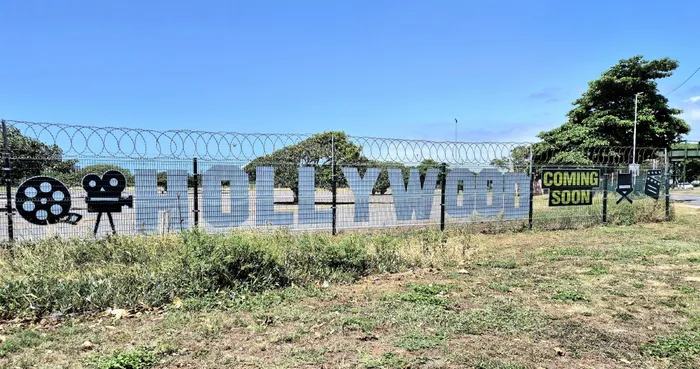
One of the signs up at the old Natal Command site in Durban. The site is earmarked for the R7,5 billion Durban film city project.
Image: SIBONELO NGCOBO / Independent Newspapers
FOR over two decades, Anant Singh's R7.5 billion Durban Film City has faced endless obstacles –from legal battles to infrastructure challenges. Yet, like the sacred Banyan tree in Durban's Botanical Gardens, this dream continues to put down roots, promising a transformed creative economy for the city's future, writes JERALD VEDAN.
FROM stalled film studios to sacred trees, Durban’s creative future may be growing more slowly than we would like, but it is still growing.
If Hollywood ever decides to make a film about trying to build a film studio in Durban, it won’t be a romance. It will be a thriller. Possibly a horror.
With strong elements of dark comedy.
There will be suspense, unexpected plot twists, disappearing documents, dramatic pauses, and at least one scene where everyone blames “the system”.
For more than two decades, film-maker Anant Singh’s dream of a world-class Durban Film City at the old Natal Command site has been stuck somewhere between “coming soon” and “maybe in the next lifetime".
A R7,5 billion project that could have placed Durban alongside Mumbai, Los Angeles and Cape Town has instead been trapped in paperwork, power outages, courtrooms and municipal mystery.
Imagine planning a major movie studio and being told: “Sorry, no water. No electricity. But all the best."
Singh has reportedly had to rely on generators, like a backyard wedding caterer, while trying to build an international film hub.
Add to that a decade-long legal battle over land ownership, sudden jumps in property valuation from R71 million to R1 billion, and service installation costs that sound like ransom demands, and you begin to understand why progress has been slower than Durban traffic when one robot is out.
There have been allegations of sabotage. Promises of investigations. Statements. Counter-statements. Committees. Sub-committees.
And probably meetings to plan meetings about meetings. In the meantime, the cameras remain packed away, waiting patiently like extras who never get their big break.
And yet, here is the miracle: despite all this, Durban remains one of the most loved film locations in the world.
Stars arrive here and immediately fall in love. They step off the plane, feel the warm air, see the ocean, smell the curry, and suddenly forget all about London traffic and Los Angeles parking fees.
They see what we sometimes forget: a city where the sea meets the skyline, where tropical light flatters every face, where culture lives on every corner, and where food alone deserves its own streaming channel.
Bollywood discovered this long ago. Films like Dhoom 2, Singam 2, Race, Welcome, and Fida turned Durban into an exotic double for everything from Miami to Mumbai. Aishwarya Rai Bachchan danced here. Abhishek Bachchan posed here. Shah Rukh Khan sang here. Priyanka Chopra smiled here. And Durbanites, in true local fashion, mostly responded with: “He looks familiar, hey? From where? Anyway, pass the bunny chow.”
Producers speak about our “warm” locations and tropical charm. Singers rave about our beaches. Fashion icons love our light.
Local celebrities describe our valleys and rivers as if they are auditioning for National Geographic. Visitors keep calling Durban a perfect blend of modern city and natural beauty. We are, in global terms, a ready-made film set, with bonus palm trees.
Which makes the delay of a proper studio even more painful. It’s like owning a Ferrari and using it only to fetch bread from the corner shop.
A fully functioning film city would change everything. It would mean jobs for actors, writers, technicians, editors, costume designers, drivers, caterers, security guards, set builders, make-up artists, and people whose official job description is simply a “person who knows where everything is”.
It would give young creatives somewhere to dream professionally, not just romantically.
Instead of saying, “One day I’ll go to Hollywood”, they could say, “I’m working in Durban, bru”. Instead of uploading audition videos from bedrooms, they could walk into real studios with real opportunities.
Hotels would fill. Restaurants would thrive. Uber drivers would finally stop asking, “Quiet today, neh?” Taxis would be busy. Even aunties selling samoosas outside studios would benefit. This is how creative economies grow, not through speeches and slogans, but through sustained investment and proper support.
Durban already has the talent. It already has the scenery. It already has the cultural depth.
What it needs is leadership and administration that match its potential.
Perhaps that is why the story of the Durban Film City feels so personal. It mirrors the city itself: gifted, beautiful, full of promise, and constantly held back by inefficiency and excuses.
But Durban has something else. Resilience.
Which brings me, finally, to my favourite place in the city: the Durban Botanical Gardens.
When life becomes too noisy, politically, socially, electrically, I escape there. It is one of the few places where the loudest sound is a bird clearing its throat. Not a hooter. Not a generator. Not someone shouting, “No lights again.”
The gardens were built by patient hands long before hashtags and complaints. Our ancestors planted trees while we plant opinions on Facebook.
Today, lovers hide there from curious aunties with binocular vision.
Families argue over picnic food. Pensioners announce the gardens were better in 1964. And everyone pretends not to notice the man sleeping peacefully under a tree older than his problems.
And there stands the banyan tree.
A tree that walks.
Not fast. Not dramatically. Slowly. Steadily. Sending roots down from its branches, turning them into new trunks, spreading wider every year. One tree becoming a forest. Like a rumour in Chatsworth, once it starts, it never stops.
In India, the Banyan is sacred. It symbolises endurance and renewal. It has survived storms, empires, politicians and human foolishness. It does not rush. It adapts. It grows quietly while the world argues loudly.
Standing under that massive canopy, I often think of Durban’s film dreams.
Like the banyan, they have taken time. Too much time, some would say.
They have faced storms. Court cases. Bureaucracy. Delays. Disappointments. Power cuts. Printer failures. Missing files. But the roots are still growing. The shade is still spreading. The potential is still alive.
Maybe one day soon, a director will shout “Action!” at a Durban Film City studio, and the world will watch stories made in our city, by our people, for everyone.
Maybe one day, young actors will say, “I started in Durban”, and mean it with pride. Until then, we wait. We push. We hope. We complain responsibly. And we learn from the banyan.
Grow steadily. Root deeply. Adapt quietly.
And when someone says Durban is moving too slowly, we can smile and reply:
“We’re not stuck. We’re just walking like a banyan tree.”
Jerald Vedan
Image: Supplied
Jerald Vedan is an attorney, community leader, and social commentator based in KwaZulu-Natal.
** The views expressed do not necessarily reflect the views of IOL or Independent Media