

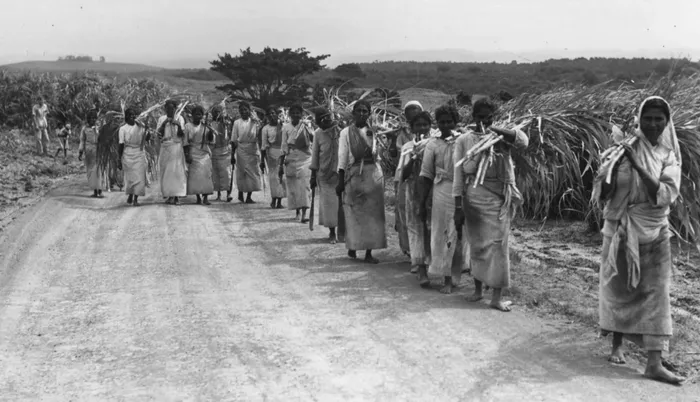
Early indentured Indian labourers on the sugar cane field in Natal.
Image: 1860 Heritage Centre
THE proposed liquidation of Tongaat Hulett is more than a corporate failure. It is more than balance sheets, creditors’ meetings, and restructuring plans. It is, for many of us on the North Coast of KwaZulu-Natal, the possible silencing of a living archive – an archive written not in ink, but in sweat, sacrifice, and sugar cane.
To understand the true weight of this moment, one must return to 1860, when the first ship carrying indentured Indians arrived on the shores of Natal. Men and women were brought to toil in the sugar cane fields owned by colonial masters. They laboured under harsh conditions – long hours under a punishing sun, meagre wages, cramped barracks, and the constant shadow of exploitation. The mills were not merely industrial structures. They were the beating heart of a system that shaped an entire community’s destiny.
The cane that moved through the rollers of those mills carried within it the fingerprints of generations of indentured labourers and their descendants. In places like Tongaat, Verulam, Maidstone, Darnall and Amatikulu, entire towns grew around the sugar economy. Schools, temples, churches, mosques, small businesses, and civic institutions were all woven into the rhythm of the planting and crushing seasons.
For decades, the plantations belonged to colonial interests. Indians were labourers – seldom landowners. Yet, history did not remain static. Over time, through resilience and entrepreneurial determination, many South Africans of Indian origin transitioned from labourers to small-scale farmers and eventually to substantial cane producers. What was once imposed as a system of exploitation slowly transformed into a platform for economic empowerment. That transformation is part of South Africa’s broader story of resilience and upward mobility. And now, we stand at the brink of watching that story unravel.
If the mills close, the consequences will not simply be financial. The farmers – many of whom are descendants of indentured labourers – will have nowhere to send their cane. Sugar cane cannot be stored indefinitely; it must be milled within a short window after harvesting. Without operational mills, fields will lie fallow. Generational farms may collapse. Workers who depend on harvesting, transport, and processing will lose their livelihoods. The liquidation of Tongaat Hulett risks erasing not just infrastructure, but memory.
Each mill is a monument to endurance. It is a testament to those who bent their backs so their children could stand upright. It reminds us that from the harshest beginnings, a community built dignity, stability, and contribution to the national economy. The sugar industry became a pillar of KwaZulu-Natal’s economy, feeding both local consumption and export markets, sustaining thousands of families across racial lines. We must ask ourselves: can we afford to allow such a foundational industry – and its layered historical significance – to disappear?
In a country that speaks so often of preserving heritage and redressing historical injustices, the closure of these mills feels like an abandonment of both economic pragmatism and moral responsibility. The descendants of indentured labourers are not asking for charity. They are asking for continuity – for the preservation of an ecosystem that supports farmers, workers, transporters, engineers, and small businesses. There must be urgent intervention. Government, private investors, development finance institutions, and community stakeholders must convene with seriousness and speed.
Creative solutions – whether through restructuring, public-private partnerships, co-operative ownership models, or sectoral support mechanisms – must be explored. This is not merely about saving a company. It is about protecting a historical continuum. If the mills fall silent, we risk sending a devastating message: that the sacrifices of our forebears can be reduced to footnotes; that economic transformation achieved through grit can be undone by corporate collapse; that rural communities are expendable.
The story of indenture in South Africa is one of pain transformed into progress. The sugar cane fields of the North Coast are living classrooms of that transformation. To allow the mills to close without exhausting every possible remedy would be to sever a vital artery connecting our past to our present. The time to act is now. Let the mills not become ruins. Let them remain symbols – not of colonial exploitation – but of resilience, transformation, and hope. For if we save the mills, we do more than save jobs. We honour history.
Dr Rajendran Govender is a social anthropologist and researcher; and a commissioner in the Cultural, Religious and Linguistic Rights Commission; and board member of the Pan South African Language Board. He is also a descendant of Tiruvengada and Valliammal Pillay, who were indentured Indian labourers. He writes in his personal capacity.
** The views expressed do not necessarily reflect the views of IOL or Independent Media.