
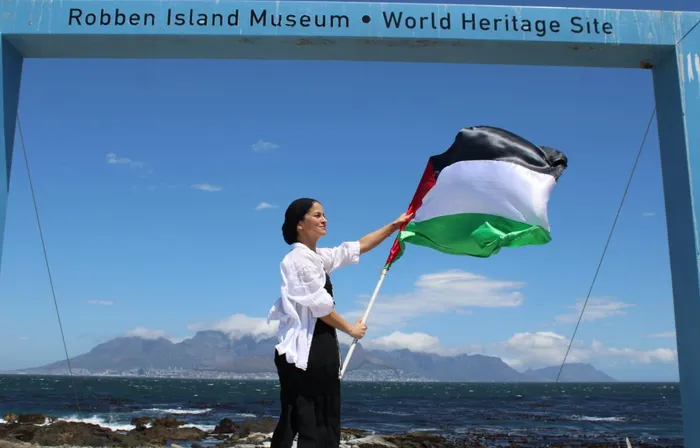
The writer, Yasemin Acar, at Robben Island.
Image: Shakira Thebus
MY NAME is Yasemin Acar. I am a human rights activist committed to struggles for social justice across the globe. I am of Kurdish origin from Türkiye and currently live in Berlin, Germany. As an international organiser and communicator, I recently helped organise the first-ever boat, The Madleen, to sail toward Gaza during the ongoing genocide. After our interception, kidnapping, and detention by Israeli forces, I joined comrades in organising the Global Sumud Flotilla, which brought together 43 boats and 483 activists to challenge Israel’s illegal siege on Gaza, deliver humanitarian aid, and demand the opening of a sea corridor.
I am writing this while visiting South Africa, as someone who has been imprisoned by Israel twice within four months. My comrades and I have witnessed Israeli military attacks and prison conditions inside occupied Palestine, first-hand. Like Israeli prisons, even the sea has been turned into a death trap for Palestinians. Yet, these experiences cannot begin to approximate what Palestinians endure simply for existing.
I visited Robben Island with former political prisoners and spent days in Cape Town listening to their stories of resistance and brutality. Standing inside that prison, one realisation struck me deeply: injustice is the same everywhere. But I could not stop asking myself - who is Robben Island really for? How many South Africans can afford to visit? Who has the time, money and freedom to take a boat to an island museum? For many, this is not a tour; it is a privilege.
Their daily reality still carry the violence museums attempt to neutralise. They do not have the luxury of “learning from history” while living inside the same structures that produced it. This is the trap of museums under capitalism: they turn revolutionary struggle into something safe to consume. They package colonial crimes into digestible narratives that allow beneficiaries of the system to feel absolved, while the system itself remains intact.
Meanwhile, the same brutality is unfolding in real-time in Palestine. Violence does not end when museums open. It continues uninterrupted. How can the world claim to “remember history” while refusing to see what is happening in Palestine? How can South Africa claim freedom from apartheid when its consequences remain embedded in society?
Colonialism and racial capitalism did not disappear; they merely changed form.
I left Cape Town feeling the weight of injustice not only for what was done in the past, but for what continues today - there and in Palestine. If we are serious about justice, we must reject the illusion that history is behind us. The same system that imprisoned Nelson Mandela and that imprisons Palestinians today is alive, profitable, and protected. Colonial prisons have always been tools of imperial rule. From the 17th century onward, they have been used to control populations, extract labour, and crush resistance.
Prisons were never meant to serve justice. Under empire, justice systems exist to silence dissent and maintain power. Justice is not an abstract moral principle; it is a structure enforced by those who benefit from it. If prisons truly served justice, how could the International Criminal Court issue arrest warrants for leaders like Benjamin Netanyahu while he continues to bomb and starve Palestinians, and is welcomed by world leaders?
This contradiction exposes the truth: our justice systems exist to preserve control, not accountability. Many acts that cause immense harm – war crimes, environmental destruction, financial exploitation – are not criminalised at all. Meanwhile, survival acts shaped by poverty, such as theft, migration, protest and drug use, are punished.
In South Africa and Palestine, this criminalisation is inseparable from apartheid, colonisation, white supremacy, and land theft. Colonisers in South Africa faced a central problem: how do you control millions who never consented to your rule? The answer was criminalisation. Visiting the sites where Mandela, Albertina Sisulu, Fatima Meer, and others were imprisoned brought me back to my own incarceration.
For the first time, I entered a prison cell voluntarily, yet the weight of those walls was no less suffocating. We know how people seeking justice vanish inside so-called justice systems. Modern prisons are continuations of colonial control. Over-policing, collective punishment, administrative detention, forced labour, and surveillance disguised as security define them. In many places, prisons replaced plantations. In Palestine, this system operates under Jewish supremacy. From British rule onward, imprisonment was used to suppress Palestinian resistance through emergency regulations, mass arrests and detention without trial.
After Israel’s establishment in 1948, imprisonment became central to controlling a displaced population. Following the 1967 occupation, Israel built a military legal system exclusively for Palestinians. They are tried in military courts with near-total conviction rates, under laws that criminalise everyday life – protest, organising, even speech.
Hundreds of thousands have passed through Israeli prisons. For many families, imprisonment is intergenerational. Administrative detention is one of the system’s most devastating tools. Palestinians are imprisoned without charge or trial, based on secret evidence, with detention orders endlessly renewed. Hunger strikes have become one of the few remaining forms of resistance. Children are routinely arrested during night raids, interrogated without parents, and coerced into confessions. Women prisoners face sexual harassment, humiliation, medical neglect, and punishment for political organising.
Imprisonment is used deliberately to fracture families and terrorise communities. Human rights organisations have documented torture, prolonged solitary confinement, denial of medical care, and deaths in custody. These crimes are framed as “security”, but they constitute collective punishment. Palestinian prisoners are not treated as individuals accused of crimes, but as a population to be managed – classic colonial logic.
Colonial power also reshapes relationships within the colonised society. Empires rely on co-opted local authorities to police their own people, fracturing resistance. The Palestinian Authority, created through the Oslo Accords, operates under occupation, economic dependency, and security co-ordination with Israel. This does not absolve responsibility, but it explains the mechanism: colonialism reproduces itself by forcing the oppressed to administer their own oppression.
As of early last month, more than 9 300 Palestinians remain imprisoned by Israel, including hundreds of children and dozens of women. Over 3 300 are held in administrative detention. Israel is now advancing legislation to allow the death penalty for Palestinian prisoners, further entrenching a dual legal system marked by systematic due process violations.
Escalation continues because accountability never arrives. Over the past year, testimonies of rape and sexual violence against Palestinian prisoners have surfaced, including documented assaults involving dogs. The perpetrators were celebrated, not punished. This is not justice – it is domination disguised as law. Palestinian prisoners expose the system for what it is: structured, deliberate oppression.
Their suffering is not accidental. We used our bodies in solidarity because our voices were no longer enough. I will never forget when Itamar Ben-Gvir told me I would be tortured – and I was. In their eyes, we were terrorists. The walls of those cells hold millions of stories. The world may turn away, but we carry those stories in our bodies. Justice is not requested; it is fought for.
To fight means refusing to believe our lives matter more than those of the oppressed. If we do not move beyond fear, imagination will give way to irreversible danger. One day, as in South Africa, we may walk through places like Ketziot Prison and read the words carved into walls by those who endured torture and death. One day, Palestine will see justice. When the doors open, they will open alongside millions of hearts – opened by the steadfastness of Palestinian sisters and brothers who endure unspeakable crimes. On that day, we will not only witness freedom; we will help build a justice that is no longer merely a word.
Yasemin Acar is a human rights activist, organiser, and communicator working at the intersection of resistance, solidarity, and accountability. She engages globally to challenge systems of racial capitalism, domination and violence.
** The views expressed do not necessarily reflect the views of IOL or Independent Media.