
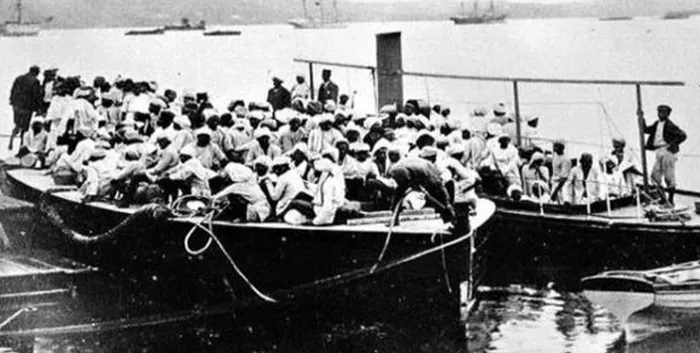
The first Indian indentured labourers arrive in Durban harbour aboard the Truro in 1860.
Image: File
Girmitiyalogy is necessary to restore fragmented colonial histories, reconstruct intergenerational identity, decolonise collective ethical mind through interdisciplinary research, and strengthen sustainable citizenship grounded in ancestral justice and connectedness.
Actual interethnic struggles reported in the newspaper in India on Thursday, February 19, 2026, The Times of India (New Delhi edition) published in its Times Special section (page 23), a column titled “Partners in apartheid fight, Indian South Africans facing racism again”.
The report revisits a recurring and deeply consequential reality: racial prejudice and intercommunity tension do not disappear simply because a nation has changed its constitutional order. They often persist as inherited social habits, as institutional residues, and as everyday micro-acts of humiliation that collectively corrode social cohesion.
As we know, no comprehensive, systematic global policy framework has been established to integrate interethnic education into binding school programmes in the colonised multiethnic nations.
The column mentioned above discusses the uplifting impact of the omission. For descendants of Indian indentured labourers, who were transported from the 19th century onward to multiple colonial destinations across Africa, the Caribbean, the Pacific, and beyond – this is not a distant headline. It is a familiar mirror. It raises an intergenerational question with contemporary urgency: how do we inhabit citizenship with dignity in multicultural societies where the political promise of equality can be undermined by the social practice of exclusion? This question concerns all relevant nations, especially those in India today.
The column's central message resonates far beyond South Africa: history is not an archive-only phenomenon. History inhabits names, accents, skin, neighbourhoods, school corridors, labour markets, and the unspoken hierarchies that determine who is presumed to belong. When public discourse slips back into the language of “go back” and “you don’t belong”, it activates older colonial grammars of domination.
The harm is not only psychological. Such rhetoric normalises dehumanisation, signals institutional permissiveness, and destabilises the moral foundation upon which democratic nations claim legitimacy. For Girmitiya-descendant communities, the struggle is therefore twofold.
First, to protect equal citizenship - legally guaranteed yet socially contested. Second, to preserve a coherent sense of identity across generations amid pressures of assimilation, stereotyping, and politicised ethnic competition. These pressures are intensified when historical knowledge is fragmented, when archives are dispersed, and when family narratives are interrupted by migration, stigma, or silence. As we recently discovered, many vital colonial archives are missing in India.
Girmitiyalogy, as an interdisciplinary, community-oriented paradigm, does not treat such incidents as isolated events. They are empirical signals within a larger field of bound-labour legacies and post-colonial social engineering. In its circular of January 31, 2026 – “Quick scan framework principal scope on core domains of the global operations 2026 – 2029” - Girmitiyalogy operations explicitly prioritise research that aims “to describe and analyse the conditions of control and dependency alongside everyday strategies of survival, including food systems, health practices, gender and interracial relations”.
And as we read today again: the problem is still ineradicable. The inclusion of interracial relations in this framework is not incidental; it recognises that social harmony is never the automatic outcome of demographic diversity. It must be cultivated through structural fairness, culturally competent institutions, and sustained public education. The Times of India report offers a concrete contemporary example: where democratic citizenship exists, but social acceptance is periodically withdrawn through stigma, scapegoating, and racial targeting. This is a core topic in my book Homogenisations in multiculturality (Mumbai, 2024).
In many multicultural societies shaped by colonial economies, tensions frequently surface between descendants of enslaved Africans and descendants of indentured Indians. This is a painful paradox. Both communities were historically positioned within systems of extraction, coercion, and racial ranking – though through distinct legal structures and ontological conditions.
Yet, political and economic pressures can reframe these intertwined histories as a rivalry over recognition and moral legitimacy. Current India is a diplomatic power to do that. This is where a scientific approach becomes ethically necessary. Girmitiyalogy insists on analytical clarity: slavery and indenture are not equivalent systems, and they should not be rhetorically merged. At the same time, they can be studied as interconnected regimes of bound labour within colonial governance. Such clarity prevents both false comparisons and competitive victimhood, and it creates room for shared civic projects grounded in truth, dignity, and mutual respect. In popular terms, we have to describe and understand the shared colonial past.
The intergenerational calling of Girmitiya descendants in contemporary multicultural societies is not a romantic narrative; it is a complex set of daily negotiations. Across the global diaspora, recurring challenges include: an Indian politician said to me: "It's a romantic narrative."
However, we note:
• Tensions around economic representation and perceived advantage or exclusion in labour markets and small business sectors.
• Identity negotiations between ancestral heritage and national citizenship, including pressures to “choose” one belonging over another.
• Resurgent ethnically-charged rhetoric in politics and social media, often intensified during elections or economic downturns.
• Intergenerational loss of historical knowledge due to archival fragmentation, language shift, and educational absence.
• Social fragmentation in multicultural states when institutional trust declines, and rumours or stereotypes replace dialogue.
These challenges are not solved by endurance alone. They require evidence-based strategies, curriculum inclusion, archive restoration, and professional training for institutions that mediate everyday life: schools, police services, health systems, media, and local governments.
The hope expressed by many observers is that India’s international diplomacy may increasingly engage, within its bilateral relations, the persistent issue of interracial tensions in postcolonial multicultural states. This must be framed carefully.
It is not the role of Girmitiyalogy operations to conduct state diplomacy. Yet, it is a scholarly duty to communicate research-based findings to governments and international bodies, so that policy can be informed by historical truth and contemporary evidence. Constructive diplomatic engagement would not constitute interference in domestic affairs. It could operate through culturally sensitive, mutually-agreed agendas such as educational partnerships, diaspora research co-operation, archival exchange agreements, and Unesco-aligned initiatives that address intangible heritage, anti-racism, and social cohesion.
When governments recognise that intercommunity tension undermines national development, diplomacy can become a platform for shared learning, not blame.
Girmitiya history teaches a profound lesson: communities once labelled as “temporary labourers” became enduring co-architects of the nations they inhabit. Their descendants are not guests in their countries; they are citizens with historical depth and cultural capital. The ethical challenge of our time is therefore not to recycle colonial divisions, but to cultivate civic solidarity across differences.
The Vedic concept "Vasudhaiva Kutumbakam" – one world, one family, a shared future – offers a moral horizon that aligns with Unesco’s commitment to human dignity and cultural diversity. In practical terms, this horizon demands the disciplined work of truth-telling, the repair of archives, the inclusion of overlooked histories in education, and the deliberate construction of intercultural trust.
If the newspaper report from South Africa functions as a warning, it also functions as an invitation: to treat intergenerational identity not as an obstacle to citizenship, but as a resource for inclusive nationhood. When Girmitiya descendants, alongside all communities shaped by colonial histories, embrace a rigorous ethics of connectedness, painful incidents can become turning points – moments of renewed dialogue, moral reorientation, and shared responsibility.
** The views expressed do not necessarily reflect the views of IOL or Independent Media.