
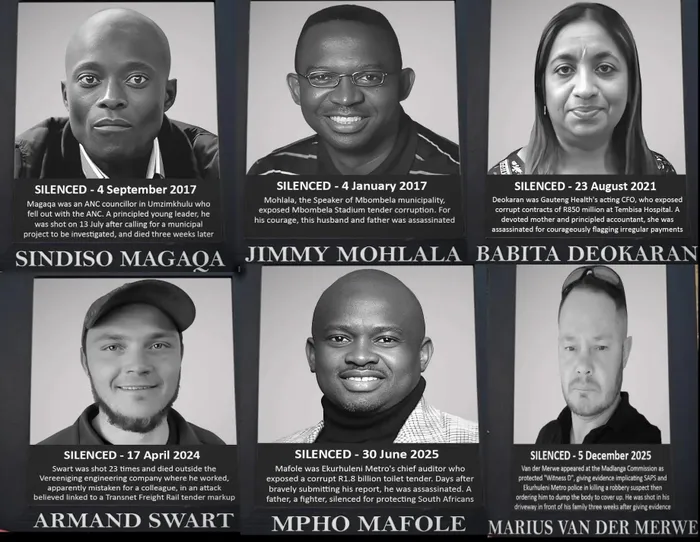
Under a campaign called 'They Have Names', OUTA has compiled a list of some of those who were killed due to being whistleblowers. The author says whistle blowers are praised publicly yet exposed privately.
Image: OUTA
South Africa has an abundance of ethics policies, but suffers from a critical shortage of consequences for wrongdoing. Shameen Thakur-Rajbansi argues that without predictable enforcement, ethics becomes merely theatrical – a performance without substance. This compelling analysis reveals how implementing consistent accountability could transform South African governance from negotiable to non-negotiable.
AT A RECENT governance conference in Cape Town, I presented a theme that was deliberately uncomfortable: South Africa does not suffer from a shortage of ethics policies, it suffers from a shortage of ethical consequences.
After 25 years of serving in the KwaZulu-Natal Legislature, this conclusion is not theoretical. It is lived experience. Our country has codes of conduct, disclosure forms, commissions of inquiry, oversight committees, auditor-general findings and recurring ethics training workshops. Yet, public trust continues to decline, and citizens increasingly believe that accountability depends on power rather than principle.
This contradiction reveals a deeper governance problem. A state may possess many rules and still lack credibility. For decades our instinctive response to ethical failure has been education. When scandals occur, we set up costly commissions of inquiry which make recommendations that don’t get implemented and we continue to train. When systems fail, we issue new guidelines. When public outrage rises, we establish another code. Training has value, but training without deterrence becomes what I describe as ethics theatre, the performance of morality without the certainty of consequences.
In too many cases, wrongdoing is investigated, but never finalised; reported, but never resolved; condemned, but never punished.
The consequences are predictable. Whistle-blowers become fearful rather than protected, oversight bodies become procedural rather than corrective, recommendations gather dust, and honest officials become isolated instead of supported. Gradually a dangerous message enters public consciousness: ethics is negotiable.
Globally, South Africa does not rank among the worst governed states – 41/100 on the Corruption Perceptions Index as per Transparency International. Yet we exist in what governance analysts call the corruption risk band, a category where institutions exist, but citizens do not trust them to enforce consequences.
This is our national paradox: strong laws combined with weak consequences produce high corruption perception. Our challenge is therefore not legislative creativity, but implementation credibility. Apart from bureaucrats’ ethics training, public education is valuable for confidence.
Democracies are not weakened merely by corruption. They are weakened when corruption becomes expected. Citizens can tolerate mistakes; they cannot tolerate impunity.
Trust depends on three beliefs: the rules are clear, the rules apply equally, and the rules are enforced consistently. When any of these collapses, legitimacy erodes.
When all three collapse, governance becomes negotiation rather than law. Of what use then are legislators whose mandate it is to protect public goods.
In countries that perform well on integrity, ethics is not taught primarily through moral persuasion.
It is taught through certainty, certainty that if you steal you are removed, if you lie you are sanctioned, and if you expose corruption you are protected. Not selectively, not eventually, not politically, but automatically.
The next phase of democratic reform must therefore shift from ethical awareness to ethical authority. Ethics cannot depend on personalities; it must depend on systems. At the conference, I proposed four minimum pillars for governance reform: predictable consequences, genuine whistle-blower protection, binding oversight and verified disclosure.
None of these ideas are radical.
They represent the minimum infrastructure of credible governance.
South Africa’s governance challenge is not corruption alone; it is unpredictability. Oversight bodies frequently issue recommendations without ensuring implementation. Investigations occur, but disciplinary processes stall. Financial disclosures are filed, yet rarely verified.
Whistle-blowers are praised publicly, yet exposed privately.
The public sees process without closure, and justice delayed repeatedly becomes justice abandoned.
Ethics reform therefore cannot succeed if treated as a political weapon between parties, and the Government of National Unity (GNU) is weak in this regard. It must become a shared insurance policy for democracy itself.
Political leaders must agree on minimum standards that apply regardless of who governs. Without cross-party consensus, every accountability mechanism risks being interpreted as selective enforcement.
The goal is not to legislate morality, but predictability. Governments cannot control virtue.
Once consequences become consistent, behaviour adjusts naturally.
Comparative governance research shows that effective states embed ethics into institutional architecture rather than the political rhetoric we hear every State of the Nation Address (Sona).
Successful systems combine enforcement that deters misconduct, prevention that removes opportunity, and education that shapes culture. Remove any one of these and the system weakens; combine all three and ethical behaviour becomes the rational choice. This explains why simply adding new anti-corruption laws rarely changes public perception. Citizens judge governance not by announcements, but by outcomes. Our enforcement agencies require an overhaul with skilled and honest civil servants.
South Africa does not need to reinvent governance; it needs to restore credibility where citizens observe predictable patterns: misconduct leads to consequence, reporting leads to protection, and findings lead to action. Once this becomes normal, ethical behaviour no longer depends on individual virtue, but on institutional habit, hence voter participation in elections remains key.
The roadmap forward is practical.
To mark the new year, we must reconvene a prayer breakfast, and political leaders must commit to common ethical standards to set the work tone. Implementation must be independently tracked. Whistle-blowers must be protected in practice, not only in principle.
Disclosures must be verified systematically. These steps move governance away from personality-driven towards system-driven accountability. When accountability becomes automatic rather than negotiated, then public trust returns.
Ethics reform is often discussed as a moral obligation. In reality it is a stability mechanism. A democracy can survive disagreement; it cannot survive disbelief. When citizens lose confidence in fairness then compliance declines, governance becomes coercive, and legitimacy weakens. Ethical enforcement therefore protects not only integrity, but rules-based democracy itself.
South Africa’s task is not to write better codes of conduct. It is to make consequences inevitable.
Once citizens believe that rules apply equally to leaders, ethical behaviour stops depending on courage, and starts depending on expectation. And when honesty becomes the safest choice rather than the bravest one, democracy stabilises. Our growth, peace and prosperity depends on ethics.
We have built awareness. The next step is certainty where ethics ceases to be an aspiration, instead it becomes governance.

1008537917__20260204__0 Shameen Thakur-Rajbansi
Image: SUPPLIED
Shameen Thakur- Rajbansi is a former MPL, KZN Legislature, leader of the Minority Front and eThekwini mayoral candidate for the 2026 local government elections.