

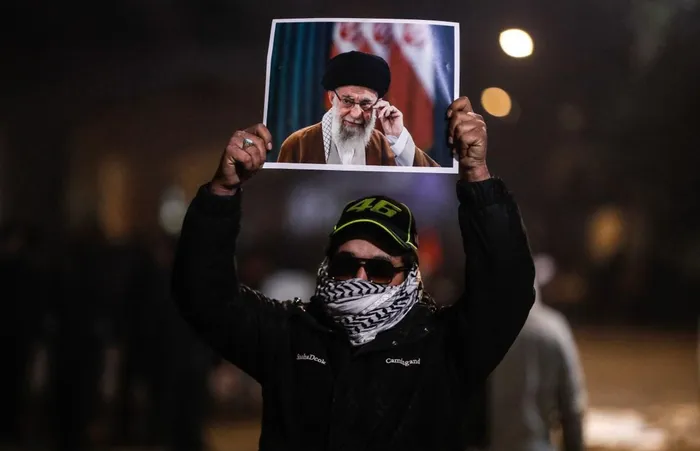
A protester holds up a portrait of Iran’s slain supreme leader Ali Khamenei during a demonstration in support of the Iranian regime at one of the entrances to Baghdad's Green Zone, where the US embassy is located.
Image: AHMAD AL-RUBAYE / AFP
THE Middle East burns once more. Skies glow with the eerie light of conflict, drawing the world into another chapter of violence in a land both cursed and holy – the birthplace of prophets and the site of endless strife. Here, truth remains perpetually on the cross, crucified by those who claim divine favour while perpetuating earthly suffering.
The Ayatollah Khamenei is dead. To the West, he was a monster. A hardline cleric condemned as evil by leaders and media alike. But step back from the rhetoric. Was he evil, or was he simply conservative?
In any nation, a conservative holds traditional views. In the West, that might mean opposing abortion on religious grounds. In Iran, a cleric governs by his interpretation of Islamic law. It is a matter of doctrine, not a mark of brutality. Iran calls itself an Islamic Republic, a system of governance shaped by faith, much as some view America’s recent embrace of Christian nationalism. It is a political stance, not a death squad.
The Ayatollah was never the demon they painted. He was a product of his beliefs, ruling a nation by its own rules. And now, with his passing, that era, for better or worse, is laid to rest. The narrative of Iranian aggression requires similar examination. Iran leads what it calls the "Axis of Resistance", claiming to fight only when provoked, typically in response to conflicts sparked by Israeli expansionist policies and American neoconservative influences.
Unlike its regional adversaries, Iran has not initiated wars of aggression against neighbours. Consider the actual bombing campaigns across the region. The true "Axis of Evil", from this perspective, consists of those who consistently invade and destabilise sovereign nations. The relentless pressure on Iran serves economic interests as much as geopolitical ones. America's desire to maintain oil sales in US dollars faces challenges from Iran and Venezuela trading with China in alternative currencies, threatening decades of financial dominance.
Allegations of human rights abuses often provide convenient cover for this economic warfare. When American sanctions cripple Iran's economy, citizens protest. At that point, outside intelligence agencies attempt to transform legitimate dissent into armed insurrection. A government's response to foreign-backed rebellion differs fundamentally from suppressing peaceful protest – it becomes national self-preservation.
The geopolitical landscape has now been dramatically transformed by a conflict few analysts anticipated. What began as a decisive US-Israeli military operation against Iran has reportedly become a strategic disaster, a trap meticulously laid by Iranian, Russian and Chinese strategists that caught Western powers completely ill prepared. The repercussions continue unfolding, revealing a seismic shift in regional power dynamics.
The initial offensive appeared monumental. Intelligence sources describe a co-ordinated air assault involving over 400 aircraft from a readiness pool of approximately 800 jets. The objective: dismantle Iran's military capabilities and eliminate its strategic assets – a swift, overwhelming strike designed to assert dominance and potentially force regime change.
The operation's sheer scale reflected unshakeable confidence in Western military superiority. However, Iran had prepared differently. As American and Israeli aircraft approached Iranian airspace, they encountered not just traditional anti-aircraft batteries but sophisticated digital defences. Iran had effectively "mined" its skies with electronic warfare capabilities, scrambling targeting systems and communications. This forced American aircraft to launch random strikes from outside defended borders, unable to penetrate and achieve primary objectives.
The crucial element of surprise vanished completely. Within an hour of this aerial standoff, while Iranian defences repelled the initial assault, the real shock arrived. Iran unleashed a counterattack US military strategists had never anticipated, not a desperate last stand, but a carefully orchestrated, massive, simultaneous series of air raids targeting American bases across the Middle East. Those bases, long symbols of American power projection, suddenly found themselves under direct assault.
A senior US official speaking anonymously to The Wall Street Journal confessed the military establishment's profound shock. Iranian capabilities proved far more extensive than intelligence had suggested. Strikes hit major American facilities in Jordan, Iraq, Qatar, the United Arab Emirates, Bahrain, Saudi Arabia and Kuwait. The co-ordination and scale challenged every assumption about Tehran's operational reach. Beyond damaging bases, Iran's strategic objective focused on neutralising American radar systems in the Gulf and Northern Israel – an objective largely achieved.
The most significant loss was the largest American radar installation in the region, an FP-132 system in Qatar valued at $1,1 billion. With a 5,000-kilometre range and technology specifically designed to track ballistic missiles, its destruction represented not merely financial loss but a critical blow to regional surveillance and missile defence. With these radar systems blinded, the strategic landscape shifted instantly. American and Israeli aircraft carriers, once symbols of invincibility, became exposed and confused.
Iran seized this moment of disarray, launching "Hashemite" missiles toward Israel as an opening salvo – reportedly not even the main strike package. Despite deploying advanced defence systems, including at least 18 Thaad and Patriot batteries, Iranian missile strikes proved devastatingly effective. Electronic warfare attacks had blinded Israeli air defences, rendering them unable to track incoming missiles.
The Islamic Revolutionary Guard Corps continued strikes targeting Israeli cities, ports, government buildings and intelligence agencies. The consequences stretch far beyond the immediate conflict. President Donald Trump, whose administration initiated the offensive, reportedly remains in shock at these unprecedented events. American military prestige, long synonymous with technological superiority, has been severely tarnished. Even stealth aircraft now prove vulnerable to Iranian missiles equipped with advanced digital radar tracking.
China has been observing these developments closely, according to intelligence sources, relaying critical information to Iran. Beijing has become an active participant, recognising that military intelligence can prove more valuable than missiles in modern warfare. China understands that containing its rising power, specifically its ambition, to establish a land corridor connecting to West Asia via Iran and Afghanistan represents America's underlying objective.
This conflict forces the radical reassessment of established concepts. The United Arab Emirates, long promoted as a stable investment haven, has seen its appeal evaporate. What billionaire would invest in glass towers vulnerable to Iranian missiles? Real estate prices across the UAE will likely plummet and remain depressed for years. The UAE leadership, once celebrated for diplomatic initiatives like the Abraham Accords, now faces a harsh new reality. The ripple effects extend further.
In Europe, Vladimir Putin may feel emboldened to intensify attacks on Ukraine while global attention diverts. In East Asia, Taiwan could become an open theatre for Chinese aggression as America finds itself strategically overstretched in the Strait of Hormuz. The Strait has been shut down by Iran. Oil prices will rise within days. Some call this World War III, a proxy conflict between America and China fought in the Middle East, while Europe and Russia fight their proxy war in Ukraine.
All this death, hoping that the international Epstein class of defective leaders will be forgotten. America learns fast as 80% of its people refuse to support fighting Israeli wars. If the devil were to forsake his horns and adorn himself with a sardonic smile and a new Italian suit, the face you would see belongs to Benjamin Netanyahu, unable to stop killing in Gaza, the West Bank, and now Iran.
For peace to become a genuine prospect in the Middle East, Israeli people must secure their own future by holding Netanyahu accountable. They must rebuild from the echoes of war crimes into a future committed to fairness and equity, a future where Palestine will be free.
** The views expressed do not necessarily reflect the views of IOL or Independent Media.