

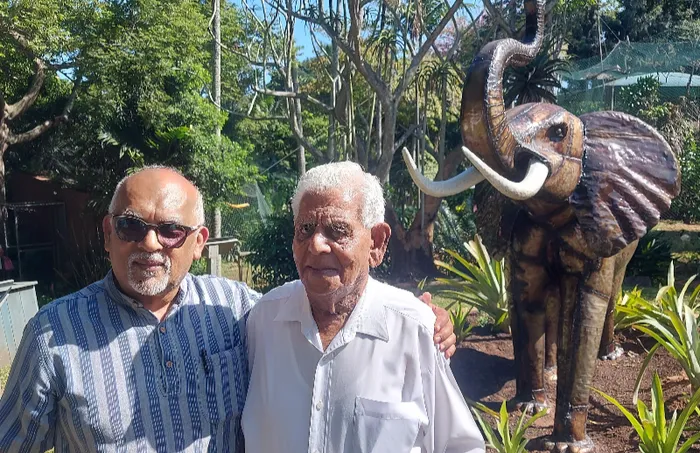
Dr Sanil Singh and Dhunniram Moolchun, trustees of Mitchell Park, in front of a statue of the lovable elephant Nellie that was donated by the Moolchun family
Image: Supplied
MITCHELL Park in Morningside, Durban, named after the then governor of the British Colony of Natal and Zululand, Sir Charles Bullen Hugh Mitchell, opened in 1910 with the kind of visionary genius only colonial capitalism could muster: an ostrich farm. Because nothing screams “future-proof investment” like betting on giant birds.
Unfortunately for the (bird) brain behind the plan, the feathered investment portfolios didn’t deliver the golden eggs of profit, so the place was hastily rebranded as a zoo. I suppose if you can’t make money off feathers, you might as well cage some animals and charge admission.
By 1913, the zoo held 325 mammals, 49 reptiles and 855 birds. Then when apartheid came, the park, which by then had morphed from a zoo into an urban green space, blossomed into a shining monument of exclusivity. Initially, it was predominantly whites who visited. Later small numbers of blacks and Indians visited, only to be greeted by segregated benches – white benches for whites and green benches for the others – segregated kiddies playgrounds, and segregated toilets, because apparently even sitting down required racial hierarchy.
Nothing says “family outing” like institutionalised racism dressed up as leisure.
I can clearly recall one incident at Mitchell Park in the early 1980s that has never left me. My photographer, Morris Reddy, and I had gone there to see how apartheid’s colour bar played out in the seemingly innocent setting of a city park. On a green bench sat a black nanny, dutifully minding a year-old white baby. The baby’s dummy slipped from its mouth, tumbled to the ground, and gathered a sprinkle of sand. Without hesitation, the nanny picked it up, licked it clean, and placed it back into the child’s mouth.
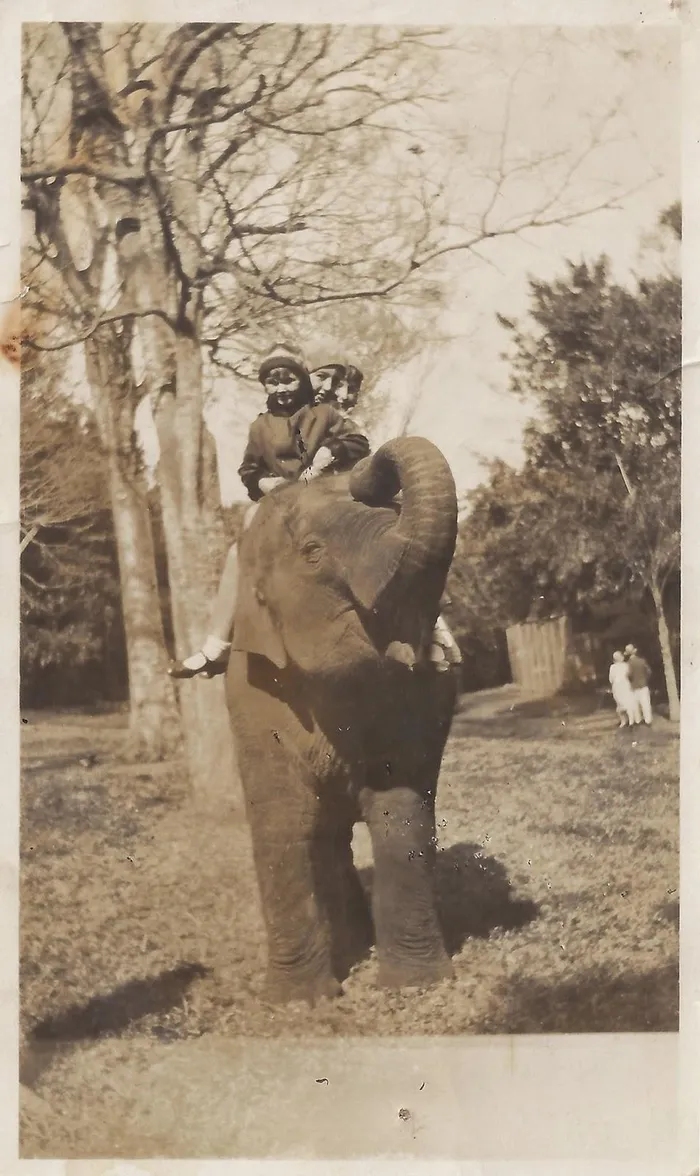
For many years, Nellie the elephant gave white children rides at the Mitchell Park.
Image: Supplied
In that simple, tender act, the absurdity of apartheid was laid bare. Here was a woman entrusted with the most intimate care of a white child – feeding, soothing, loving – yet she herself was denied the right to sit freely on any bench, to use any toilet, to exist as an equal in the very park where she was faithfully doing her job.
Morris captured the moment with his camera. The photograph said what words could not: apartheid, with all its pompous cruelty, was licked by the very humanity it tried to deny.
Now where was I? Of yes, here’s the delicious twist: while Mitchell Park strutted around for decades as a whites-only paradise, it was Indian labour that kept the whole thing running from Day One. During its early days, the backbone of the labour force at the zoo comprised mainly Indian men who lived with their families in nearby quarters.
India’s first agent general in South Africa, Srinivasa Sastri, took office in Durban in June 1927. A statesman of rare dignity, he did not need long to grasp the daily humiliations inflicted on those who were not white – the petty exclusions, the cruel hierarchies, the relentless sting of racism. In Hindu tradition, the elephant-headed god Ganesha is revered as the remover of obstacles, the one who clears the path when all seems blocked. Perhaps with that symbolism in mind, Sastri, a devout Hindu, approached the Maharaja of Mysore, Krishnaraja Wadiyar, before leaving office with an unusual request: to send an elephant to Durban as a gesture of goodwill.
Karuppa Gounden arrived from Chingleput in South India in 1880, bound by the harsh chains of indenture. When his contract ended, he found work as a humble zookeeper at Mitchell Park. Yet, history gave him a singular role: in 1928, he was sent to the Durban Harbour to escort Nellie, the elephant gifted from India, and became her mahout, the trusted minder who guided her for years as she carried white children on her back in rides of delight.
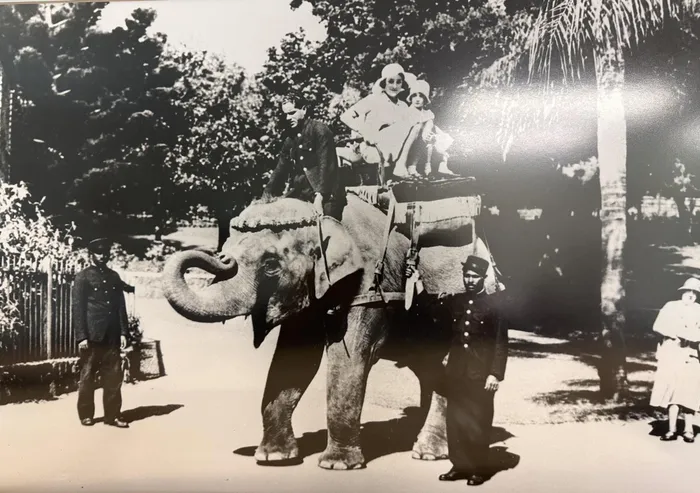
Nellie at the Mitchell Park in the early 1900s.
Image: Supplied
His son, Swaminathan, a political activist of note, often recalled with pride his father’s bond with Nellie. The elephant was no ordinary creature; she brimmed with personality, entertaining Durban’s children with playful tricks. She learnt to play the mouth organ, and with a flourish, cracked open coconuts to the cheers of her audience. But here lies the irony that history whispers: was Gounden’s training of Nellie to break coconuts more than mere spectacle?
In Hindu tradition, coconuts are sacred offerings to Ganesha, symbolising the shattering of ego and the surrender of self. Could it be that each coconut Nellie split was a quiet, veiled act of resistance, a symbolic prayer to Ganesha to clear away the crushing obstacle of racial prejudice that plagued Durban?
In the laughter of white children and the applause of their parents, perhaps they never saw it. But behind the spectacle, an Indian mahout and his elephant carried a deeper truth: that even in a park built on exclusion, the spirit of Ganesha was at work, reminding the world that no wall of prejudice is unbreakable.
Another strong Indian connection to Mitchell Park is the family of Gordon Michael, 71, who worked for 46 years at the popular Blue Zoo Restaurant and Tea Garden as a waiter. The restaurant closed in 2021 after 112 years, progressing from Mitchell Park Tearoom to Mitchell Park Tea Gardens and a fine dining establishment that at one time only allowed whites to enjoy baby chicken peri-peri; more than 12 varieties of toasted sandwiches; scrambled eggs topped with smoked salmon, cream cheese and spring onion; lamb shank roasts in port wine; crispy duck charred and filleted in a sherry-brandy and orange sauce; pastas; an assortment of curries; burgers; waffles; cheese cake and English tea, and the finest wines, indoors or under the trees in an atmosphere of beauty and tranquility.
Michael, his father, uncles, his two sons, cousins, nephews and nieces gave a combined 250 years of service to the Blue Zoo. Today Michael manages the tuckshop at Mitchell Park and is in demand to give talks on the history of Durban, especially relating to his days as a lowly-paid caddy, a newspaper vendor and his association with yesteryear’s greats of golf, cricket and horse-racing.
Last Thursday, 99-year-old Dhunniram Moolchun, former Durban educationist, community leader and founder trustee of the Mitchell Park Trust, stood tall despite his years, unveiling a metal statue of Nellie, the elephant. His family had personally sponsored the memorial, a gesture not just of remembrance, but of reclamation. Moolchun, who had a one penny ride on Nellie in 1938, has long been a driving force behind the Environmental Education Centre at the park, determined to turn a place once scarred by exclusion into one of learning and renewal.
His involvement with the trust began in 1998, born of a deep desire to make a difference after witnessing the suffering of Indian workers at Mitchell Park, and the humiliation endured by all those denied equal facilities simply because of the colour of their skin.
Durban-based veterinarian and trustee of Mitchell Park, Dr Sanil Singh, reflected on the park’s transformation, noting that it had become a true “people’s park”, a space open and welcoming to all, regardless of race, class or age. He emphasised that the unveiling of the statue of Nellie carried profound symbolic meaning.
“It is not merely a tribute to a cherished animal, but also a gesture of healing, a balm to soothe the wounds inflicted by apartheid, when many were denied access to the park’s facilities and excluded from its joys,” he said.
And so, the irony of Mitchell Park’s legacy comes full circle. A park once celebrated as a sanctuary of “white leisure” was, in truth, built on the sweat of Indian workers and the presence of an Indian elephant. The monument to Nellie is more than stone and memory. It is a reminder that history cannot be whitewashed. The very foundations of the park rest on the backs and trunk of those it excluded. A name change to Karuppa Gounden Park will be fitting.
** The views expressed do not necessarily reflect the views of IOL or Independent Media.