

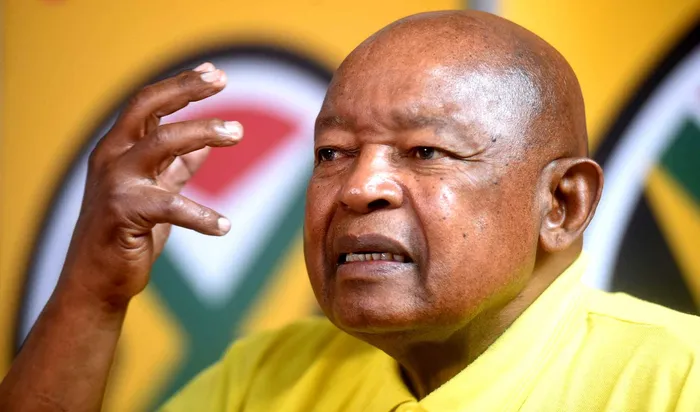
Cope leader Mosiuoa Lekota Mosiuoa Lekota
Image: Itumeleng English/ Independent Newspapers.
Mosiuoa Gerard Patrick Lekota
13-08-48 to 04-03-26
I FIRST met Terror Lekota in the 1970s at the then Himalaya Hotel in Durban. It was a South African Student Organisation (Saso) cultural evening. I cannot recall him speaking that evening, but his presence has become an abiding memory because that is the impact he had with his warmth, his genuine engagement, and, of course, that defining gap toothed smile.
He loved people without reservation. At that time we were all part of the Black Consciousness Movement. Many years later, he was briefly hosted (I recall it was a little more liquid than just tea) at my maternal grandparent’s home in Albersville, Port Shepstone, opposite the hall where he had just addressed a political meeting. His enthusiasm, and what one journalist had called exuberance, was simply infectious. A relatively traditional Indian home, he won over the entire family and left them inspired.
Mosiuoa Gerard Patrick Lekota (nicknamed “Terror” because of his football skills) was born to working class parents in Kroonstad in 1948 where he did his early schooling. Soon a strong KwaZulu-Natal bond was to emerge. He matriculated at St Francis College, in Mariannhill, Durban (another historic contribution by the religious sector to the development of our education, in this instance the Catholic Church).
He later studied at the University of the North and became active in the Saso, becoming the full-time organiser. In 1974, he was arrested with others for organising celebrations of the independence of Mozambique. He was charged under the Terrorism Act, found guilty and sentenced to six years' imprisonment on Robben Island.
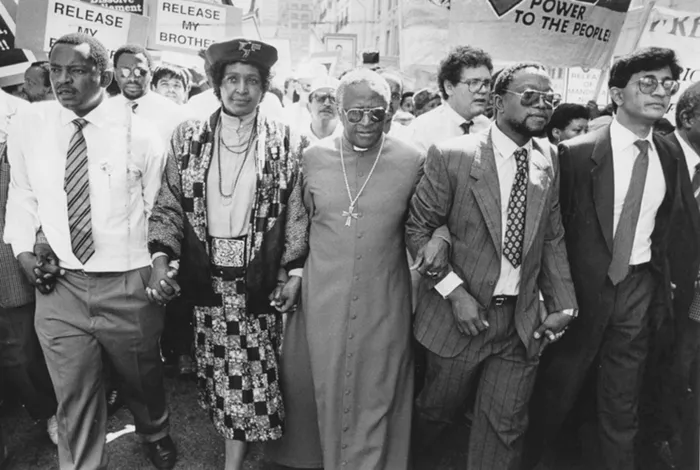
"Terror" Lekota of the United Democratic Front (UDF), left, Winnie Mandela, Archbishop Desmond Tutu, Popo Molefe and Mohammed Valli-Moosa, both of the UDF, lead a march in 1990. File picture Leon Muller/African News Agency (ANA)
Image: File
History online records that while on Robben Island, he wrote these words to his daughter: “After all then my dear, I am in prison for the sake of peace for our country and the world. I am in prison so that our generation may leave to yours and later generations a country and a world that has the greatest potential for progress.”
During his imprisonment, he was influenced by the political leadership there and embraced the principles of non-racialism, the Freedom Charter and Congress political thought. Immediately on his release in 1982, he threw himself into further political activism, later becoming the national publicity secretary of the UDF.
There is the famous picture of Lekota carrying Billy Nair on his shoulders after the six UDF leaders had left the British Consulate. Lekota faced continued police harassment, including detention. In 1985, he was again arrested and charged for treason in what became known as the Delmas trial. The accused were held without bail. He was found guilty and sentenced to 12 years' imprisonment. This was reversed on appeal and he was released on December 15, 1989, after spending a further four years and six months in prison.
After the unbanning of the ANC, he was appointed to lead the then Southern Natal Region which covered the then Stanger area, to Durban, Port Shepstone and Harding. This required pioneering organisational work. The threat of violence was ever present. This period further cemented his historic contribution to our province. Future historians will reflect on the role of ethnic contradictions then and indeed until today.
Lekota was also elected on to the ANC national executive committee, and later from 1997 to 2007 as its national chairperson. He held various positions in government, including as premier of Free State province, minister of defence and chairperson of the NCOP.
After the ANCs Polokwane conference in 2007, Lekota was one of the driving forces behind the formation of COPE, a new political party that claimed true custodianship of Congress principles as adopted at the Congress of the People in Kliptown in 1955. Launched with much energy, it had significant impact and won 30 seats in the National Assembly. Since then, however, due to leadership disputes and other factors, it has dwindled to virtually no political presence.
Almost all political parties have hailed the historic contribution of Lekota to the freedom Struggle and building our democracy. The ANC in its statement hailed his stellar contribution, saying, “as we commemorate the 30th anniversary of the Constitution and Human Rights month, we state unequivocally that Mr Lekota has left indelible footprints in these milestones".
The Thabo Mbeki Foundation in its tribute to Lekota quoted German playwright and poet: “There are those who struggle for an hour and that is good. There are those who struggle for a year and they are better. There are those who struggle for many years and they are better still. But there are those who struggle all their lives: these are the indispensable ones."
Lekota has left us with many lessons: of love, sacrifice, determination, commitment to non-racialism and all of humanity. I recall him chairing the ANC Polokwane conference in 2007. It was difficult with the majority hostile because of the dynamics at the time. It remains a lesson about the destructive and often mindless nature of factionalism.
Lekota attempted to persuade the conference to support a very rational proposal for sectoral branches such as academia (as opposed to only geographical ward-based branches). He was howled down.
He was not perfect and arguably could have shown more strategic insight at critical points on our journey in building our democracy. But none can contest his invaluable contribution. President Cyril Ramaphosa has very appropriately declared an official state funeral in recognition of this outstanding patriot.
Hamba kahle, Cde Terror Lekota. You have served our nation well.
Ravi Pillay is an ANC activist and former KZN MEC for Finance.