

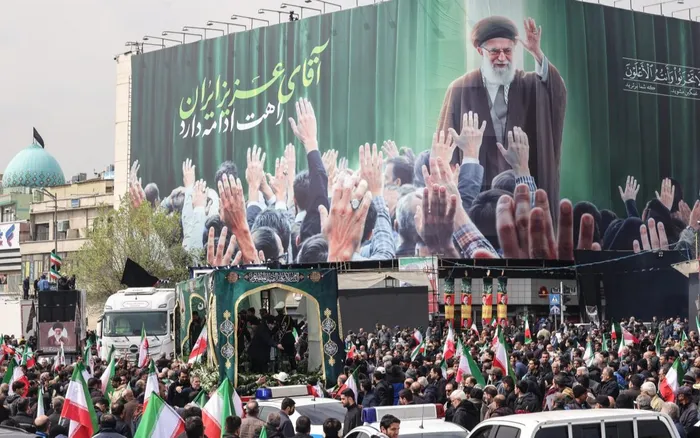
Iranians gather beside a billboard depicting Iran’s slain supreme leader Ayatollah Ali Khamenei as they attend the funerals of Iran's Revolutionary Guards Corps (IRGC) commanders, army commanders and others killed in the early days of the United States and Israeli strikes on Iran, at Enghelab Square in Tehran today.
Image: ATTA KENARE / AFP
THE 20th century closed with the collapse of colonial empires and the triumphant declaration that the world had entered an era governed by international law, sovereign equality and human rights. Yet in the first quarter of the 21st century, the reality confronting much of the Global South suggests that the old hierarchies of power have not disappeared. They have merely changed form.
From the sanctions imposed on Iran to the economic and political pressure applied to Venezuela, and the enduring dispossession experienced by the people of Palestine, the world is witnessing a pattern that demands sober reflection, a geopolitical order in which the sovereignty of some states is treated as conditional, while the power of others is treated as unquestionable.
The question confronting humanity is not simply whether these policies are effective, it is whether they are just.
To understand the tensions of our present moment, we must examine the architecture of power that has shaped international relations since the end of the Cold War.
The US emerged from that era as the world’s most dominant political, military and economic force. Its alliances, most notably with Israel, became pillars of a global security order designed to protect strategic interests and maintain regional influence.
Supporters of this order argue that it has helped prevent large-scale wars and protect democratic values. Critics, particularly in the Global South, see something different, a system in which international rules are applied unevenly.
When powerful states invoke international law selectively, the credibility of that law itself begins to erode.
The consequences manifest in sanctions regimes that cripple national economies, military interventions justified as preventive security, and diplomatic pressure that seeks to reshape governments in accordance with external priorities.
Few countries embody this tension more starkly than Iran.
For decades, Iran has faced sanctions, diplomatic isolation and periodic military confrontation linked to its nuclear programme and regional influence. The latest escalation between the US, Israel and Iran has once again pushed the region toward instability.
From Washington and Tel Aviv, these measures are framed as necessary to prevent nuclear proliferation and counter regional threats. Yet for many Iranians, sanctions have meant something far more immediate, soaring inflation, restricted access to medicine and the daily hardships of economic suffocation.
A policy designed to pressure governments often ends up punishing populations.
The paradox is profound. The same international community that proclaims universal human rights frequently deploys tools that undermine the social and economic rights of ordinary people.
A similar story unfolds in Venezuela.
Sanctions and political confrontation have defined the country’s relationship with the US for more than a decade. Officially, these measures seek to promote democratic reform and hold leaders accountable for corruption and repression.
But the experiences of many Venezuelans tells a more complex story.
Economic isolation has compounded an already fragile economy, deepening shortages, accelerating migration and destabilising social institutions. Critics argue that such pressure risks entrenching political divisions rather than resolving them.
History offers sobering lessons. Economic siege rarely produces democratic renewal, more often it hardens nationalist resistance and pushes societies further into crisis.
No discussion of global justice can ignore the unresolved tragedy of Palestine.
For generations, Palestinians have lived under conditions that human rights observers frequently describe as systemic inequality and occupation. Military checkpoints, land seizures and periodic conflict have shaped daily life for millions.
Israel, for its part, argues that these measures are necessary to ensure security in a region marked by hostility and violence. The trauma of Jewish history, particularly the Holocaust, casts a long and undeniable shadow over these debates.
Yet acknowledging historical suffering cannot justify the perpetuation of new injustices.
If international law is to retain meaning, it must apply equally to all parties. The rights of Israelis to security and the rights of Palestinians to freedom and self-determination cannot be treated as mutually exclusive.
In global debates, a question is rarely examined with intellectual honesty: "Why does the US consistently align itself so closely with Israel in international forums, even when large segments of the global community express concern about Israeli policies?"
Some critics go so far as to suggest that American foreign policy is “captured” by Israeli interests. Such language oversimplifies a far more intricate relationship shaped by strategic partnership, domestic political dynamics, shared ideological narratives and decades of military co-operation. But acknowledging this complexity should not silence scrutiny.
The real issue is not whether one state controls another. It is whether alliances sometimes lead powerful nations to overlook injustices they would otherwise condemn.
When that happens, the moral authority of the international system begins to fracture.
For many nations in Africa, Asia and Latin America, the pattern is familiar.
Colonialism once operated through direct territorial control. Today, influence often manifests through economic leverage, strategic alliances and the ability of powerful states to shape global narratives.
The result is a persistent perception, especially in the Global South, that international law operates on two tracks, one for the powerful, and another for everyone else.
Whether or not this perception is entirely fair, its existence is deeply destabilising.
A world order cannot endure if large portions of humanity believe the rules are rigged.
If the crises surrounding Iran, Venezuela and Palestine teach us anything, it is that the current framework of global governance is struggling to maintain legitimacy.
What might a more just order look like?
First, sanctions must be fundamentally reimagined. Economic pressure that devastates civilian populations violates the spirit of human rights law. Targeted accountability measures, directed at individuals responsible for abuses, should replace broad economic punishments that cripple entire societies.
Second, diplomacy must be restored as the primary instrument of international conflict resolution. The erosion of trust between states has created an environment where military escalation becomes thinkable. Rebuilding diplomatic channels is not a concession, it is a necessity.
Third, the United Nations and other multilateral institutions must evolve to reflect the realities of a multipolar world. Greater representation for nations of the Global South is essential if international law is to command universal respect.
Finally, the global community must reaffirm a simple but radical principle, that the dignity of human beings, regardless of nationality, ideology or geopolitical alignment, is the ultimate measure of justice.
The struggles unfolding in Tehran, Caracas and Gaza are not isolated events. They are signals of a deeper transformation in world politics.
Humanity stands at a crossroads.
One path leads toward a future where power continues to define justice; where sanctions, intervention and geopolitical rivalry dominate international relations.
The other path leads toward a world in which sovereignty is respected, human rights are applied universally, and global governance reflects the voices of all nations, not only the most powerful.
History rarely offers easy choices. But it does offer moments when clarity becomes unavoidable.
This is one of those moments.
The unfinished freedom of nations, like the unfinished dignity of humanity itself, demands courage, imagination and a willingness to question the structures of power we have too long accepted as inevitable.
The question is no longer whether the world will change. The question is whether we will shape that change toward justice.
** The views expressed do not necessarily reflect the views of IOL or Independent Media.