

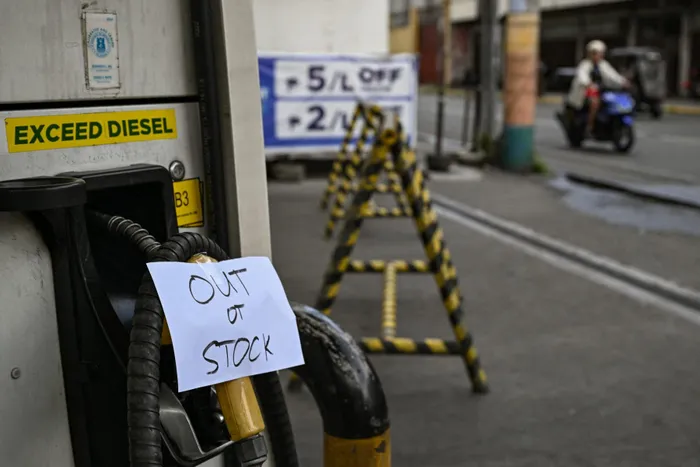
A sign reading 'out of stock' is displayed at a gas station amid rising petrol prices in Manila. The price of the main US benchmark for oil surged more than 30% on March 9 over concerns that the Middle East war could create prolonged supply disruptions.
Image: JAM STA ROSA / AFP
THE wages of war are almost always blood and money. March this year marked an escalation of conflict in the Middle East involving Iran, the US and Israel, creating a major supply-side shock to global energy markets and triggering a "geopolitical risk premium".
For South Africa, a net importer of oil, this translates to higher fuel prices, imported inflation, delayed interest rate relief, and increased strain on the fiscus. While the National Treasury has built some buffers, the crisis threatens to derail the recent improvement in fiscal optimism.
In early March, Brent crude oil surged almost 18%, due to the closure of the Strait of Hormuz, a maritime chokepoint through which roughly 20% of the world’s oil and liquefied natural gas (LNG) passes.
The world’s largest LNG supplier, Qatar and other Gulf states, are seeing their supply routes paralysed. Saudi Arabia and Russia, led by OPEC+, continue to manage the market through production cuts, reducing the global supply cushion and exacerbating supply shocks, thereby driving up prices for refined products such as petrol, diesel and jet fuel.
South Africa's fuel prices are largely determined by international oil and gas prices, and the rand/dollar exchange rate. Higher landed costs of refined fuels or a weaker rand mean petrol prices go up.
The Red Sea shipping crisis forces vessels to reroute around the Cape of Good Hope. While this brings more traffic to South African waters, it adds roughly 4,000 nautical miles to each journey, increasing transit times by 30% and significantly hiking freight and insurance costs.
JP Morgan Research estimates these disruptions could add 0.7 percentage points to global core goods inflation.
South Africa is a "net importer" of oil, meaning we are structurally exposed to any volatility in the Middle East.
Domestic petrol and diesel prices are likely to increase due to the higher oil prices and a weaker Rand
- Rand volatility: the rand has depreciated significantly, recently trading at its lowest levels since late 2025 (around R16,80 to the US dollar). Investors are fleeing emerging markets for "safe haven" US dollar assets. As an importer of oil, South Africa can expect a drain on the current account of the balance of payments. As the higher oil import bill rises, the country needs more foreign currency (US dollars) to pay for it, thereby increasing demand for dollars and putting pressure on the rand.
Then a weaker rand further exacerbates the cost of all imports, including fuel, creating a vicious cycle. A weaker currency also adds to domestic inflation, reinforcing the pressures mentioned above. The rand's status as a risk-sensitive, emerging-market currency means it often weakens precisely during periods of global geopolitical stress, amplifying the initial oil price shock.
- Inflation and interest rates: fuel is a major input for all forms of transport. Increased fuel prices lead to higher logistics costs for goods, from food to manufactured products. This is passed on to consumers. Many industries, from mining to manufacturing, rely heavily on diesel for their operations (including running generators to mitigate load shedding, which adds another layer of cost).
Higher diesel prices directly increase their operating expenses. The South African Reserve Bank (SARB) had previously signalled a potential interest rate cut. However, due to "imported inflation" from higher fuel and transport costs, the SARB is now redrafting its risk scenarios. The Reserve Bank governor indicated that markets were now pricing in a potential 0,25% interest rate hike rather than a cut. While South African gold producers stand to benefit, as global uncertainty rises, gold prices typically climb, and a weaker rand means higher local earnings for exporters, which provides some cushion for the National Treasury.
- Future debt and 2027 National Budget
Debt has stabilised for the first time in 17 years. The finance minister announced that gross loan debt is projected to peak at 78,9% of GDP in 2025/26. However, where the rand's weakness is expected, our national debt may well be strained in the 2027 Budget, affecting future Budget spending.
For South Africans, this translates to a burden on every household. Higher diesel prices directly lead to higher grocery prices and delivery fees. As an economy, our resilience is being tested by external shocks that are likely to delay much-needed interest rate relief and keep the cost of living elevated for the foreseeable future.
For the South African consumer and economy, the turmoil in the Middle East translates into a series of tangible and interconnected hardships: higher fuel prices, elevated inflation, pressure on the rand, and increased costs for traded goods. It underscores the country's vulnerability as a price taker in global energy markets.
While South Africa cannot influence geopolitical events in the Middle East or OPEC+ decisions, the experience reinforces the critical importance of diversifying energy sources, improving logistics efficiency, and maintaining policy credibility to build resilience against these unavoidable external shocks.