

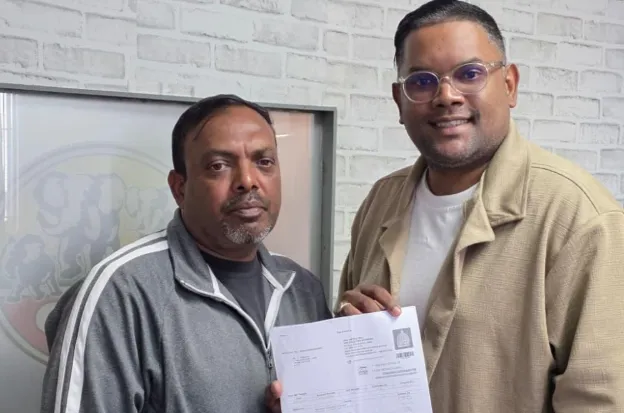
After a shocking R1.4 million water bill, Phoenix resident Rajesh Sahadeo, left, is relieved after the account was reversed following intervention from IFP councillor Dr Jonathan Annipen.
Image: Supplied
ACCESS to basic municipal services such as water, electricity, sanitation and refuse removal is a fundamental component of dignity in any society. Yet for many residents across our communities, the monthly municipal bill has become a source of deep anxiety rather than a simple statement of services rendered. Over the past several years in public office, one of the most consistent issues brought to my attention has been the burden of incorrect or inflated utility accounts faced by ordinary residents.
In my experience as a ward councillor, thousands of residents have approached my office seeking assistance with municipal billing disputes. The stories are often deeply distressing. Pensioners living on fixed incomes suddenly receive accounts running into tens or hundreds of thousands of rand. Families who have faithfully paid their municipal bills for years suddenly face unexplained escalations due to estimated readings, faulty meters or historical charges that have accumulated over long periods.
Through sustained engagement with municipal departments and the persistent lodging of disputes on behalf of residents, my office has been able to assist thousands of customers in having incorrect charges reviewed and reversed. In many cases, the amounts involved are significant. Some residents have had bills reduced by R10,000 or R20,000 after errors were corrected. In other cases, the amounts have been far larger.
The highest single adjustment facilitated through our interventions involved a staggering R1,5 million that had been incorrectly billed to a resident. While such extreme cases are rare, they highlight the profound impact that billing inaccuracies can have on individuals and families. Overall, through the collective efforts of my office working with municipal officials, more than R50 million in incorrect or disputed charges have been written off or corrected for residents.
It is important to emphasise that these interventions are not about avoiding payment for legitimate services. On the contrary, they are about ensuring that residents are billed accurately and fairly for what they actually consume. When billing systems malfunction or administrative errors occur, the consequences can be devastating for households that simply do not have the means to challenge complex municipal processes on their own.
A number of recurring factors contribute to the billing problems experienced by residents. One of the most common causes is estimated billing. When meters are not read regularly, accounts may be calculated based on estimates rather than actual consumption. Over time, these estimates can accumulate and lead to dramatic adjustments once actual readings are finally taken.
Water leaks are another frequent cause of unusually high bills. Many residents only discover underground or concealed leaks after their accounts escalate dramatically. In such cases, the financial burden can be overwhelming, particularly for low-income households.
Historical debt is also a major factor. In some instances, charges dating back many years suddenly appear on accounts due to system reconciliations or administrative adjustments. Residents are then confronted with debts they were often unaware existed.
While addressing billing disputes is critical, it is equally important to ensure that residents are aware of the support mechanisms available to them through the municipality. The city has several social relief programmes designed specifically to assist vulnerable households.
One of the most important of these is the municipal indigent support programme. This programme provides qualifying households with a range of relief measures, including free basic water and electricity allocations as well as reductions or rebates on certain service charges. For pensioners and low-income households, these benefits can make a significant difference in managing monthly expenses.
In addition to the indigent programme, the city periodically introduces debt relief initiatives aimed at assisting residents who have accumulated arrears. These programmes may offer structured repayment plans, partial debt write-offs or incentives to encourage residents to regularise their accounts.
Such initiatives recognise an important reality: many residents are willing to pay for services but simply require fair billing, reasonable repayment arrangements and compassionate support where genuine hardship exists.
However, these programmes can only benefit residents if they are aware of them and if they apply. Unfortunately, many households remain unaware of the assistance available to them or find the administrative processes difficult to navigate.
This is where local leadership and community engagement become essential. My office has made it a priority not only to assist residents in resolving billing disputes, but also to guide them through the process of accessing municipal relief programmes for which they qualify.
Ultimately, the goal is not merely to correct accounts but to restore trust between residents and the municipality. When people feel that the system is responsive and fair, they are far more likely to remain committed to paying for the services they receive.
Municipal sustainability depends on this balance. Residents must be billed accurately and treated fairly, while the municipality must ensure that revenue collection remains strong enough to maintain and expand essential infrastructure.
The experiences of the past several years have reinforced a simple, but important lesson: local government works best when it remains accessible to the people it serves. Behind every billing dispute is a family, a pensioner, or a small household struggling to make ends meet.
If residents believe that their municipal accounts are incorrect, or if they require assistance navigating the city’s relief programmes, they should not hesitate to seek help. My office remains committed to assisting residents wherever possible.
Those who require assistance can contact our office via WhatsApp at 069 763 2606, where our team will guide them through the necessary processes to resolve billing concerns or access available support.
Ensuring fairness in municipal billing is not simply an administrative task. It is part of a broader commitment to justice, dignity and responsible governance in the communities we serve.
** The views expressed do not necessarily reflect the views of IOL or Independent Media.