
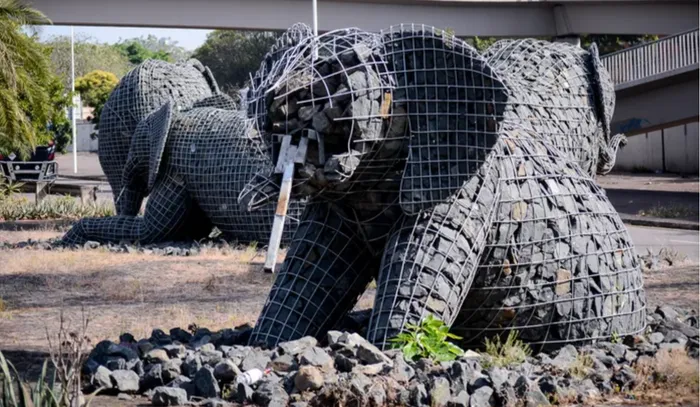
The Elephant Sculptures by Andries Botha that was completed in 2010 was meant to celebrate a proud African heritage of the the city of Durban.
Image: Suppiled
VANDALISED elephant sculptures made of a galvanised steel armature filled with rocks emerge from a freeway island as you enter the city of Durban. Its state of dismemberment, disrepair and decay is a precursor to a city that lies in an equal state of malaise. The sculptures, intended to be completed ahead of the 2010 Fifa World Cup, signified a golden period 16 years into South Africa’s democracy when revisionist signs, symbols and memorials were emerging after the dismantling of apartheid in 1994.
The call to see a memorialisation of a long marginalised people’s history that was reflective of the majority of people in South Africa came from a speech by then president Nelson Mandela on Heritage Day in 1997. On that occasion, Mandela inaugurated the Robben Island Museum on the very site where he had been held as a prisoner.
In his speech, Mandela openly flogged the country’s museums, characterising these places as, by and large, “disgraceful to the majority of its citizens. 'Ninety-seven percent' of their displays reflected colonialist and apartheid points of view.”
A seminal study by Steven Dubin titled Transforming Museums, Mounting Queen Victoria in a democratic South Africa, argues that since the first democratic general election of 1994, “South Africa is a society rife with contradictions – a far cry from the condition of moral clarity regarding good and evil that the apartheid system afforded for both its supporters and opponents. South Africa today is simultaneously more open and more closed up; concurrently tribal and universalistic; both inclusive and alienating; and alternately buoyed by optimism, and laden with hopelessness.”
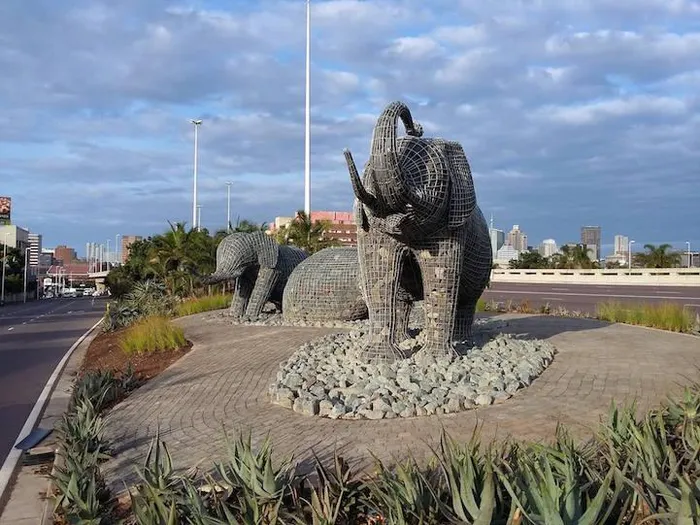
The sculptures, by Andries Botha, were commissioned by the eThekwini Municipality.
Image: Supplied
This hopelessness is the antithesis of what renowned sculptor Andries Botha expected the elephant sculptures would symbolise. Botha believed that the exact spot where the sculpture had been positioned marked the place where the last free-roaming elephant was killed at the turn of the 20th century. The elephant installation was meant to symbolise the triumphal rise of the species in a post-colonial paradigm that hoped to shed a shackled identity of a people waiting to forge a distinct and proudly African identity.
This unique South African identity has yet to fully reveal itself, 32 years into South Africa’s democracy. Despite this, it’s an identity that overwhelmingly refused to accept the unveiling of eThekwini’s Nelson Mandela and Oliver Tambo bronzes last week.
The unveiling came at a time when the city lay in a state of disrepair, dismemberment and decay, with municipal services in a corrupt state of neglect that is similar to the disbanded state of the elephant sculptures. While the right to water and basic amenities must be prioritised at the top of our city's priority lists, the importance of memorialising a people’s history and heritage to reflect a truly South African identity must be kept alive.
In the words of President Cyril Ramaphosa: “The cost of what they contributed to our Struggle is incalculable. We cannot even begin to count what it costs for us to be where we are. In stone and bronze, we continue to write our history. Not the history of those who held power unjustly, but the history of those who refused to let injustice have the final word.”
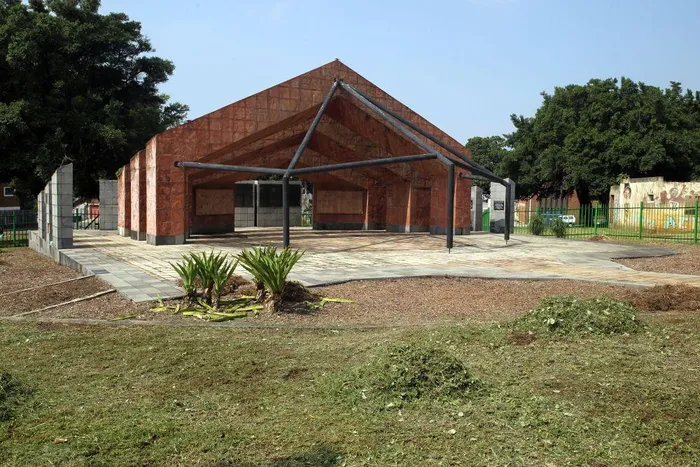
The Passive Resistance Park in Umbilo that is presently being renovated commemorates the 1946 Passive Resistance Campaign that was a pivotal anti-segregation movement launched on June 13, 1946, by South African Indians against the "Ghetto Act".
Image: Supplied
The importance of rewriting our history was emphasised by the 2015 Rhodes Must Fall (RMF) movement at the University of Cape Town (UCT) that significantly impacted South Africa and the globe. After a month of intense organising and struggle, it resulted in the removal of a statue of British colonist Cecil Rhodes at the University of Cape Town on April 9, 2015.
The RMF movement opened a broad, ongoing and critical discourse on decolonising higher education and dismantling institutional racism. It successfully removed the Cecil Rhodes statue, sparked the #FeesMustFall campaign, and inspired international movements, like #OxfordMustFall, to challenge colonial symbols.
The movement was about more than this. Students across the country agitated for the decolonisation of the university and the decommodification of education. Those conversations about apartheid supremacy and the enduring legacy of colonialism continue today against the backdrop of failing municipalities that inspire little in keeping hope alive. In this vein, and as we debate the need for the Mandela and Tambo bronzes, a question that we can also throw into the debate is whether Durban has shed its apartheid and colonial identity.
As South Africa’s Constitution was being formed, many Struggle veterans believed that apartheid constructs like Chatsworth, Phoenix, uMlazi and Wentworth should give way to create a common South African identity that is free from the shackles of the past, and free to emerge without inhibition.
Throughout the world, identities emerge, giving vent to creative expression in the forms of architectural styles, memorials, museums, commemorations and national identities that have centuries-old existence.
Durban’s post-colonial and post-apartheid identity is in its infancy. Thirty-two years into our democracy, the elephant sculpture, the presently-constructed Indentured Workers Memorial, the former Durban Central Prison Wall, the Passive Resistance Park in Umbilo, Phansi Museum, the 1860 Heritage Centre, the Moses Mabhida Stadium, the South Africa in the Making Museum, the site of the martyrdom of Johannes Nkosi at Cartwright Taxi Rank, Currie's Fountain, the Early Morning Market, and the Mandela and Tambo bronzes deserve their place in the sun to shine on a long overdue identity.
In 2000, the eThekwini Metropolitan Municipality was established, incorporating Durban and surrounding areas, with the name derived from the Zulu word iTheku (bay/lagoon). Ongoing, often controversial, renaming initiatives in the region aim to replace colonial-era names with those honoring liberation heroes and reflecting local heritage, featuring proposed changes to even the renaming of the province of KwaZulu-Natal.
King Misuzulu Sinqobile kaZwelithini wishes to dispose of the colonial identity of Natal to KwaZulu, which must be given careful consideration and thought. The process that follows in the renaming must be inclusive and practical. Holding on to the name "Natal" in KwaZulu-Natal keeps us celebrating a fractured past with no attempt to bring pride to a people's identity.
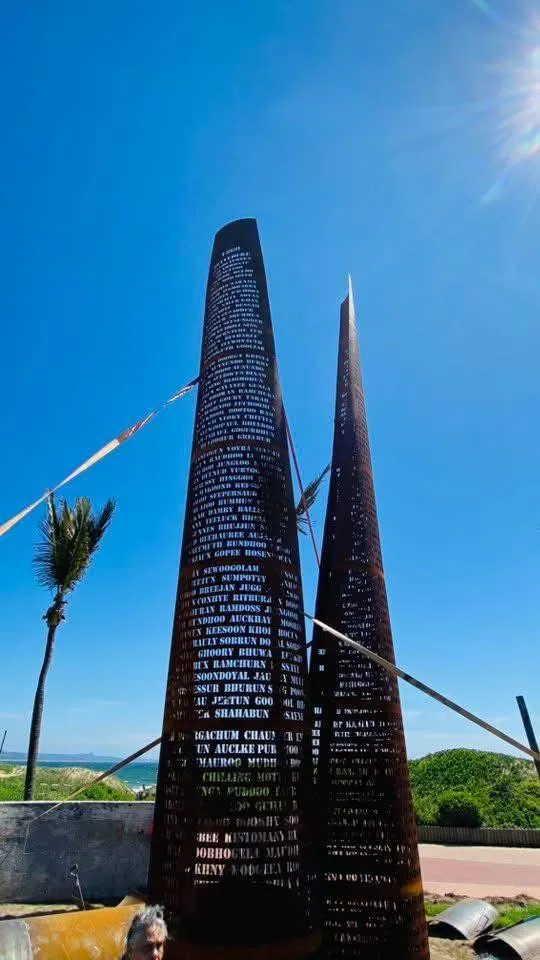
The Indentured Workers Memorial being constructed on the Durban beach promenade.
Image: Selvan Naidoo
The cost implications, however, make for a phased, sensible, and budget-driven implementation process. The change in the names of Tshwane and Gauteng would guide our processes in ensuring a smooth transition, but only after the priority of fixing our city is met, by putting access to health care, water and sanitation at the top of our agenda.
Three decades into the 21st century, it is time we restore dignity to a people's identity. Why names like Port Shepstone, Chatsworth, Wentworth and others still exist is beyond inclusivity and practicality. Colonial and apartheid era names continue to erase a people’s presence and memory.
Chatsworth deserves to be named after indentured workers like Mulliah Ankie Reddy, who built community schools in the area. The University of KwaZulu-Natal Nelson Mandela Medical School should be renamed after South African medical doctor, academic and former anti-apartheid activist, Professor Jerry Coovadia.
Asherville should be named after the recipient of the Order of Luthuli, Swaminathan Karuppa Gounden. Wentworth should be renamed after former MK veteran Greta Apelgren, and Umbilo after Harriet Bolton.
Countries like Australia recognise Aboriginal and Torres Strait Islander peoples through legal frameworks like Native Title, acknowledging their traditional laws and customs over land and waters since the landmark Mabo decision, alongside cultural practices such as the acknowledgement of country. Surely South Africa and Durban, after prioritising their citizens’ basic needs, should follow suit in the renaming of their places of conscience and building revisionist signs, symbols, and memorials to create an identity that is distinctly and proudly South African.
** The views expressed do not necessarily reflect the views of IOL or Independent Media.