
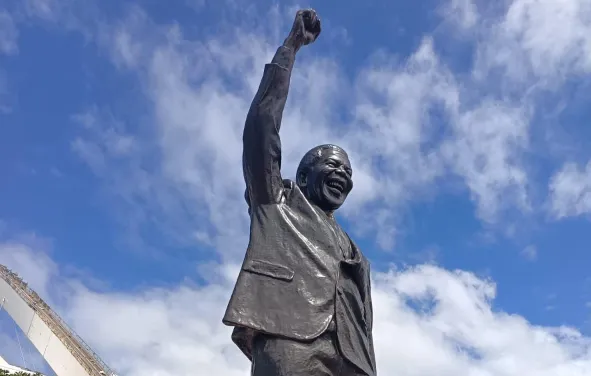
The statue of Nelson Mandela was unveiled at the Moses Mabhida Stadium on Tuesday.
Image: SABC News
THE recent unveiling of two monumental statues in Durban depicting Nelson Mandela and Oliver Tambo has ignited both celebration and debate across South Africa. While these works of public art honour two of the nation’s most influential liberation leaders, the estimated R22 million cost has raised questions about government spending priorities. Yet from a tourism perspective, their significance extends far beyond the price tag.
The statues represent a deliberate intervention in heritage tourism, destination identity, and the symbolic landscapes that shape how visitors experience Durban. Tourism scholarship recognises the role of monuments in shaping the cultural narratives of destinations. Statues and public art contribute to the “symbolic capital” of a place, creating physical focal points where historical memory, political identity, and cultural heritage are communicated. By choosing to commemorate Mandela and Tambo in prominent urban spaces, Durban aligns itself with South Africa’s broader liberation heritage tourism landscape.
Mandela and Tambo occupy central positions in the country’s democratic history. Mandela’s leadership in the transition from apartheid to democracy, and Tambo’s decades of mobilising international support for the anti-apartheid Struggle, remain foundational to the nation’s collective memory. By embedding these figures in Durban’s urban fabric, the city participates in the ongoing process of memorialising the Struggle for freedom, providing residents and visitors with tangible connections to the country’s democratic journey.
The placement of the statues is strategic from a tourism planning perspective. Mandela’s statue stands near Moses Mabhida Stadium, an iconic landmark built for the 2010 Fifa World Cup that attracts visitors for sport, concerts and panoramic views from its arch. The statue reinforces the stadium’s role as a multifunctional tourism node where leisure, heritage and cultural storytelling intersect.
Tambo’s statue along Durban’s beachfront promenade similarly capitalises on high visitor traffic, integrating heritage monuments into spaces already central to the city’s tourism.
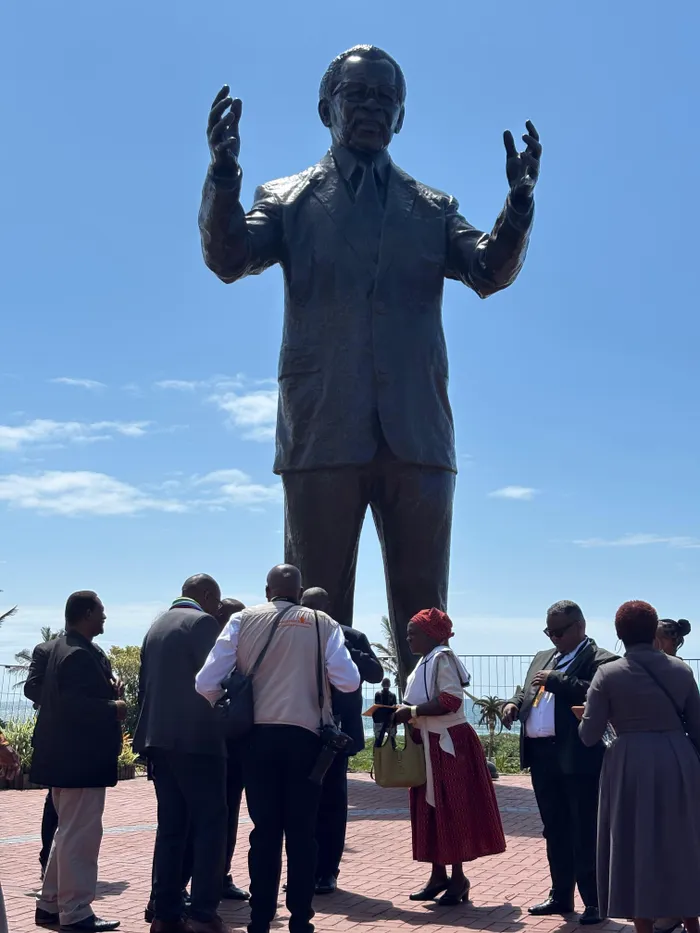
The O R Tambo statute was officially unveiled by President Cyril Ramaphosa in Durban.
Image: Sipho Jack
This approach embeds historical storytelling into the everyday movement of visitors, making engagement with heritage seamless and accessible. These interventions reflect contemporary approaches to destination development. While Durban’s tourism has long centred on sun, sea and leisure, the city’s global competitiveness increasingly depends on diversifying its offerings. Heritage tourism, cultural tourism and memory tourism provide meaningful opportunities to engage visitors beyond beaches and resorts.
Academic programmes at institutions such as Mancosa mirror this perspective, incorporating heritage landmarks and commemorative sites into the curricula. Students examine how symbolic spaces, historical interpretation and destination development intersect, equipping them to shape culturally-informed tourism experiences. The statues contribute to what tourism researchers call “meaning-making”, allowing visitors to connect emotionally and intellectually with historical narratives.
By encountering these monuments, tourists are prompted to reflect on the significance of Mandela and Tambo, and on South Africa’s broader Struggle for freedom. In doing so, Durban fosters a form of experiential learning, where public art becomes both an educational tool and a catalyst for dialogue about history, identity and civic values. The presence of the statues also opens the door to complementary tourism products. Guided heritage walks, educational tours, storytelling initiatives and cultural events can be built around these sites, creating opportunities for local economic participation. Tour guides, cultural interpreters and community-based tourism enterprises can all benefit from the enhanced visitor engagement these landmarks generate.
Nevertheless, the R22 million cost remains contentious. Critics argue that funds could have been redirected toward urgent service delivery priorities, such as housing, water or infrastructure. This tension highlights a recurring challenge in urban governance: balancing investments in cultural and symbolic infrastructure with the immediate needs of local communities. From a tourism policy standpoint, however, cultural infrastructure often yields long-term intangible benefits. Monuments, museums and heritage sites rarely provide immediate economic returns, yet they significantly enhance a city’s cultural branding, identity and recognition.
Over time, such landmarks can become defining symbols of a destination, attracting visitors, media attention and cultural prestige. While Durban’s statues may not yet achieve global fame, they strengthen the city’s cultural landscape, and offer visual markers that can be incorporated into heritage routes and tourism marketing. Beyond tourism, monuments serve a critical social function by fostering civic pride and collective memory. Public art commemorating national heroes resonates with residents as well as visitors, reinforcing shared identity.
Mandela and Tambo embody values such as resilience, freedom and reconciliation, and their public commemoration provides daily reminders of these ideals. For younger generations who did not live through apartheid, the statues function as embedded educational tools, inviting reflection and dialogue within everyday urban spaces. For Durban, the unveiling of these monuments signals an effort to reposition the city within South Africa’s national heritage narrative.
While public debate over cost will persist, the long-term implications for tourism are substantial. If integrated into heritage trails, educational programming and marketing strategies, these statues can become central to Durban’s tourism ecosystem. Success depends not only on their physical presence, but on the interpretive frameworks and engagement strategies built around them. Stories, guided experiences, and cultural programming transform statues from static structures into living heritage attractions.
In this context, the Mandela and Tambo statues represent more than artistic or political gestures. They exemplify the intersection of memory, identity and destination development. Durban’s approach demonstrates how cities can materialise history within public space while navigating governance, accountability and the expectations of both residents and tourists. Whether seen as contested expenditures or investments in cultural heritage, the statues have become integral to Durban’s evolving tourism narrative, honouring the past while shaping the city’s future as a destination.
Ultimately, these monuments highlight the role of heritage in contemporary urban tourism. Visitors encounter not only physical structures, but the stories, struggles and triumphs they represent. For Durban, Mandela and Tambo now occupy spaces where leisure, culture, and history converge, offering tourists meaningful experiences, and locals a daily reminder of the values that underpin the nation’s democratic journey. Through these statues, Durban is not just celebrating its heroes; it is crafting a heritage-driven tourism identity that bridges memory and modernity, education and experience, past and future.

Shireen Eraman
Image: Supplied
Shireen Eraman: academic programme leader – School of Marketing, Communication and Global Tourism and Hospitality at Mancosa.
** The views expressed do not necessarily reflect the views of IOL or Independent Media.