
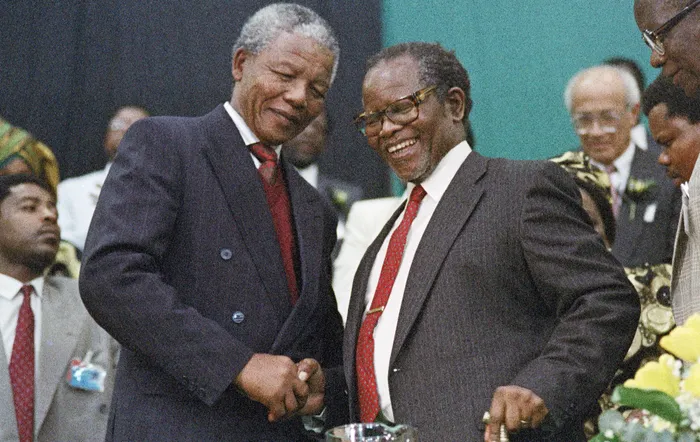
The eThekwini Municipality released statues of ANC leaders Nelson Mandela and Oliver Tambo in Durban.
Image: AFP
AS SOME South Africans celebrate yet another round of the unveiling of statues of former presidents of the ANC, Oliver Tambo and Nelson Mandela, other citizens of South Africa are growing tired of the over-celebration of the same leaders.
The reasons for the tiredness range from the ANC government’s inability to deliver on its promise of creating "a better life for all", to its obsession with selectively honouring the ANC leaders as the only heroes of post-apartheid South Africa.
It is now obvious even to a teenager that the ANC’s claim of ready-to-govern was not honest. Instead of acknowledging that it keeps overpromising and underdelivering, it shifts the focus to changes that involve renaming public spaces and erecting statues. Of course, it is easier to erect statues of Tambo and Mandela than to fix the city’s problems, such as the glaring infrastructure decay and inability to provide basic services.
The more the ANC government prioritises symbolic change, the more it sends the message that it is out of touch and running out of ideas to bring about meaningful change that lifts millions out of poverty, and restores the dignity of almost half the population that remains dependent and trapped on social grants.
It should be noted that one of the promises of post-apartheid was the representation of all citizens regardless of race and social class. If we say all citizens are now represented, then the question is: how can one be said to represent another, and what it is that elected representatives represent?Are these the views of the represented, their best interests, or merely representation based on resemblance, that is, having representatives who look like the make-up of the whole population?
In essence, the question is: are most Durban citizens better off in 2026 than they were 32 years ago in terms of their quality of life? Has the ANC local government been responsive and accountable to the citizens of eThekwini?
Last week, President Cyril Ramaphosa unveiled the statues of Tambo on Durban’s North Beach and of Mandela at the Moses Mabhida Stadium. Undoubtedly, these two men are heroes to millions of South Africans, particularly those who admire the ANC’s role in ending apartheid rule.
However, some South Africans are wondering why so many statues of the same people from the same political party are erected across the country. There is no doubt that Tambo and Mandela made sacrifices, but so did the leaders of other liberation movements, such as the Pan-African Congress and the Azanian Peoples’ Organisation, to name a few. Is the ANC government trying to suggest that only the ANC fought against apartheid rule?
This begs the question: would Tambo and Mandela approve of, and be proud of, having priority given to their statues rather than to basic services such as a reliable supply of water and electricity? Moreover, Tambo and Mandela would be ashamed to have their statues erected in a dirty city whose infrastructure has been neglected, as evidenced by the potholes on the roads, the hijacking of buildings, and the unattended drainage systems.
To make matters worse, the city of eThekwini is not enforcing by-laws. This has enabled vagrants to invade downtown, leaving a stench that is now suffocating in the central business district.
Another problem with this blatant rewriting of history is that it seeks to erase the contributions of South Africans outside the ANC. Over time, when the ANC no longer dominates South African politics, future generations will question this selective honouring of heroes and even query their relevance in a post-apartheid state that is fraught with mismanagement, corruption and unethical leadership.
The result is that, one day, there would be those calling for the removal of Tambo’s and Mandela’s statues, similar to the calls for the removal of colonial statues, such as those of Cecil Rhodes at the University of Cape Town and King George at Howard College campus of the University of KwaZulu-Natal.
This means ANC leaders are showing a lack of foresight by failing to recognise the danger of excluding South African heroes outside the ANC.
Already, the names of these two Struggle heroes are deeply ingrained in South African history, and they are celebrated through the renaming of public spaces and the building of their statues. For example, the country’s main international airport in Johannesburg is named after Tambo, with his statue towering over the airport, and the UKZN's medical school in Durban is named after Mandela, and so is Port Elizabeth (now Nelson Mandela Bay).
Mandela’s statues, it seems, are everywhere. The most famous and largest statue is the 9-meter bronze statue located at the seat of the executive branch of government, the Union Buildings in Pretoria. Another prominent 6-meter statue is located in the Mandela Square in Sandton.
The million-dollar question now is: why did the city of eThekwini spend R22 million of taxpayers’ money to erect the two statues at a time when eThekwini faces so many problems?
The leaders of eThekwini's local government say these statues will boost tourism in the city and go a long way in recognising the immense contributions of these freedom fighters.
There is already a gigantic statue of King Shaka at Durban’s King Shaka International Airport, meant to attract tourists. How do we know that the statue of King Shaka at the airport is playing any role in attracting tourists to KZN?
This begs the question: is the city of eThekwini (South Africa’s playground) trying to tell us that more tourists would be drawn to eThekwini just to see the three statues? One wonders why leaders of eThekwini are not focusing on cleaning one of the dirtiest cities in South Africa and making it safe to attract tourists and investors.
The unveiling of these statues comes at a time when South Africa is preparing to hold local government elections this year. The ANC has lost significant support in eThekwini, across KZN, and in provinces such as Gauteng, Mpumalanga, and the Northern Cape. In the 2024 elections, the ANC suffered a humiliating defeat in KZN, finishing third behind former president Jacob Zuma’s MK Party and the IFP.
The result is that the ANC is now part of a coalition government at the national level, in the three provinces of KZN, Gauteng, and the Northern Cape, and in the eThekwini local government. So, what does this tell us about what we can expect in the upcoming elections?
It is clear that the ANC is likely to lose more electoral support in the 2026 elections. The unveiling of the two statues is a desperate attempt to regain lost support and cling to power in eThekwini.
** The views expressed do not necessarily reflect the views of IOL or Independent Media.