
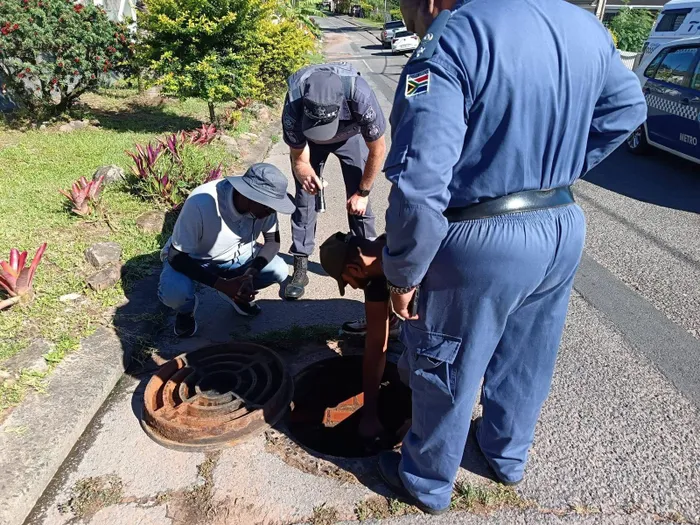
Members of the SAPS and metro police inspect a manhole for drugs during a recent raid at a Chatsworth home.
Image: Supplied
IN RECENT weeks, our news has been flooded with stories of the drug scourge in our communities of Chatsworth and Phoenix. It is time for us to confront this uncomfortable reality.
Every community has its corners, the street light at the end of a road, the bench outside a small shop, the patch of pavement where young people gather when the day has ended. In many parts of Chatsworth and Phoenix, these corners tell the stories of the drug crisis that is taking place, and that statistics alone cannot explain.
Picture this –three young men stand under a street light. One has left his house because his parents are fighting again. Their shouting is heard through thin walls and he needs silence to study. Another lingers outside because his mother works two jobs and his father has never been part of his life. He is lonely. A third lives with his grandmother, and she supports his brother and him with her only source of income – her government pension. There is little to eat on most days, and even less that he feels that he can do to change the situation.
None of them had the intention of becoming addicts. They were all searching for something every young person sought and that was belonging, relief and validation. Eventually one of these young men introduces a small packet or pill. He was told that it could provide a moment of happiness, a brief escape from the weight that each of them carries. What begins as experimentation slowly becomes dependence. This is how the drug crisis often begins within our communities, with wounded young people searching for relief, not hardened criminals.
When the conversation about drugs in Chatsworth and Phoenix takes place, the public imagination often turns immediately to the figure of a drug dealer. In popular mythology, these figures are sometimes portrayed as local heroes, individuals who distribute money, sponsor events or help struggling families. But those who live in our neighbourhoods know the real and complicated truth. The reality is that most residents do not admire drug dealers; they fear them. Drug dealers carry weapons, they command networks of men and women from different backgrounds, they possess the capacity to intimidate anyone who challenges them.
In some cases they approach vulnerable children, introduce them to drugs and then cultivate loyalty through small acts of so-called generosity. For example, rent might suddenly be paid for a struggling household or groceries may arrive unexpected. Yet these gestures do not represent kindness, rather they represent control. Communities learn quickly that accepting a favour means surrendering a measure of independence – the meal provided today may become silence demanded tomorrow. Fear, not admiration, is the real currency of the drug economy.
The story can, however, be more complex. Among those once involved in drug networks are individuals who have turned away from that life and now seek redemption. Some former dealers attempt to guide younger people away from the mistakes they themselves made. Their existence proves that transformation is possible, even in spaces where hope appears scarce.
When discussing drugs in Chatsworth and Phoenix, attention often focuses exclusively on illegal substances such as heroin, nyaope, or crystal methamphetamine. Yet another crisis is also unfolding alongside it, the abuse of prescription medication. Powerful painkillers, sedatives and amphetamine-based stimulants circulate widely through both formal and informal channels. Tablets intended for legitimate medical treatment have become sought-after commodities, and because these substances originate in pharmacies rather than clandestine laboratories, many underestimate their danger. Addiction does not distinguish between a pill from a pharmacy and a powder from a packet, and the effect on families can be equally devastating.
Understanding why the drug economy flourishes requires us to confront uncomfortable truths, especially about opportunity and recognition. Young people who struggle within the traditional schooling system often become invisible in our communities. The child who fails a grade may sit quietly at the back of the classroom while attention focuses on those who succeed. Then one day a sinister someone arrives – with an offer, a ride in a flashy kitted-out car, a shiny chain to wear around the neck, a chance to have the appearance of status.
In a world where dignity often feels scarce, such symbols can appear intoxicating. But the promise always carries a hidden cost. Eventually the same young person may be asked to take the fall when police arrive, to carry the risk that others will refuse to bear. A young life becomes expendable in a marketplace built on exploitation. The tragedy is that many of these young people possess talents that are simply undiscovered. Not every child will thrive in conventional academic pathways, but many could excel in technical fields, such as plumbing, electrical work, mechanical trades and digital skills. Communities that create alternative pathways for dignity deprive the drug economy of its most valuable resource, young people who believe they have nowhere else to belong.
Yet even the most thoughtful community initiatives cannot succeed without confronting another difficult reality – integrity within institutions matters. Across South Africa, countless police officers serve with courage and honour, often at great personal risk. Communities depend on their dedication. But it would be dishonest to ignore that corruption also exists within the very systems meant to protect us. Residents occasionally whisper to each other about officers seen visiting the homes of known dealers, about warnings that have been given before raids, about investigations that endlessly stall. Whether every rumour is true is less important than the damage such perceptions cause. Trust is fragile. When communities begin to believe that the law can be bought, fear can grow stronger than justice. This is why confronting the drug crisis requires more from us than arrests or speeches. It requires moral courage within institutions and within us, the communities, itself.
We must reject the subtle normalisation of criminal patronage. A free meal or a sponsored event may appear harmless, but dependence erodes the independence that we need – to defend ourselves. Dignity cannot be built on borrowed generosity. Yet even as we speak hard truths, we must remember that the roots of the drug crisis extend deeper than crime alone. They reach into loneliness, poverty, broken homes, untreated trauma and the despair that often lives behind closed doors.
A young person standing under a street light is rarely ever there by accident. What would it mean for communities to intervene earlier, before the first packet appears? It might mean teachers recognising the struggling student not as a failure, but as a future artisan. It might mean mentorship programmes led by reformed individuals who understand the cost of the drug trade better than anyone else. It might mean expanding rehabilitation so that addiction is treated as a health crisis rather than merely a criminal offence. Most importantly, it means restoring a culture of collective responsibility. No single institution will solve the drug crisis in Chatsworth and Phoenix. Not the police alone, not the government alone, not families alone. But when we, the communities, confront the truth with courage – when we refuse fear, when we reject corruption and when we create new pathways for our youth, we possess power.
We, the same communities that once survived displacement and hardship, posses within us the capacity to overcome this challenge as well. Yes, the poison that runs through our streets today is real, but so too is the possibility of healing. The future of our communities will depend on which of those forces we choose to strengthen.
** The views expressed do not necessarily reflect the views of IOL or Independent Media.