

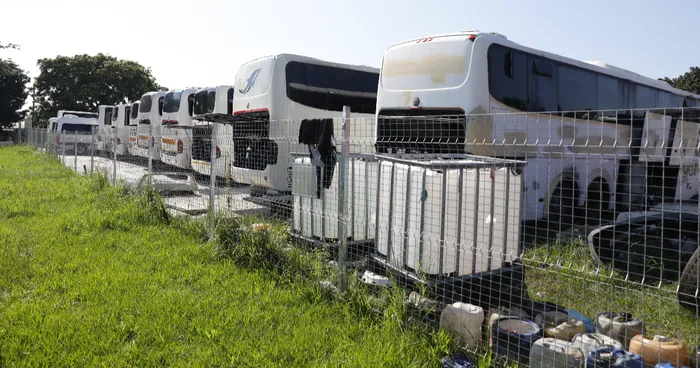
Buses parked on the grounds of Havenpark Secondary in Phoenix.
Image: Doctor Ngcobo/Independent Newspapers
MARTIN MEYER writes about the critical role of laws and regulations in maintaining order in society, particularly within the education sector, and highlights the responsibilities of the KZN Department of Public Works and Infrastructure.
RULES matter because they are the invisible framework that holds a society together.
They create order where there could easily be chaos, allowing millions of people to live, work and move alongside one another with confidence.
Laws protect the vulnerable as much as the powerful, ensure that rights are respected, and provide clear consequences when those rights are violated. They make our roads safer, our communities more stable, and our institutions more trustworthy.
When rules are applied equally and enforced consistently, they do more than punish wrongdoing; they create fairness, security and predictability.
In that way, the rule of law is not a burden on society but the engine that allows society to function, grow and move forward together. The KwaZulu-Natal Department of Public Works and Infrastructure, like any government department, operates within the framework of the law.
While a number of laws apply to the department, two are particularly central: the Government Immovable Asset Management Act (Giama) of 2007 and the KwaZulu-Natal Land Administration and Immovable Asset Management Act of 2014.
These laws make it clear that the department is the custodian of provincial government properties. That responsibility includes public schools. In my work I visit schools regularly across the province, and I am acutely aware of the serious funding pressures facing many government schools.
While the department is not directly responsible for school funding, we are trying to assist where possible.
For example, we are addressing water leaks that lead to inflated utility bills, and we are working on the broader issue of how schools are rated and charged municipal tariffs. Schools are allowed, within the confines of the law, to raise funds. This can include making facilities available for community activities.
However, this must always happen within the boundaries set by legislation and municipal by-laws.
These rules exist to protect people and to ensure that school facilities continue to serve their primary purpose: education.
Activities should support the broader educational environment, including sport and community engagement, not undermine or limit teaching and learning. Across the province many schools, for example, rent out halls or classrooms to churches on Sundays.
These activities typically do not harm neighbouring communities, do not physically alter school infrastructure, and do not interfere with teaching. However, the need to raise funds cannot override the law. It cannot override building regulations, zoning rules or municipal by-laws that determine where certain activities may take place and what types of structures may be built. These rules exist for a reason. As custodians of provincial government properties, the department has both a legal mandate and a moral responsibility to ensure that activities on these properties comply with the law.
A school governing body cannot simply allow an illegal structure to be built on government land in the name of fund-raising. Building regulations exist to keep people safe.
We have recently seen tragic building collapses in places such as Verulam, George and Johannesburg. These incidents remind us why regulations matter. Similarly, zoning and by-laws regulate where certain types of businesses may operate for reasons of safety and public order. Ignoring these rules can create real risks.
When the department receives complaints from communities, we do what the public rightly expects of us: we send officials to investigate. Those officials must be allowed to perform their legally mandated duties. No principal and no school governing body has the authority to prevent government officials from carrying out their work.
If an investigation finds that everything is compliant and above board, that is welcome news. If it finds that regulations are not being followed, the department will engage constructively with the school to ensure that the situation is corrected. I welcome the broader debate about school funding in South Africa. It is an important discussion and one that deserves serious attention.
But as we engage in these debates, let us do so on the basis of facts and with a shared commitment to finding workable solutions that respect both the needs of our schools and the rule of law. In the end, the rule of law is not about restriction, but about protection: protection of safety, fairness and the shared space in which our communities and our schools can thrive.
Martin Meyer
Image: Supplied
Martin Meyer is MEC, KZN Department of Public Works and Infrastructure.
** The views expressed do not necessarily reflect the views of IOL or Independent Media.
SIDEBAR:
Two weeks ago, the KZN Department of Public Works and Infrastructure received a complaint about a bus and truck depot operating from Havenpark Secondary, in Phoenix, property, without planning permission. A fenced-off section of the school grounds serves as a depot containing buses, minibuses, tyres, shipping containers, wooden structures, and miscellaneous items.
Department officials together with law enforcement went to the school to investigate.
At the time, Meyer said the depot brought a “severe health risk and safety risk to the pupils” and added that his department was the “custodian and caretaker of all provincial government properties within KZN”.
He said he understood schools could raise funds, even by renting property, but regulated renting space for tuckshops or churches was typically permitted.
“But something like this that is against the bylaws of the city, that is against the land use of the property, and what we as Public Works have assigned as property cannot be allowed, and it must be investigated,” Meyer said.
He added that there was a structure that was erected illegally on the school property and that bylaws, construction laws and land use laws exist to protect.
THE POST