

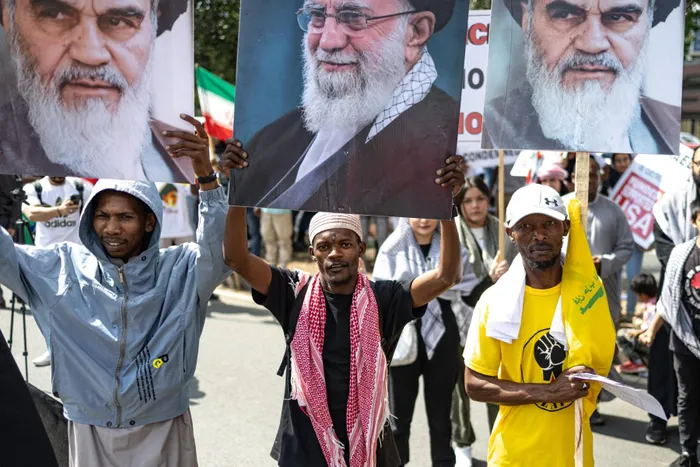
Portraits of the late Iranian Supreme Leader Ayatollah Ali Khamenei, centre, and of the late Ayatollah Komeini, left and right. the founder of the Islamic Republic of Iran, are carried outside the US Consulate in Johannesburg during a demonstration against the ongoing war involving the United States, Israel and Iran, with protesters expressing solidarity with Iran, Yemen and Palestinians.
Image: EMMANUEL CROSET / AFP
WHEN the United States and Israel began attacking Iran and assassinating its spiritual leader, the Ayatollah Khamenei, on the first day of the attack, the conventional wisdom was that they would easily overpower Tehran and achieve their ultimate goal of regime change.
The United States-Israel war with Iran in the Middle East has reached its fourth week with no sign of an imminent end. This begs the question: did the Donald Trump administration make the same mistake as previous administrations of underestimating the opponent?
Iran has targeted countries in the region, such as Saudi Arabia, Qatar, Kuwait, Bahrain, Iraq, and the United Arab Emirates (UAE). These Persian Gulf states have become targets of Iranian attacks because they host the US’s military bases, while Israel is targeting Lebanon, which hosts Iran’s proxy, Hezbollah.
As the war escalates and spreads across the Middle East, it is quite possible that the free flow of goods, particularly petroleum, will remain disrupted in the foreseeable future. The closure of the Strait of Hormuz, a narrow passage through which roughly a fifth of the world’s oil passes, is causing serious problems for the global economy.
Donald Trump, the President of the US, has even appealed to the North Atlantic Treaty Organization (NATO) for help in reopening the Strait for trade.
To make matters worse, both sides in the conflict are also targeting the oil infrastructure and tankers across the Middle East.
This is not good news for the global economy, and indeed for South Africa, whose citizens are already struggling to cope with the high costs of living. Lest we forget, almost half of the South African population depends on social grants. The South African economy, like other economies, is still recovering from the devastating effects of the Covid-19 pandemic. As if that is not bad enough, the violent riots in 2021 also caused massive damage to the South African economy.
There is no doubt that the South African government is following the developments in the Middle East with keen interest. Quite interestingly, South Africa recently hosted a multinational naval exercise dubbed WILL FOR PEACE 2026. The naval exercise included BRICS+ nations of Russia, China, and, controversially, Iran. Conspicuous by their absence were other BRICS+ members, notably India and Brazil. Since returning to the White House, Trump has turned up the heat on countries such as Venezuela, Cuba, and now Iran.
While South African political parties differ on who is to blame for the ongoing war in the Middle East, they all agree that it is bad news for our economy. The disruption to the global oil supply is driving up prices, making the cost of living almost unbearable for many South Africans.
This war comes at a time when South Africa’s relations with both the United States and the state of Israel are severely strained. Since the governing ANC came into power in 1994, South Africa’s relations with Israel and the US have not been cordial. It is an open secret that the ANC has long grudged the two countries for their perceived and tacit support for the apartheid regime.
While the US administrations are generally unfriendly towards the ANC, the Republican ones are much more hostile to it. For instance, in the 1980s, US President Ronald Reagan favoured a constructive engagement policy towards the apartheid regime and even vetoed the comprehensive anti-apartheid bill aimed at imposing sanctions on South Africa. As an advocate for economic sanctions, the ANC viewed the Reagan administration’s actions as an attempt to frustrate its efforts to isolate and punish the apartheid regime.
In his first visit to the US after his release from prison in 1990, Nelson Mandela stirred controversy in a town hall meeting at New York’s City College when he praised the Palestinian Liberation Organization’s Yasser Arafat, Libya’s Colonel Muammar Gaddafi, and Cuba’s Fidel Castro for having supported the liberation struggle in South Africa “to the hilt” and providing resources to the ANC for waging the struggle.
By the same token, Mandela did not mince his words when he lambasted the US and other Western nations for not being there when the ANC appealed for support. Mandela’s rhetoric in the early 1990s, during his US tour, thus set the tone for the ANC government’s attitude towards the West.
Mandela went further and declared his support for the PLO’s struggle for the right to “self-determination”. He infuriated the powerful Jewish lobby in the US when he likened the Israeli state to the apartheid regime. In an unprecedented move, Mandela even campaigned for the liberal Democrat Bill Clinton, who ran for president of the US against the incumbent, the conservative Republican George HW Bush in 1991.
As the governing party in South Africa for the past three decades, the ANC obviously determines the country’s foreign policy. In most countries, foreign policy is shaped primarily by national interests.
However, it appears that the ANC has conflated its interests with the national interests when it comes to its dealings with the US and Israel. In addition, the ANC-led government of national unity (GNU) continues to punch above its weight as if it is a force to be reckoned with in global affairs.
The ANC seems to forget that South Africa’s economy remains heavily reliant on the Western world. For instance, South Africa’s main trading partners remain the European Union (EU) and the North American states of the US and Canada.
Most multinational corporations operating in South Africa are Western and employ millions of people. Similarly, a lion’s share of international tourists who visit South Africa comes from the West. It is in this context that South Africa’s foreign policy towards Israel and the United States appears to be at odds with its national interests.
Since South Africa’s decision to take Israel to the International Court of Justice (ICJ) over accusations of genocide, relations between Pretoria and both Israel and the US have worsened. In early 2025, the Trump administration expelled South Africa’s ambassador to the United States, Ebrahim Rasool, who has not been replaced. Recently, South Africa declared Israel’s ambassador to South Africa, Ariel Seidman, persona non-grate in a major escalation of bilateral relations.
Ironically, South Africa has signaled its willingness to mediate in this conflict, as it has in other conflicts, such as in Northern Ireland and Zimbabwe. Since the end of apartheid, South Africa has sought to champion multilateralism through cooperation and a non-aligned stance. However, South Africa would no longer be considered an impartial mediator in the Middle East conflict because of its perceived bias against Israel.
Since the GNU's formation in 2024, its partners have not spoken with one voice on foreign policy. the Democratic Alliance, the Freedom Front+, and the Inkatha Freedom Party tend to be pro-West. When the ANC government took Israel to the ICJ, these three political parties vehemently opposed the decision. Then last year, when the Trump administration expelled South Africa’s ambassador, Rasool, these parties felt that the ANC was to blame.
What is clear now is that South Africa’s foreign policy is not consistent and principled. In the ongoing war between Russia and Ukraine, South Africa has declared neutrality while it hosts Russia in the naval exercises. It is not good for South Africa to have a foreign policy that preaches non-alignment in some conflicts while openly taking sides in others.
Like Trump, who faced growing pressure on the domestic front after the release of the Epstein files, it appears that the ANC-led government also uses foreign policy to escape its domestic failures.
** The views expressed do not necessarily reflect the views of IOL or Independent Media.