

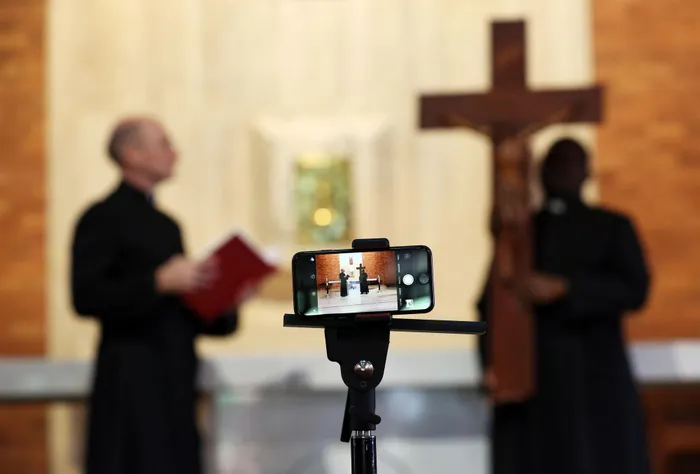
Across the country, Christian communities commemorate Easter through church services, processions, and family gatherings that reflect themes of sacrifice, resurrection, and hope. African Traditional Religion practitioners also utilise this period for rituals, ancestral remembrance, and communal gatherings that affirm identity and continuity.
Image: Shelley Kjonstad/African
Every year, the Easter weekend in South Africa unfolds as far more than a religious observance confined to a single tradition. It becomes a profound national moment of spiritual convergence - where diverse faith communities gather in large numbers, not only to worship, but to reconnect, reflect, and renew bonds of unity. It is a weekend where the sacred and the social intertwine, offering powerful lessons in social cohesion and nation-building.
Among the most remarkable of these gatherings is the pilgrimage of the Zion Christian Church (ZCC) to Moria. Hundreds of thousands of congregants travel across provinces to assemble in a shared act of devotion, prayer, and spiritual renewal. Rooted in a rich history dating back to the early 20th century and inspired by the vision of Engenas Lekganyane, this pilgrimage stands as one of the largest religious gatherings on the African continent. It is a powerful demonstration of collective faith - where unity transcends language, geography, and social divides.
Yet, while the ZCC pilgrimage is widely recognised, it forms part of a broader and deeply layered spiritual landscape that defines the Easter weekend in South Africa.
Within the Hindu community, the same period carries immense historical and cultural significance, shaped profoundly by the era of indentureship. During the colonial period, Indian indentured labourers were often granted leave during Easter due to the shutdown of sugar mills. What began as a practical necessity gradually evolved into a sacred and social tradition. Labourers seized this rare moment of respite to gather, worship, and reconnect with family and community across plantations.
This gave rise to the vibrant Mariammen festivals— - particularly in regions such as Mount Edgecombe and Isipingo - which continue to this day. Devotees converge to pay homage to Mariamman, revered as the divine feminine force associated with protection, healing, and sustenance. These gatherings are marked by deep spiritual rituals, but equally by a celebratory atmosphere where temples transform into vibrant cultural spaces. Families reunite, friendships are renewed, and communities once separated by the geography of plantations rediscover a shared sense of belonging.
Equally significant is one of the largest Kavady observances in the region, hosted in Tongaat by the Brake Village Temple. Here, thousands of devotees undertake acts of deep spiritual commitment - carrying Kavady or pulling chariots in fulfilment of vows. The atmosphere is both intensely devotional and communally uplifting, as participants and observers alike are drawn into a shared spiritual journey marked by discipline, sacrifice, and faith. These acts are not merely ritualistic - they are lived expressions of resilience, gratitude, and devotion.
In the same spirit of sacred endurance and spiritual purification, the Sathie Sanmarka Sungum hosts its annual fire-walking ceremony during this period. This powerful ritual, steeped in symbolism, represents the triumph of faith over fear and the purification of the body and spirit. It is a moment of intense collective focus, where communities gather not only to witness but to support those undertaking this profound spiritual act.
Similarly, the International Society for Krishna Consciousness (ISKCON) marks this period with its annual chariot festival, a visually striking and spiritually uplifting event that draws devotees and onlookers alike. The procession becomes a public celebration of faith—joyful, inclusive, and deeply unifying.
Across the country, Christian communities commemorate Easter through church services, processions, and family gatherings that reflect themes of sacrifice, resurrection, and hope. African Traditional Religion practitioners also utilise this period for rituals, ancestral remembrance, and communal gatherings that affirm identity and continuity.
What emerges from this mosaic of observances is a powerful truth: that religious festivals, while rooted in distinct traditions, share a common capacity to bring people together. They create sacred spaces where differences are set aside, where human connection is foregrounded, and where communities are strengthened through shared experience.
In a society that continues to grapple with inequality, division, and the lingering effects of historical fragmentation, these gatherings offer a compelling model for social cohesion. They remind us that unity is not achieved through uniformity, but through the respectful coexistence of diverse identities, each contributing to the broader national tapestry.
The Easter weekend, therefore, becomes more than a calendar event - it becomes a national moment of convergence. It is a time when South Africans, across faiths and cultures, engage in acts of collective spirituality that reinforce values of compassion, solidarity, and mutual respect.
These festivals - whether at Moria, in temple precincts, along chariot routes, or within churches and sacred spaces - serve as living platforms for nation-building. They foster dialogue without words, connection without barriers, and belonging without exclusion.
In celebrating them, we are reminded that the true strength of South Africa lies not only in its diversity, but in its ability to unite that diversity in shared purpose. The Easter weekend stands as a powerful testament to this possibility - a sacred convergence where faith becomes a bridge, and community becomes the destination.