

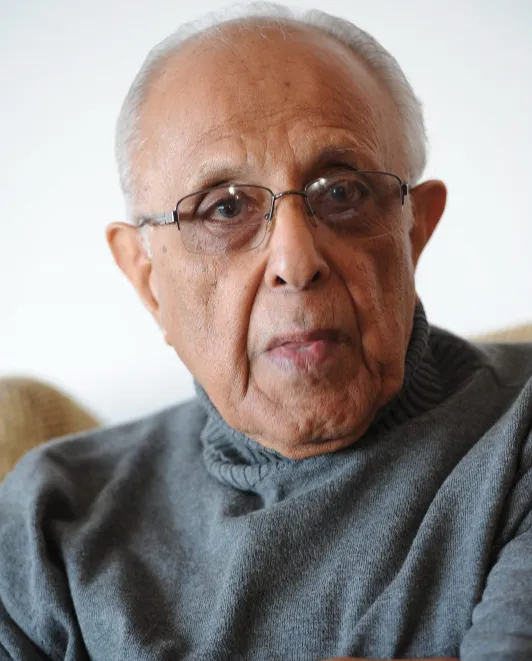
Struggle icon, the late Ahmed Kathrada was remembered in a special event at the weekend.
Image: File
ONE of the things I remember about Ambassador Moola is that he was proud to tell us he was born in Christiani. Ahmed Kathrada was also not shy about referring to his birthplace, Schweizer-Reineke. There must be something in the water and maize of the North West in that it gave life to incredible sons and daughters. Among the luminaries are Sol Plaatje, Moses Kotane, Ruth Mompathi, Modiri Molema and so many more.
We are living in a very testing time for the survival of international law and human solidarity. Our country’s foreign policy affirms the importance of international law, of multilateralism and the importance of the United Nations as a balancing centre for global relations. Linked to these are our full awareness of the influence of our colonial history on our policies, and of the contribution of our liberation aspirations of freedom, equality, social justice, and respect for the dignity of all.
Our established views on where we stand on matters of justice and human rights are facing severe stress tests today. Fuelled by dishonest news reporting and blatant disinformation that the world faces in ever growing levels today, many are often uncertain on where they stand on critical issues. Some of this news distortion has sought to achieve respectability by attempting to reframe Kathrada, Nelson Mandela and their companions as leaders who had weak attachments to the struggle of the people of Palestine, and who may have been swayed by those supporting Palestine oppression to waver in their commitment to solidarity with Palestine. These are all vain attempts to cloak untenable support for apartheid Israel in a cloak of Kathrada and Mandela respectability.
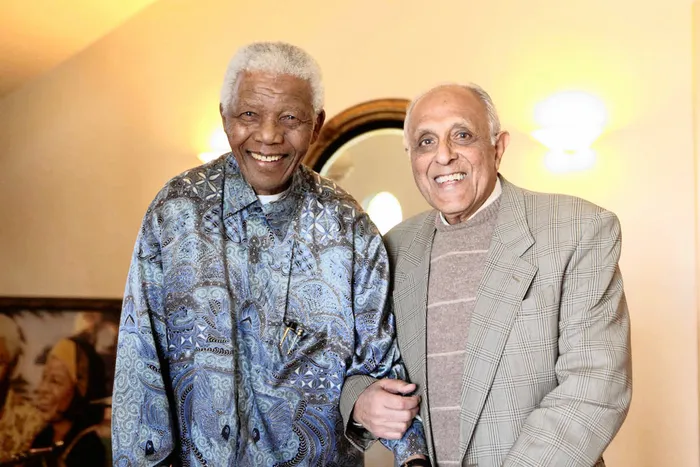
Nelson Mandela with Ahmed Kathrada.
Image: Debbie Yazbek/Nelson Mandela Foundation
Much has been written about Kathrada and Mandela. Their approach to the Struggle, their awareness of, and contribution to the struggle of others, and their belief in the innate human dignity of every person. Their belief in human rights as necessary for all persons is undoubted and cannot be altered.
The character and attitudes of Kathrada are well articulated in a little book I found on my shelves some months ago when I could not put words together for a talk on the Israel war on Gaza.
One excerpt from that book stands out for me. The book is a collection of favoured quotations that impressed and possibly impacted on Kathrada. One that seemed relevant for today is the following. It is titled: “I will be as harsh as truth, and as uncompromising as justice.”
“On this subject I do not wish to think, or speak, or write with moderation. No! No! Tell a man whose house is on fire to give a moderate alarm, tell him to moderately rescue his wife from the hands of a ravisher, tell the mother to gradually extricate her babe from the fire into which it has fallen – but urge me not to use moderation in a cause like the present. I am in earnest, I will not equivocate – I will not excuse – I will not retreat a single inch – and I will be heard. (William Lloyd Garrison, principal leader of the Abolitionist (of slavery) in North America, 1831 quoted in A simple Freedom, 2008,47).
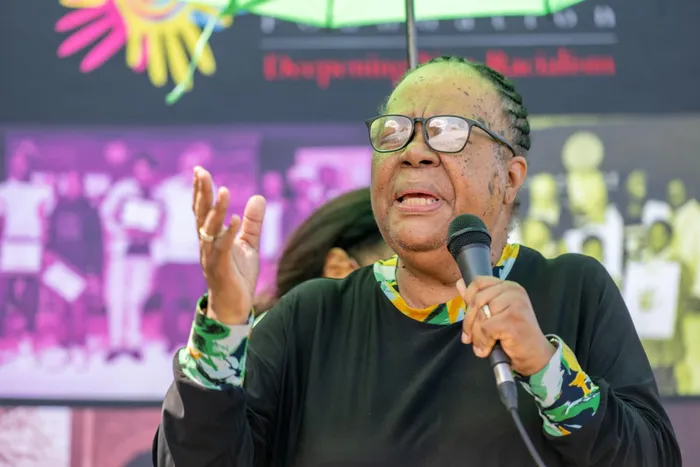
Dr Naledi Pandor delivered the keynote address at the event.
Image: Yunus Chamda
Kathrada would have certainly recognised the current geo-political uncertainty and poly crises as an important litmus test for humanity, and more specifically for democratic South Africa which has attached its foreign policy to the transparent principles of social justice, human dignity, equity and respect for multilateralism and international law.
Kathrada would have strongly supported South Africa’s actions in support of Palestine and may even have expected more with respect to sanctions and boycott. I had been requested to address the celebration of Kathrada; and I confess here that having closely observed the two for several years, I find it impossible to write of one on key global issues without including the other.
Kathrada and Mandela fully understood the importance of international law to the well-being of vulnerable people, innocent civilians and to freedom fighters that are imprisoned by oppressive states. Their Struggle for freedom inherently shaped international human rights law and critical elements of humanitarian law.
Consider for a moment the development of international conventions and treaties that protect all prisoners, offer them health monitoring, legal representation and freedom from torture. The universally applied guideline for the protection of prisoner rights and dignity (the UN Minimum Standard Rules for the Treatment of Prisoners, known as the Nelson Mandela Rules) affirm the contribution Kathrada and Mandela made to shaping a fairer world through sacrifice and commitment.
The geo-political storm that is under way today is about these and other universal frameworks of protections. Those who wish to reverse multilateralism and its contribution to a better world seek to ensure that international law becomes irrelevant, so that raw military force imposes its authoritarian fist on sovereign nations that cannot protect themselves against armed malevolent military action.
The breaches of international law evidenced today illustrate the dangerous position that world has fallen into through permitting the USA, Europe and their allies to bully a world that had no alternative power until the emergence of an economy such as emergent China, India and Brazil.
The decades of struggle by Palestinian people is a singularly stark example of the abuse of international law, and a glaring exposure of the limits of multilateralism. South Africa. through the Mass Democratic Movement and more particularly the ANC, the SACP and Cosatu, has been a steadfast advocate for Palestine self-determination, freedom and justice. Parties such as the PAC, Azapo, the EFF and others, have also clearly articulated support for freedom for Palestine.
Any person who knows Kathrada is fully aware that he could never have been mild mannered on the need to ensure Palestine is free. Views that imply Mandela or Kathrada would countenance Zionist separation and cruelty are an invention of lies and distortions. They falsely imply Kathrada and Mandela would support Bantustans, would support forced removals, detention without trial, ethnic cleansing and genocide. This would be a manifest distortion of the policies, attitudes and beliefs of these significant exemplary veterans.
Mandela called for South African support of Palestine through his statement that South Africa would not be fully free until Palestine was free. This was said in 1997 at an International Day of Solidarity with Palestine. He repeated these views as did Kathrada on many occasions.
Kathrada and Mandela were vocal advocates of freedom and self-determination for the oppressed people and for Palestine. They understood that the Palestinian cause had strong resonance with South Africa’s Struggle against apartheid. They recognised that any human being who did not enjoy basic civil and political liberties is a prisoner of his society. They also acknowledged that the Struggle of the oppressed against apartheid had strong similarity to the Palestinian struggle against apartheid Israel.
Much has been made by the Zionist lobby in South Africa of Mandela speaking in support of a two-state solution. The common refrain has sought to imply that acknowledging a possible two-state solution, a common perspective in the post Oslo Agreement period, signals support for illegal occupation of Palestinian land, settler violence, detention without trial of Palestinians, torture rape and murder of Palestinians, theft, bombing and a wide range of cruel abuses. This is patently untrue.
The freedom fighters of South Africa led ably by Kathrada, Mandela and their companions would not ever accept that such oppression could enjoy support from any freedom loving South African.
The concern today is that so many of us have become lazy at being active in our societies in fighting abuse and intolerance. In this unconscious state we allow ourselves to be entranced by illusions of faiths that embrace hate and division and to be paid off by limited official visits to Israel and none to occupied Palestine.
If we are to act as deserving beneficiaries of the legacies of Kathrada, Mandela and others, we must probe beyond the veil of disinformation that tries to cloud our knowledge of the truth of Israel oppression of Palestine and the marauding determination of Israel to dominate far beyond the occupied territories. Living at the south end of our continent may cause us to believe we are immune from threat but as you have observed in the past three weeks, no one is safe.
Activists should do more to mount robust outcomes, focussed global campaigns that set out clear campaign objectives, and join the global community in common purpose. The actions mounted thus far must continue but should be significantly ordered and coordinated. Attention should also be given to reform of the UN and building more effective structures and mechanisms.
The south should act to become an example of progressive thought and progressive institutions, BRICS, the NAM, G 77 plus China, The Hague Group must work closely together to set a south political agenda that reflects ideological clarity, a vision of active pursuit of freedom, social justice, equality and prosperity.
The world lacks the commitment of freedom fighters such as Kathrada and Mandela and we gathered here can play a central role in reviving the essence and spirit of those who fought for freedom.
Dr Naledi Pandor, Chairperson of the Nelson Mandela Foundation, delivered the keynote address on the ninth year death anniversary of Ahmed Mohamed Kathrada (March 28, 2017). The tribute event, by the Ahmed Kathrada Foundation, was held at Kathrada's gravesite at the Westpark Cemetery in Johannesburg.