

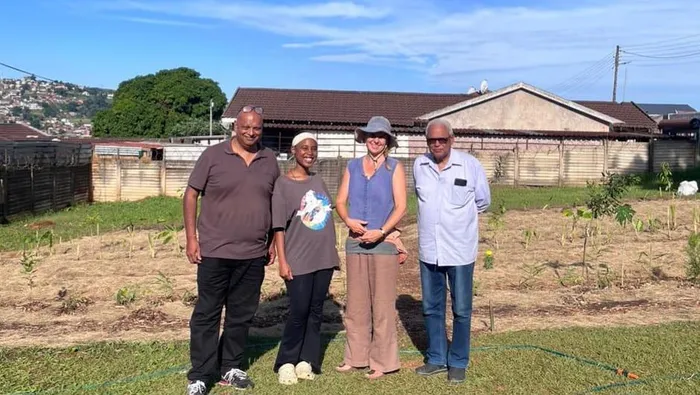
Roshan Jainath, South African Food Sovereignty Campaign (SAFSC) local coordinator, from left, Qhawe Mahlalela, SAFSC National coordinator; Kate Curtis, permaculture trainer; and Pundit Kirun Sagtoor, president of the Arya Pratinidhi Sabha (South Africa).
Image: Supplied
SOMETHING shifts in the air when a group of people decides to put their hands back into the soil. From March 22 to 28, that shift is happening at the Arya Samaj premises on Dresda Road in Northdale, Pietermaritzburg. An intensive seven-day permaculture training course is unfolding, bringing together theory and the practical work of establishing a 200-square-metre garden.
It is, in its own quiet way, a revolution. Revolution is a weighty word, I know. But when regenerative training in our capital city challenges the dominant logic of extractive farming - the logic of chemical fertilisers and GMO seeds - then the simple decision of 30 SMME farmers to pursue organic methods becomes something more. It becomes a choice to step outside a system that has promised abundance while quietly eroding the ground beneath our feet.
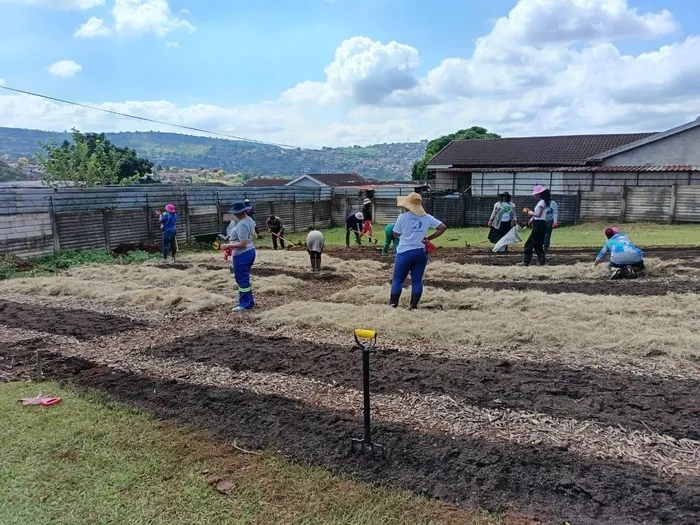
A garden unfolding.
Image: Supplied
I came to this work as a coordinator for the South African Food Sovereignty Campaign (SAFSC), appointed in February last year. I have been an activist for many years, but this terrain was new to me. By September 2025, we had put together a three-day workshop at the Stay Easy Hotel for 25 young African farmers. The outreach was driven by my fellow activist, Snenhlanhla Mngadi, who wears many hats - among them, chair of the KZN AFASA Women’s Desk.
Most of our trainees came through the African Farmers’ Association of South Africa (AFASA), and what struck me most was their hunger. Not just for land or markets, but for knowledge. A deep-rooted passion for farming, yes, but also a genuine eagerness to learn permaculture within the broader framework of agroecology. I had attended a permaculture course at Wits University myself, and I came back determined to bring that training home.
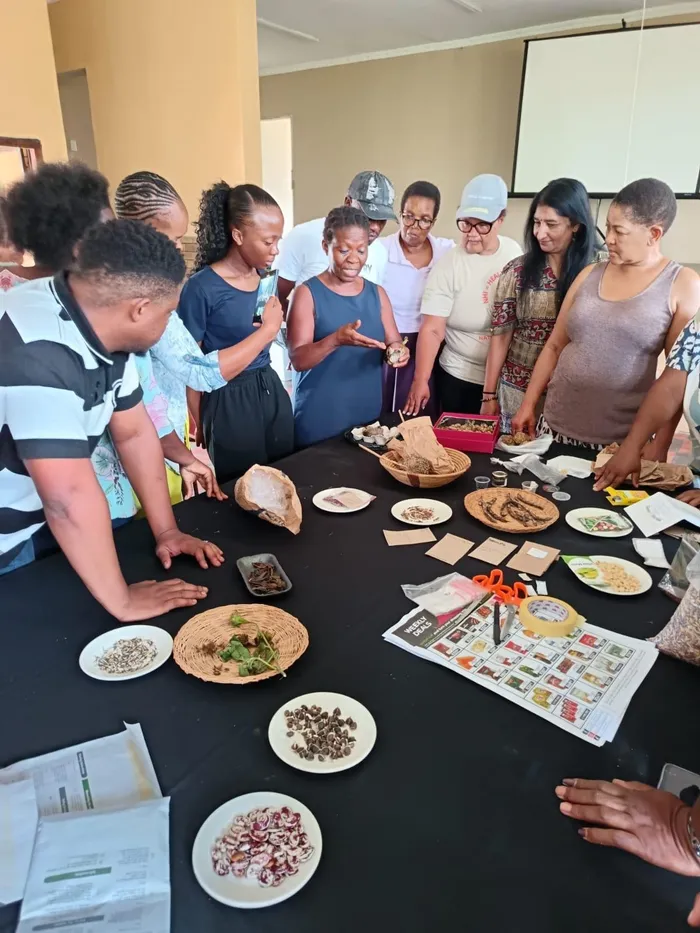
Sharing seeds.
Image: Supplied
At Wits, SAFSC and the Co-operative and Policy Alternative Centre (COPAC) have built permaculture gardens that feed thousands of students. More than that, they have established a training centre and a seedbank right on campus. SAFSC itself emerged from the need to unite partners and organisations around a common goal: to champion food sovereignty on a national platform. Its founder, Professor Vishwas Satghar, is a former Pietermaritzburg resident, part of a pioneering family of activists in this city. So the work we are doing here feels less like an import and more like a homecoming. Still, you do not need to be a farmer to care about how food is grown. Perhaps, more than anything, the consumer needs to understand what they consume. And to understand that, we need to talk about how we arrived at this moment.
Let me tell you a story. Years ago, America was locked in a long, brutal war with Vietnam. The arms industry thrived on conflict, and when that war ended, business slowed. So the same scientific minds that had built weapons turned their attention elsewhere. They built a new kind of weapon, this time aimed at the soil: the nitrogen-based chemical fertiliser industry. In the 1960s, India faced the prospect of mass famine. Chemical fertilisers and high-yield seeds - later genetically modified - promised a way out. They delivered, tripling grain production and saving millions of lives.
There is a reason it was called the Green Revolution. Before it, India imported grain just to keep people alive; after it, the country began to export. In places like Punjab and Haryana, farming became a path to the middle class. Families bought tractors, built houses, sent their children to school. That much is true. But the costs were not counted at the start. They took decades to appear, and by the time they did, they had become permanent. The soil changed first. Synthetic nitrogen feeds the plant but starves the life beneath. The microbes that once held the earth together disappeared. The ground grew hard, pale, dependent on the next chemical dose.
Across millions of hectares, soil lost its organic matter, turned acidic, turned salty. What had once been a living ecosystem became little more than a medium for inputs.The water followed. Fertilisers ran off the fields into rivers, creating dead zones. They seeped into groundwater, loading it with nitrates. In Punjab, the water table began to fall, and the water that remained was often poisoned. In villages across India’s breadbasket, rates of cancer began to climb - gastric cancers linked directly to nitrates in drinking water. And then there were the pesticides.
GMO seeds engineered to tolerate herbicides did not reduce chemical use; they increased it. Glyphosate, now classified as a probable human carcinogen, became so common it was everywhere - in the fields, in the dust, in the water. For farmers, the trap tightened slowly. Hybrid and GMO seeds could not be saved; every season meant buying new ones. The cost of inputs rose year after year. Small farmers borrowed to plant, hoping the harvest would cover the debt. Often, it did not. Since 1995, India has recorded over 400,000 farmer suicides. This is not a distant tragedy. It is a warning.
As I write, global conflicts are sending fuel and fertiliser prices soaring. The same system that promised security is showing its fragility. In India, Dr Vandana Shiva has spent decades offering a different path. Through Navdanya, she has helped over 500,000 farmers transition away from chemical-intensive agriculture toward regenerative, biodiversity-rich practices. Known as the “Gandhi of grain,” her work is rooted in seed sovereignty, Earth Democracy, and the central role of women in feeding communities.
Now, back to Pietermaritzburg. Here, we are choosing another way. In our permaculture training, we have banned chemical fertilisers. Instead, we are using compost, wood chips, and effective mulching to reignite the biodiversity in the soil. We are learning to use different root systems together, letting them support one another in a common garden. Imagine the nutrient density of vegetables and fruit grown this way - so rich that they could reduce the need for bulk calories by half. Imagine every home with a garden of hope. Imagine a government that values the sustainability of food sovereignty over GMO-driven food security, which cannot hold against rising prices. Imagine ordinary people being treated with dignity.
Pundit Kirun Satgoor, spiritual head of the Ved Dharam Sabha and president of its national body, the Arya Pratinidhi Sabha, understands this. Swami Dayanand, he reminds us, was a revolutionary in his own right. Pundit Satgoor commits himself to that legacy by investing in sustainable systems and social cohesion across race, class, and gender. Regenerating the soil, he says, is akin to regenerating the spirit of humanity. And then there are the three angels who visited us.
Kate Curtis, a renowned permaculture trainer, whose energy and presence seem to move mountains for agroecology. Qhawe Mahlalela and Nomaswazi Mthombeni - a Master’s and a doctoral student at Wits - bring with them an African feminist thought that reframes everything. They teach us that life is not a production line. It is a web: between soil and seed, water and root, grandmother and grandchild, the woman who saves seed and the community that eats from it. Tending that web is not romantic. It is the most practical work there is.
This is food sovereignty. Not just the right to eat, but the right to decide what is grown, how, and for whom. It is built from the ground up by communities who refuse to wait for permission to feed themselves. The African feminists among us are stirring something in this sleepy hollow of Pietermaritzburg. They are threatening to make us the city of flowers again - not just in name, but in truth. Blossoming with hope, sustainability, and the quiet dignity of self-reliance.