

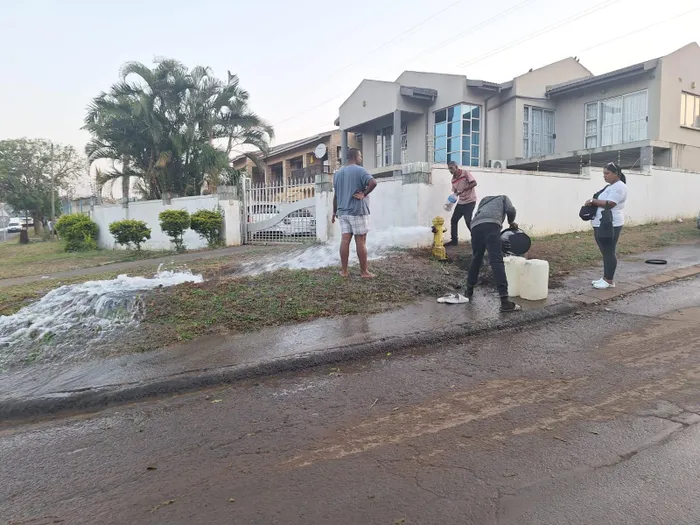
Residents retrieve water from a burst hydrant after the water supply was cut for days to fix it.
Image: Supplied
THERE comes a point where failure is no longer a technical problem. It becomes a political choice. Has KwaZulu-Natal (KZN) reached that point?
According to figures presented to the KZN Legislature last week by CoGTA Deputy Director-General, Barbara Mgutshini, eThekwini is losing 58.7% of its treated water as non-revenue water.
Across the province, the average is 54%. Zululand loses 88.8%. uMgungundlovu loses 66%. uThukela loses 60.9%.
Those figures should shock every resident and ratepayer in KZN. They should also settle the argument around the kind of crisis we are dealing with.
This is not a minor administrative shortcoming. It is not a one-off systems glitch.
It is not a problem that can be explained away with another presentation, another plan, or another round of excuses.
It is evidence of municipalities that are failing at one of the most basic tasks of local government: protecting and delivering water. And nowhere is that failure more visible than in eThekwini.
When more than half of treated water disappears before it can generate revenue, residents are not simply paying for the water they use.
They are paying for leaking pipes, poor maintenance, weak metering, billing failures, slow response times and years of municipal neglect.
They are paying for infrastructure that was not properly maintained when it should have been. They are paying for systems that should have been fixed long before they reached this point. They are paying, in short, for government failure - squarely at municipal level.
That is the scandal.
Residents are repeatedly told that the crisis is about supply, complexity, old infrastructure, the size of the city or about this flood or that emergency.
But the figures tell a more damning story. Within the area supplied by uMngeni-uThukela Water, dam levels remain relatively strong. The problem is not only whether water exists at source. It is that too much is being lost after municipalities take charge of it.
That is not nature. That is bad governance.
KZN Premier, Thamsanqa Ntuli, is right that this crisis requires urgent attention and a properly funded plan.
But for many people, the crisis is beyond warning stage - it is already a lived reality. It is the reality of taps running dry while water is being lost elsewhere in the system.
It is the reality of sewage spills, tanker dependence, unreliable repairs and communities that are always told to wait a little longer while the basics continue to collapse.
The explanation is not complicated. Municipal infrastructure needs maintenance.
Pipes do not repair themselves. Pump stations do not sustain themselves. Reservoirs, meters and reticulation networks do not survive on speeches and slogans.
National Treasury’s Municipal Finance Management Act (MFMA) Circular 71 set a clear benchmark years ago: municipalities should spend around 8% of the carrying value of infrastructure assets on repairs and maintenance.
Yet the Auditor-General’s (AG) findings show that the average spend by water service authorities was only about 3% in 2023/24, with most failing to meet the benchmark.
That gap is the whole story.
It is the reason pipes burst and stay burst. It is the reason sewage overflows have become normalised. It is the reason non-revenue water rises year after year.
And it is the reason municipalities lurch from crisis to crisis, always surprised by consequences that were entirely predictable.
It is time to stop pretending that this is simply about ageing infrastructure. Infrastructure ages everywhere. Functional municipalities plan for that.
Functional municipalities maintain assets before they fail. Functional municipalities put qualified people in technical posts, protect maintenance budgets, monitor losses, and intervene before collapse becomes routine.
What too many KZN municipalities have is the opposite: weak financial discipline, poor technical capacity, maintenance deferral, political deployment and a culture in which accountability arrives late, if at all.
This is where eThekwini becomes more than a metro problem. It becomes our province’s clearest warning about what happens when local government stops doing the basics.
A city of this scale, with this budget and this economic importance, should not be losing 58.7% of its water. If it is, then the problem is not incidental. It is systemic.
And that is why water must become an election issue.
The upcoming local government election should not be about clever slogans, staged walkabouts or recycled promises. It should be about one question only: do our municipalities work? Do they deliver water? Do they fix leaks? Do they maintain infrastructure? Do they protect public money? Do they appoint competent individuals? Do they provide the services residents are forced to pay for?
If the answer is no, then voters should stop rewarding failure.
Our argument is simple because the problem is simple. Revenue raised for water and sanitation must be protected for water and sanitation. Maintenance must be treated as a core obligation, not an optional extra. Measurable targets for reducing water loss must be published and tracked. Technical systems must be led by properly qualified professionals. Municipalities must be judged on whether they keep infrastructure working - not on how well they explain its collapse.
That is what proper local government looks like.
KZN cannot afford another decade of municipalities that are better at public relations than public services. It cannot afford another decade of ratepayers funding decay. It cannot afford another decade in which more than half of its treated water disappears while municipalities ask for more time, more money and less accountability.
At some point, residents must draw the obvious conclusion: if they keep electing governments that fail to govern, they will keep getting failure.
The next local government election is about more than party politics. It is about whether municipalities across our province will work at all. A vote for the DA is a vote for competence over cadre deployment, maintenance over neglect and service delivery over political survival. KZN’s people do not need more excuses. They need functioning municipalities. And voters have the power to choose them.
Marlaine Nair
Image: Supplied
Marlaine Nair: DA KZN Spokesperson on CoGTA
** The views expressed do not necessarily reflect the views of IOL or Independent Media.