

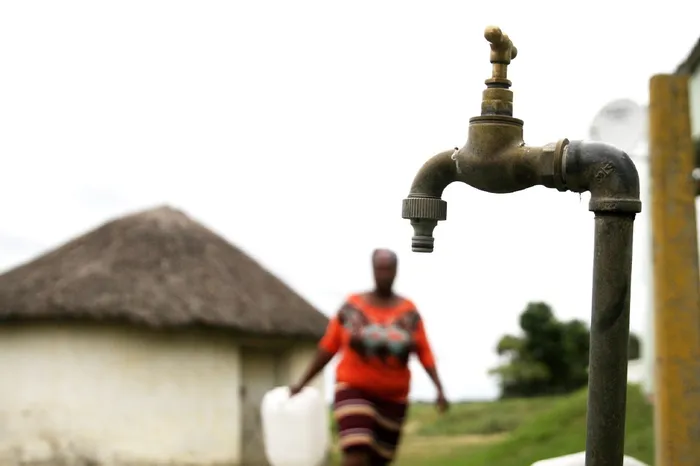
Most of South Africa’s bulk water infrastructure – the dams, pipelines and treatment plants – were built between the 1960s and 1980s. Like an ageing athlete, it is breaking down under a population it was never designed to carry, says the writer.
Image: File
THE sound of a dripping tap is not just a nuisance. In Durban and the surrounding areas of KwaZulu-Natal, that drip means something worse. It is the sound of a city’s water spilling away while those in power fail to respond adequately.
Take Mrs Dlamini, a 67-year-old retired nurse living in the Sobantu township near Pietermaritzburg. For three days her taps have been dry. The pipes under her street, laid decades ago, have finally burst. Two blocks away, clean treated water shoots from a crack in the asphalt and runs into a stormwater drain. She watches it with a mix of anger and exhaustion.
“They say we must save water,” she says.
“But how can I save it when they cannot even keep it in the ground?”
That is the paradox of South Africa’s unfolding water crisis. It is not simply a crisis of scarcity. It is a crisis of competence, will and vision.
Decades ago, Omar Latiff – the first democratically-elected mayor of Pietermaritzburg and later chair of Umgeni Water – warned that future wars would not be fought over oil, but over water.
He said: “Water is the essence of life, and without water there will be no life."
We are looking at a cold war being fought in our streets, council chambers and crumbling pump stations. It's a people's war of survival simply because water is life.
The first enemy is time. Most of South Africa’s bulk water infrastructure – the dams, pipelines and treatment plants – was built between the 1960s and 1980s. Like an ageing athlete, it is breaking down under a population it was never designed to carry.
In KwaZulu-Natal, the numbers are a confession of neglect and a lack of vision. The Department of Water and Sanitation reports that municipalities across the province lose more than 40% of their water to leaks. In some districts, that figure exceeds 50%. For every two litres purified and pumped into the system, one litre is lost before reaching a home. In Durban alone, millions of litres vanish daily from corroded pipes that go unrepaired for months.
A broken pipe can be fixed. The real tragedy is the toxicity of KZN politics.
Political sabotage runs deep in KZN’s volatile landscape. Water has become a weapon. Municipal workers, aligned with factional or opposition parties, have been known to deliberately damage infrastructure to destabilise administrations they oppose. There have been multiple reports in the Durban and Pietermaritzburg press, of water treatment plant operators going on “go-slows” during political standoffs, or of critical valves being tampered with to cut supply to specific wards.
This sabotage has also created a parallel economy. When taps run dry, the only relief is a water tanker. Too often those tankers are owned by a connected few. Through bribery and kickbacks, a network of private operators ensures that permanent repairs are delayed, that tenders for pipeline replacements are stalled, and that the municipality stays dependent on emergency supply.
Mrs Dlamini knows this well. She says: “They bring us water like it is a gift, but it is a business.”
If ageing pipes and sabotage are the bullets, climate change and global warming are the gunpowder. Southern Africa has been declared a climate change “red zone” – one of the hottest regions on the planet, warming at twice the global rate.
The KZN floods of 2022, which killed over 400 people and washed away large sections of water infrastructure, were a stark warning. Now we are seeing the other side of government incompetence. The failure to champion a fight against global warming.
The El Nino‑induced droughts scorching the catchment areas is clearly creating a pathway towards a “day zero” scenario. We saw this in Cape Town, and fights were breaking out in lines as people fought for water. It was contained in Cape Town, but the threat is far from over.
However there is another story in this province. It does not come from a government press release or a municipal tender. It comes from Tongaat, a town north of Durban that has suffered some of the worst water outages in recent years.
While the authorities dithered, a local man named Ricky Naidoo decided to act. He founded the Tongaat Task Team, a volunteer group that now delivers clean water daily to multiple communities – not once a week, not as a photo opportunity, but every single day. He does this largely at his own cost, using his own resources and the help of a small network of residents who refuse to let their neighbours go thirsty.
The government’s response has been complicated. Officials express gratitude for the relief work. They thank Naidoo and his team publicly. But behind closed doors, there is often cynicism. Some councillors see the task team as an embarrassment – a reminder that the state has failed. Others quietly tolerate it because it takes pressure off them. What you do not hear is any serious effort to partner with Naidoo or to learn from what he has built.
That is the real missed opportunity. The Tongaat Task Team is not just a charity operation. It is a working model of public, private and community collaboration. It proves that ordinary people, when organised and motivated, can solve problems that bureaucracy cannot touch. Imagine if every municipality in KZN identified similar local champions – not to replace the state, but to work alongside it. Imagine repair crews being guided by community members who know exactly where every leak is. Imagine emergency tankers being dispatched not by a distant tender process, but by a neighbourhood forum that reports directly to a mayor’s office.
A bottom‑up solution and the November 2026 elections have a core resonance.
What we need is not another grand plan from Pretoria. We need to revive a participative, bottom‑up democratic model of governance. That means moving away from the current system where everything is controlled by factional elites who profit from failure. It means creating formal spaces for community task teams – like the Tongaat Task Team, to sit on water management committees, to receive resources, and to hold officials accountable. The biggest opportunity is for the communities to talk about global warming in simple dialogue and truly understand the inherent threats.
Naidoo has shown what one person can do. However, one person should not have to carry this burden alone. The magic in the model advocated by the core entrepreneur in Naidoo, was building community structures through the Tongaat Task Team. The government should be scaling his model across every district in KZN. Not with cynical gratitude, but with genuine partnership.
This brings us to the elections in November 2026. Water management will almost certainly play a role at the ballot box, especially in KZN, where taps run dry more often than anywhere else. Voters who cannot flush toilets or fill a kettle will remember. Political parties that ignore this issue will pay a price. But the real question is not whether water will be debated. It is whether any party has the courage to embrace a community model; one that moves power away from corrupt tender systems and towards community-led task teams like the Tongaat Task Team. That would be a true bottom‑up democratic revival.
The water is dripping away. But we can still catch it. The Tongaat Task Team has shown the way. The only question is whether those in power – and those seeking power in November 2026 – have the humility to embrace and build on this model. If political parties do not embrace workable community solutions then perhaps KZN needs independent candidates or community structures to stand for local government elections. My concluding view is that the outcome of local government elections should belong to communities. The next revolution after 1994 is for communities to reclaim its democratic space.
** The views expressed do not necessarily reflect the views of IOL or Independent Media.