

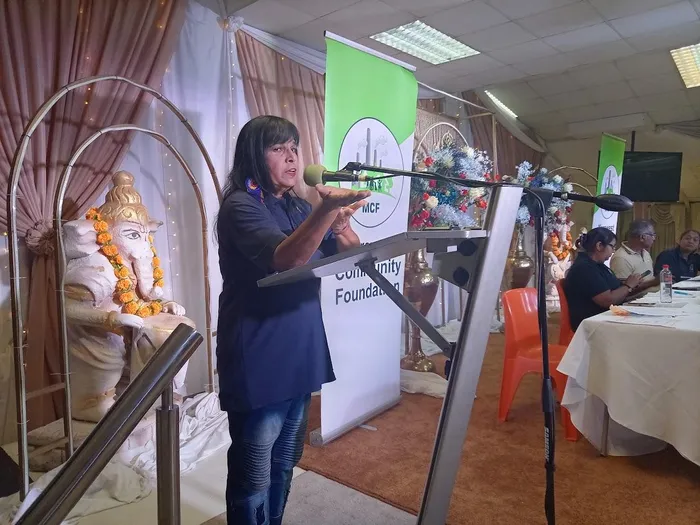
Premilla Deonath addressing the meeting about the dangers of a bitumen plant.
Image: Willem Phungula
Residents of Merebank are standing firm against a proposed bitumen plant, demanding transparency and accountability from decision-makers. Premilla Deonath explains the community's concerns over health, safety, and the lack of meaningful engagement in the planning process
THERE is something deeply wrong when a community is asked to object to a project it knows almost nothing about. That is exactly where we, the residents of Merebank, find ourselves now.
Residents have been told that an application has been submitted to operate a bitumen plant, including the transportation and use of mobile bitumen kettles, within our community. We have been invited to submit objections. But here a troubling reality emerges. We are being asked to object blindly. We were not given any meaningful information of detailed reports. There has been no explanation of the operations and no engagement before the deadline.
We are told that engagement will only happen after the objection period has closed. No consultation and no transparency means that this is just a box-ticking exercise. Public participation is meant to empower communities. To give ordinary people a voice in decisions that affect their health, their safety, and their environment. But how can we participate when we are deliberately kept in the dark?
It is like being asked to sign a contract without reading it. Almost like being told to approve or reject a surgery without being told the risks. We are expected to list the grounds of our objections, yet the very information needed to form those grounds has not been provided. It raises a serious question: is this a genuine invitation for public input, or simply a step to satisfy legal requirements? This application involves bitumen works and the operation of mobile bitumen kettles.
Bitumen is a thick, black, sticky substance that comes from crude oil. It is what remains after petrol, diesel, and other fuels are removed during the refining. It is the heaviest, dirtiest part of oil, the residue. It is a dangerous substance. With bitumen one cannot see the danger. You breathe it in. We often think of danger as something you can see flames. But this is like a fire you can’t see. Instead of burning your skin, it slowly burns your lungs. It is like taking a tiny dose of poison every single day. Not enough to collapse immediately, but enough to damage or kill you over time.
Even without detailed reports, we know enough from global experience and prior local exposure to understand the risks. These risks are not theoretical. We have already lived through this so we are predicting what will happen. We are not fearmongering or speculating. We are not guessing what might happen. This has already happened.
A few months ago, heavy trucks blocked roads meant for residents. Residents were forced to risk their lives by dangerously overtaking huge trucks, right here, right at the very spot where this bitumen factory is being proposed. This resulted in collisions, constant danger to drivers, school children and pedestrians. Traffic lights were destroyed, roads were destroyed, pavements were broken and homes ploughed into by superlink trucks. The company didn’t repair these damages. We paid the price. And now they want to come back? To the same premises that has been shut down?
We say "no". Not again. Not here. Not in our community. Why here? Is it because we are an easy target? Because we are meek and docile? Why near homes and schools? There are plenty of empty industrial space to rent, where no one will complain. When the smell comes, you can try closing your windows. But you cannot lock out the air. It is dangerous because once it is in the air, you will live with it or die from it.
Asthma, worsening heart conditions, chronic respiratory illness and long-term exposure of toxic fumes linked to cancer. By the time you smell bitumen, it is already inside your body. That smell is a warning sign of chemical exposure. This is reality in many places where industrial activity is introduced without proper planning and safeguards. Health and safety must come first.
Despite the lack of information, residents came out in numbers. Voices were heard. Concerns were raised. A clear mandate was given: we reject this proposed operation.
We don’t oppose development. We are not being unreasonable. But we refuse to gamble with our health, our safety, and our dignity. Our children’s future is at stake here. Our community is made up of living breathing human beings, families, children, grandparents whose lives will be directly affected by decisions made behind closed doors. If there is nothing to hide, then why is nothing being shared? Transparency is not optional. It is a responsibility.
Right now, that responsibility is not being met. This process undermines our trust. It creates suspicion, and leaves communities feeling powerless and disrespected. Responsible development does not work like that. We, as the Merewest Community Foundation, are urging the public to be vocal. Do not remain silent. Even without full information, your voice matters. Submit your objections. Demand transparency. Ask questions and insist on answers.
To the municipality and decision-makers, please pause this process. Ensure that there is full disclosure of all relevant documents. Ensure genuine, meaningful public participation. Not after the fact, but before decisions are made. Do not approve any application where the community has been denied the information needed to engage properly.
To Energex. Communicate with the community openly and honestly. Provide detailed reports. Explain your plans. Address our concerns now. Don’t wait for deadlines you have set to close the objections. Anything less will only deepen mistrust. This is not only about bitumen. It is about accountability. It is about whether communities have a real voice, or just the illusion of one. And it is about whether health and safety are truly prioritised, or quietly compromised. This process is supposed to protect the public if used correctly. But in this case, it is just being done to meet legal requirements.
Nothing of value can be built on a foundation of silence and secrecy. We are saying no because we have not been given any reason to say yes. Until there is transparency, accountability and genuine engagement, this community stands firm. No bitumen plant. We must ask as one human being to another: would you raise your child here? Would you let your elderly grandmother breathe this air? Would you sleep peacefully knowing what could drift through your windows at night? This is where our children laugh and play, where families gather, where elderly residents sit quietly in the sun, believing they are safe.
We are not statistics. We are not a checkbox on a compliance form. We are a living, breathing community; and we deserve to be treated with dignity, honesty and respect. Our health should not be risked for your convenience or profits. We are standing together out of love for our families, for our neighbours and for the place we call home. Some things are not negotiable. Our health. Our safety. Our home. This fight has become the catalyst for our community to stand up, find their voice and be counted.
It is evident that there is no genuine concern for the community. We have found our voice. We demand that this proposed bitumen plant be relocated to a suitable industrial area, far from homes, schools and community spaces. This is not negotiable.
Premilla Deonath is the chairperson of the Merewest Community Foundation, and the chairperson of Merebank Alliance Forum Women’s Forum.
** The views expressed do not necessarily reflect the views of IOL or Independent Media.